decic
Compute consistent initial conditions for ode15i
Syntax
Description
[ uses y0_new,yp0_new]
= decic(odefun,t0,y0,fixed_y0,yp0,fixed_yp0)y0 and yp0 as
guesses for the initial conditions of the fully implicit function odefun,
holds the components specified by fixed_y0 and fixed_yp0 as
fixed, then computes values for the nonfixed components. The result
is a complete set of consistent initial conditions. The new values yo_new and yp0_new satisfy odefun(t0,y0_new,yp0_new)
= 0 and are suitable to be used as initial conditions with ode15i.
Examples
Consider the implicit system of equations
These equations are straightforward enough that it is simple to read off consistent initial conditions for the variables. For example, if you fix , then according to the second equation and according to the first equation. Since these values of , , and satisfy the equations, they are consistent.
Confirm these values by using decic to compute consistent initial conditions for the equations, fixing the value . Use guesses of y0 = [1 0] and yp0 = [0 0], which do not satisfy the equations and are thus inconsistent.
odefun = @(t,y,yp) [2*yp(1)-y(2); y(1)+y(2)];
t0 = 0;
y0 = [1 0];
yp0 = [0 0];
[y0,yp0] = decic(odefun,t0,y0,[1 0],yp0,[])
y0 = 2×1

     1
    -1
yp0 = 2×1

   -0.5000
         0
Calculate consistent initial conditions and solve an implicit ODE with ode15i.
Weissinger's equation is
.
Since the equation is in the generic form , you can use the ode15i function to solve the implicit differential equation.
Code Equation
To code the equation in a form suitable for ode15i, you need to write a function with inputs for , , and that returns the residual value of the equation. The function @weissinger encodes this equation. View the function file.
type weissingerfunction res = weissinger(t,y,yp) %WEISSINGER Evaluate the residual of the Weissinger implicit ODE % % See also ODE15I. % Jacek Kierzenka and Lawrence F. Shampine % Copyright 1984-2014 The MathWorks, Inc. res = t*y^2 * yp^3 - y^3 * yp^2 + t*(t^2 + 1)*yp - t^2 * y;
Calculate Consistent Initial Conditions
The ode15i solver requires consistent initial conditions, that is, the initial conditions supplied to the solver must satisfy
.
Since it is possible to supply inconsistent initial conditions, and ode15i does not check for consistency, it is recommended that you use the helper function decic to compute such conditions. decic holds some specified variables fixed and computes consistent initial values for the unfixed variables.
In this case, fix the initial value and let decic compute a consistent initial value for the derivative , starting from an initial guess of .
t0 = 1;
y0 = sqrt(3/2);
yp0 = 0;
[y0,yp0] = decic(@weissinger,t0,y0,1,yp0,0)
y0 =
1.2247
yp0 =
0.8165
Solve Equation
Use the consistent initial conditions returned by decic with ode15i to solve the ODE over the time interval .
[t,y] = ode15i(@weissinger,[1 10],y0,yp0);
Plot Results
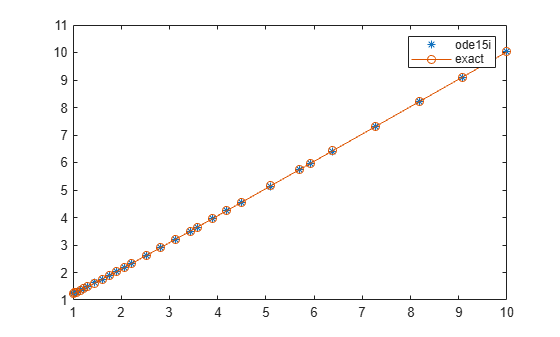
The exact solution of this ODE is
.
Plot the numerical solution y computed by ode15i against the analytical solution ytrue.
ytrue = sqrt(t.^2 + 0.5);
plot(t,y,'*',t,ytrue,'-o')
legend('ode15i', 'exact')
Input Arguments
Output Arguments
Tips
The
ihb1daeandiburgersodeexample files usedecicto compute consistent initial conditions before solving withode15i. Typeedit ihb1daeoredit iburgersodeto view the code.You can additionally use
decicto compute consistent initial conditions for DAEs solved byode15sorode23t. To do this, follow these steps.Rewrite the system of equations in fully implicit form
f(t,y,y') = 0.Call
decicto compute consistent initial conditions for the equations.Specify
y0_newas the initial condition in the call to the solver, and specifyyp_newas the value of theInitialSlopeoption ofodeset.
Version History
Introduced before R2006a

