diff
Differences and approximate derivatives
Description
Y = diff(X)X. By
default, diff operates along the first array dimension whose
size does not equal 1.
If
Xis a vector of lengthm, thenY = diff(X)returns a vector of lengthm-1. The elements ofYare the differences between adjacent elements ofX.Y = [X(2)-X(1) X(3)-X(2) ... X(m)-X(m-1)]
If
Xis a nonempty, nonvector p-by-m matrix, thenY = diff(X)returns a matrix of size (p-1)-by-m, whose elements are the differences between the rows ofX.Y = [X(2,:)-X(1,:); X(3,:)-X(2,:); ... X(p,:)-X(p-1,:)]
If
Xis a 0-by-0 empty matrix, thenY = diff(X)returns a 0-by-0 empty matrix.If
Xis a p-by-m table or timetable, thenY = diff(X)returns a table or timetable of size (p-1)-by-m, whose elements are the differences between the rows ofX. IfXis a 1-by-m table or timetable, then the size ofYis 0-by-m. (since R2023a)
Examples
Create a vector, then compute the differences between the elements.
X = [1 1 2 3 5 8 13 21];
Y = diff(X)
Y = 1×7

     0     1     1     2     3     5     8
Note that Y has one fewer element than X.
Create a 3-by-3 matrix, then compute the first difference between the rows.
X = [1 1 1; 5 5 5; 25 25 25];
Y = diff(X)
Y = 2×3

     4     4     4
    20    20    20
Y is a 2-by-3 matrix.
Create a vector and compute the second-order difference between the elements.
X = [0 5 15 30 50 75 105];
Y = diff(X,2)
Y = 1×5

     5     5     5     5     5
Create a 3-by-3 matrix, then compute the first-order difference between the columns.
X = [1 3 5;7 11 13;17 19 23];
Y = diff(X,1,2)
Y = 3×2

     2     2
     4     2
     2     4
Y is a 3-by-2 matrix.
Use the diff function to approximate partial derivatives with the syntax Y = diff(f)/h, where f is a vector of function values evaluated over some domain, X, and h is an appropriate step size.
For example, the first derivative of sin(x) with respect to x is cos(x), and the second derivative with respect to x is -sin(x). You can use diff to approximate these derivatives.
h = 0.001;       % step size
X = -pi:h:pi;    % domain
f = sin(X);      % range
Y = diff(f)/h;   % first derivative
Z = diff(Y)/h;   % second derivative
plot(X(:,1:length(Y)),Y,'r',X,f,'b', X(:,1:length(Z)),Z,'k')
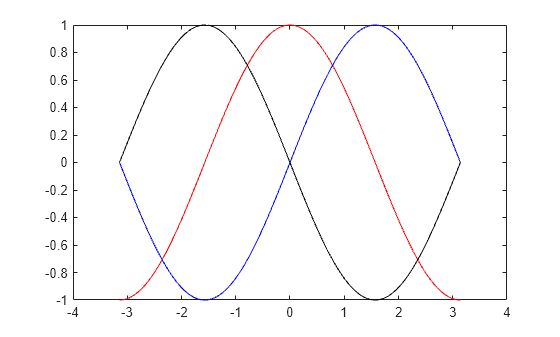
In this plot the blue line corresponds to the original function, sin. The red line corresponds to the calculated first derivative, cos, and the black line corresponds to the calculated second derivative, -sin.
Create a sequence of equally-spaced datetime values, and find the time differences between them.
t1 = datetime('now');
t2 = t1 + minutes(5);
t = t1:minutes(1.5):t2
t = 1×4 datetime
13-Feb-2026 20:51:01 13-Feb-2026 20:52:31 13-Feb-2026 20:54:01 13-Feb-2026 20:55:31
dt = diff(t)
dt = 1×3 duration
   00:01:30   00:01:30   00:01:30
diff returns a duration array.
Input Arguments
Input array, specified as a vector, matrix, multidimensional array, table,
or timetable. X can be a numeric array, logical array,
datetime array, or duration array, or a table or timetable whose variables
have any of these data types.
Complex Number Support: Yes
Difference order, specified as a positive integer scalar or
[]. The default value of n is
1. When n is larger than the
dimension being operated on, diff returns an empty
array.
Data Types: single | double | int8 | int16 | int32 | int64 | uint8 | uint16 | uint32 | uint64
Dimension to operate along, specified as a positive integer scalar. If you do not specify the dimension, then the default is the first array dimension whose size does not equal 1.
Consider a two-dimensional p-by-m input array, A:
diff(A,1,1)works on successive elements in the columns ofAand returns a (p-1)-by-m difference matrix.diff(A,1,2)works on successive elements in the rows ofAand returns a p-by-(m-1) difference matrix.

Data Types: double | single | int8 | int16 | int32 | int64 | uint8 | uint16 | uint32 | uint64

