interpn
Interpolation for 1-D, 2-D, 3-D, and N-D gridded data in ndgrid format
Syntax
Description
Vq = interpn(X1,X2,...,Xn,V,Xq1,Xq2,...,Xqn)X1,X2,...,Xn contain
the coordinates of the sample points. V contains
the corresponding function values at each sample point. Xq1,Xq2,...,Xqn contain
the coordinates of the query points.
Vq = interpn(V,Xq1,Xq2,...,Xqn)V. Use this syntax when you want to conserve memory and
are not concerned about the absolute distances between points.
Vq = interpn(___,method,extrapval)extrapval, a scalar value that is assigned
to all queries that lie outside the domain of the sample points.
If you omit the extrapval argument for queries
outside the domain of the sample points, then based on the method argument interpn returns
one of the following:
The extrapolated values for the
'spline'and'makima'methodsNaNvalues for other interpolation methods
Examples
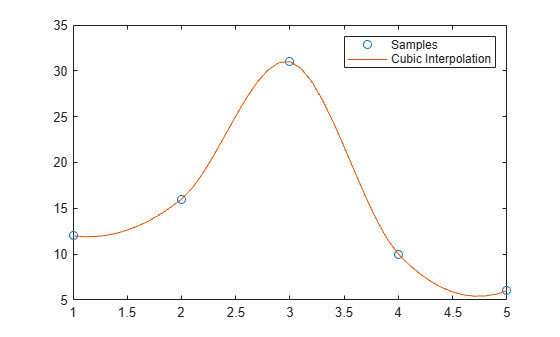
Define the sample points and values.
x = [1 2 3 4 5];
v = [12 16 31 10 6];
Define the query points, xq, and interpolate.
xq = (1:0.1:5);
vq = interpn(x,v,xq,'cubic');
Plot the result.
figure
plot(x,v,'o',xq,vq,'-');
legend('Samples','Cubic Interpolation');
Create a set of grid points and corresponding sample values.
[X1,X2] = ndgrid((-5:1:5));
R = sqrt(X1.^2 + X2.^2)+ eps;
V = sin(R)./(R);
Interpolate over a finer grid using ntimes=1.
Vq = interpn(V,'cubic');
mesh(Vq);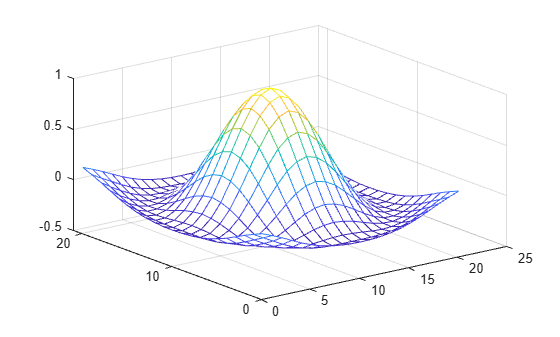
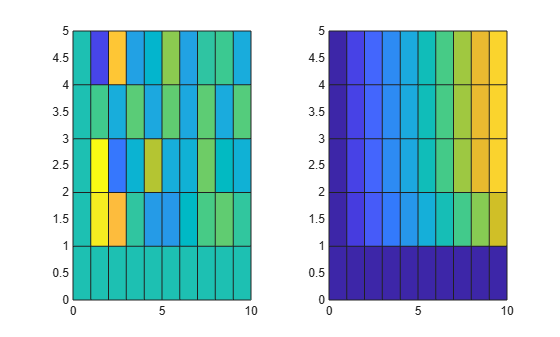
Create a grid of 2-D sample points using ndgrid.
[x,y] = ndgrid(0:10,0:5);
Create two different sets of sample values at the sample points and concatenate them as pages in a 3-D array. Plot the two sets of sample values against the sample points. Because surf uses meshgrid format for grids, transpose the inputs for plotting.
v1 = sin(x.*y)./(x+1);
v2 = x.*erf(y);
V = cat(3,v1,v2);
tiledlayout(1,2)
nexttile
surf(x',y',V(:,:,1)')
view(2)
nexttile
surf(x',y',V(:,:,2)')
view(2)
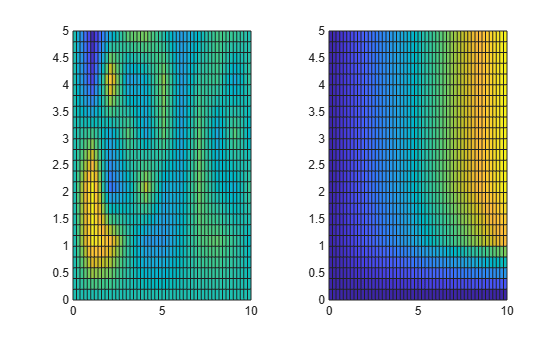
Create a set of query points for interpolation using ndgrid and then use interpn to find the values of each function at the query points. Plot the interpolated values against the query points.
[xq,yq] = ndgrid(0:0.2:10);
Vq = interpn(x,y,V,xq,yq);
tiledlayout(1,2)
nexttile
surf(xq',yq',Vq(:,:,1)')
view(2)
nexttile
surf(xq',yq',Vq(:,:,2)')
view(2)
Create the grid vectors, x1, x2, and x3. These vectors define the points associated with the values in V.
x1 = 1:100;
x2 = 1:50;
x3 = 1:30;
Define the sample values to be a 100-by-50-by-30 array of random numbers, V.
rng default
V = rand(100,50,30);
Evaluate V at three points outside the domain of x1, x2, and x3. Specify extrapval = -1.
xq1 = [0 0 0];
xq2 = [0 0 51];
xq3 = [0 101 102];
vq = interpn(x1,x2,x3,V,xq1,xq2,xq3,'linear',-1)
vq = 1×3
-1 -1 -1
All three points evaluate to -1 because they are outside the domain of x1, x2, and x3.
Define an anonymous function that represents  .
.
f = @(x,y,z,t) t.*exp(-x.^2 - y.^2 - z.^2);
Create a grid of points in  . Then, pass the points through the function to create the sample values,
 V.
[x,y,z,t] = ndgrid(-1:0.2:1,-1:0.2:1,-1:0.2:1,0:2:10);
V = f(x,y,z,t);
Now, create the query grid.
[xq,yq,zq,tq] = ...
ndgrid(-1:0.05:1,-1:0.08:1,-1:0.05:1,0:0.5:10);
Interpolate V at the query points.
Vq = interpn(x,y,z,t,V,xq,yq,zq,tq);
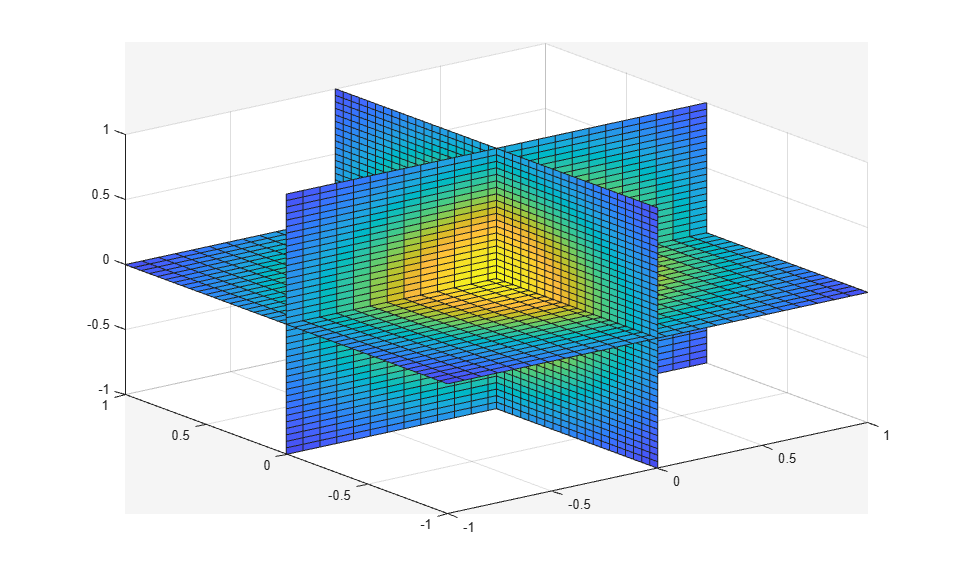
Create a movie to show the results.
figure;
nframes = size(tq, 4);
for j = 1:nframes
   slice(yq(:,:,:,j),xq(:,:,:,j),zq(:,:,:,j),...
         Vq(:,:,:,j),0,0,0);
   clim([0 10]);
   M(j) = getframe;
end
movie(M);
Input Arguments
Sample grid points, specified as real arrays or vectors. The sample grid points must be unique.
If
X1,X2,...,Xnare arrays, then they contain the coordinates of a full grid (in ndgrid format). Use thendgridfunction to create theX1,X2,...,Xnarrays together. These arrays must be the same size.If
X1,X2,...,Xnare vectors, then they are treated as grid vectors. The values in these vectors must be strictly monotonic, either increasing or decreasing.
Example: [X1,X2,X3,X4] = ndgrid(1:30,-10:10,1:5,10:13)
Data Types: single | double
Sample values, specified as a real or complex array. The size requirements for
V depend on the size of the grid of sample points
defined by X1,X2,...,Xn. The sample points
X1,X2,...,Xn can be arrays or grid vectors, but in
both cases they define an n-dimensional grid.
V must be an array that at least has the same
n dimension sizes, but it also can have extra
dimensions beyond n:
If
Valso hasndimensions, then the size ofVmust match the size of the n-dimensional grid defined byX1,X2,...,Xn. In this case,Vcontains one set of sample values at the sample points. For example, ifX1,X2,X3are 3-by-3-by-3 arrays, thenVcan also be a 3-by-3-by-3 array.If
Vhas more thanndimensions, then the firstndimensions ofVmust match the size of the n-dimensional grid defined byX1,X2,...,Xn. The extra dimensions inVdefine extra sets of sample values at the sample points. For example, ifX1,X2,X3are 3-by-3-by-3 arrays, thenVcan be a 3-by-3-by-3-by-2 array to define two sets of sample values at the sample points.
If V contains complex numbers, then interpn interpolates
the real and imaginary parts separately.
Example: rand(10,5,3,2)
Data Types: single | double
Complex Number Support: Yes
Query points, specified as real scalars, vectors, or arrays.
If
Xq1,Xq2,...,Xqnare scalars, then they are the coordinates of a single query point in Rn.If
Xq1,Xq2,...,Xqnare vectors of different orientations, thenXq1,Xq2,...,Xqnare treated as grid vectors in Rn.If
Xq1,Xq2,...,Xqnare vectors of the same size and orientation, thenXq1,Xq2,...,Xqnare treated as scattered points in Rn.If
Xq1,Xq2,...,Xqnare arrays of the same size, then they represent either a full grid of query points (inndgridformat) or scattered points in Rn.
Example: [X1,X2,X3,X4] = ndgrid(1:10,1:5,7:9,10:11)
Data Types: single | double
Refinement factor, specified as a real, nonnegative, integer
scalar. This value specifies the number of times to repeatedly divide
the intervals of the refined grid in each dimension. This results
in 2^k-1 interpolated points between sample values.
If k is 0, then Vq is
the same as V.
interpn(V,1) is the same as interpn(V).
The following illustration depicts k=2 in R2.
There are 72 interpolated values in red and 9 sample values in black.

Example: interpn(V,2)
Data Types: single | double
Interpolation method, specified as one of the options in this table.
| Method | Description | Continuity | Comments |
|---|---|---|---|
'linear' | The interpolated value at a query point is based on linear interpolation of the values at neighboring grid points in each respective dimension. This is the default interpolation method. | C0 |
|
'nearest' | The interpolated value at a query point is the value at the nearest sample grid point. | Discontinuous |
|
'pchip' | Shape-preserving piecewise cubic interpolation (for 1-D only). The interpolated value at a query point is based on a shape-preserving piecewise cubic interpolation of the values at neighboring grid points. | C1 |
|
'cubic' | The interpolated value at a query point is based on a cubic interpolation of the values at neighboring grid points in each respective dimension. The interpolation is based on a cubic convolution. | C1 |
|
'makima' | Modified Akima cubic Hermite interpolation. The interpolated value at a query point is based on a piecewise function of polynomials with degree at most three evaluated using the values of neighboring grid points in each respective dimension. The Akima formula is modified to avoid overshoots. | C1 |
|
'spline' | The interpolated value at a query point is based on a cubic interpolation of the values at neighboring grid points in each respective dimension. The interpolation is based on a cubic spline using not-a-knot end conditions. | C2 |
|
Function value outside domain of X1,X2,...,Xn,
specified as a real or complex scalar. interpn returns
this constant value for all points outside the domain of X1,X2,...,Xn.
Example: 5
Example: 5+1i
Data Types: single | double
Complex Number Support: Yes

