det
R2026bMatrix determinant
Syntax
Description
Examples
Create a 3-by-3 square matrix, A.
A = [1 -2 4; -5 2 0; 1 0 3]
A = 3×3

     1    -2     4
    -5     2     0
     1     0     3
Calculate the determinant of A.
d = det(A)
d =
-32
Examine why the determinant is not an accurate measure of singularity.
Create a 10-by-10 matrix by multiplying an identity matrix, eye(10), by a small number.
A = eye(10)*0.0001;
The matrix A has very small entries along the main diagonal. However, A is not singular, because it is a multiple of the identity matrix.
Calculate the determinant of A.
d = det(A)
d =
1.0000e-40
The determinant is extremely small. A tolerance test of the form abs(det(A)) < tol is likely to flag this matrix as singular. Although the determinant of the matrix is close to zero, A is actually not ill conditioned. Therefore, A is not close to being singular. The determinant of a matrix can be arbitrarily close to zero without conveying information about singularity.
To investigate if A is singular, use either the cond or rcond functions.
Calculate the condition number of A.
c = cond(A)
c =
1
The result confirms that A is not ill conditioned.
Examine a matrix that is exactly singular, but which has a large nonzero determinant. In theory, the determinant of any singular matrix is zero, but because of the nature of floating-point computation, this ideal is not always achievable.
Create a 17-by-17 diagonally dominant singular matrix A and view the pattern of nonzero elements.
A = diag([36 54 24 46 64 78 88 94 96 94 88 78 64 46 24 54 36]);
S = diag([-27 -12 -13 -24 -33 -40 -45 -48 -49 -48 -45 -40 -33 -12 -27 -36],1);
A = A + S + rot90(S,2);
spy(A)
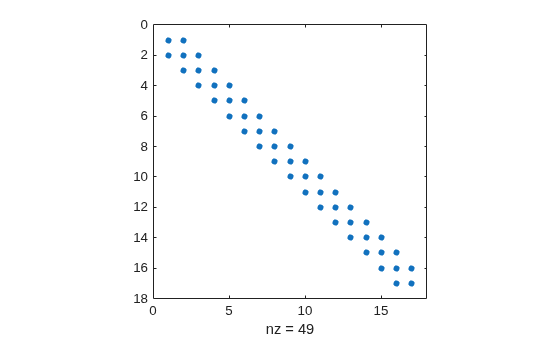
A is singular because the rows are linearly dependent. For instance, sum(A) produces a vector of zeros.
Calculate the determinant of A.
d = det(A)
d =
2.6698e+10
The determinant of A is quite large despite the fact that A is singular. In fact, the determinant of A should be exactly zero! The inaccuracy of d is due to an aggregation of round-off errors in the MATLAB® implementation of the LU decomposition, which det uses to calculate the determinant. This result demonstrates a few important aspects of calculating numeric determinants. See the Limitations section for more details.
Input Arguments
Limitations
Avoid using det to examine if a matrix is
singular because of the following limitations. Use cond or rcond instead.
| Limitation | Result |
|---|---|
The magnitude of the determinant is typically unrelated to the condition number of a matrix. | The determinant of a matrix can be arbitrarily large or small without changing the condition number. |
| The determinant calculation is sometimes numerically
unstable. For example, |
Algorithms
det computes the determinant from the triangular
factors obtained by Gaussian elimination with the lu function.
[L,U] = lu(X)
s =  det(L)      % This is always +1 or -1
det(X) = s*prod(diag(U))
Extended Capabilities
Version History
Introduced before R2006a

