ellipj
Jacobi elliptic functions
Description
Examples
Find the Jacobi elliptic functions for U = 0.5 and M = 0.25.
[s,c,d] = ellipj(0.5,0.25)
s =
0.4751
c =
0.8799
d =
0.9714
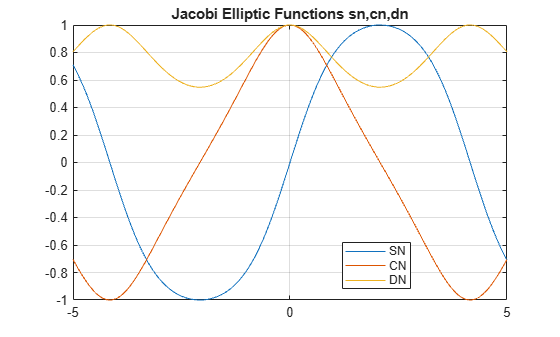
Plot the Jacobi elliptic functions for -5≤U≤5 and M = 0.7.
M = 0.7;
U = -5:0.01:5;
[S,C,D] = ellipj(U,M);
plot(U,S,U,C,U,D);
legend('SN','CN','DN','Location','best')
grid on
title('Jacobi Elliptic Functions sn,cn,dn')
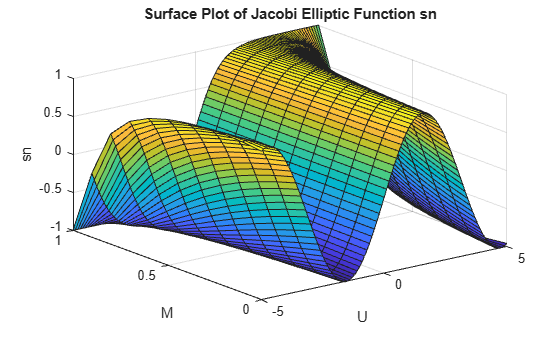
Generate a surface plot of the Jacobi elliptic sn function for the allowed range of M and -5≤U≤5.
[M,U] = meshgrid(0:0.1:1,-5:0.1:5);
S = ellipj(U,M);
surf(U,M,S)
xlabel('U')
ylabel('M')
zlabel('sn')
title('Surface Plot of Jacobi Elliptic Function sn')
The default value of tol is eps. Find the run time with the default value for arbitrary M using tic and toc. Increase tol by a factor of 1000 and find the run time. Compare the run times.
tic
ellipj(0.253,0.937)
ans =
0.2479
toc
Elapsed time is 0.201865 seconds.
tic
ellipj(0.253,0.937,eps*1000)
ans =
0.2479
toc
Elapsed time is 0.029991 seconds.
ellipj runs significantly faster when tolerance is significantly increased.
Input Arguments
Output Arguments
More About
Algorithms
ellipj computes the Jacobi elliptic functions
using the method of the arithmetic-geometric mean of [1]. It
starts with the triplet of numbers
ellipj computes successive iterations using
Next, it calculates the amplitudes in radians using
being careful to unwrap the phases correctly. The Jacobian elliptic functions are then simply
References
[1] Abramowitz, M. and I. A. Stegun, Handbook of Mathematical Functions, Dover Publications, 1965, 17.6.
Extended Capabilities
Version History
Introduced before R2006a

