fplot
R2026bPlot expression or function

Syntax
Description
fplot(___, specifies the line
style, marker symbol, and line color. For example, LineSpec)"-r" plots
a red line. Use this option after any of the input argument combinations in the
previous syntaxes.
fplot(___, specifies line
properties using one or more name-value arguments. For example,
Name=Value)LineWidth=2 specifies a line width of 2 points.
fplot( plots into the axes
specified by ax,___)ax instead of the current axes
(gca). Specify the axes as the first input
argument.
fp = fplot(___)FunctionLine object or a ParameterizedFunctionLine object,
depending on the inputs. Use fp to query and modify
properties of a specific line. For a list of properties, see FunctionLine Properties or ParameterizedFunctionLine Properties.
[x,y] =
fplot(___) returns the abscissas and ordinates for the function without
creating a plot. This syntax will be removed in a future release. Use the
XData and YData properties of the line
object, fp, instead.
Note
fplot no longer supports input arguments for
specifying the error tolerance or the number of evaluation points. To
specify the number of evaluation points, use the MeshDensity property.
Examples
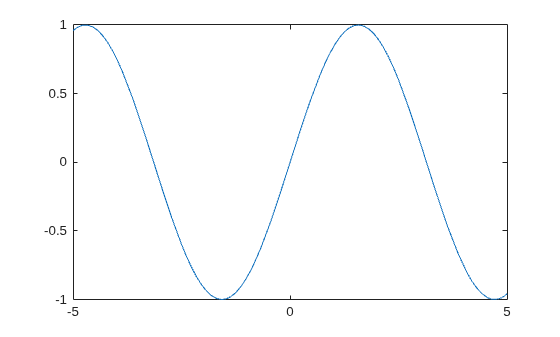
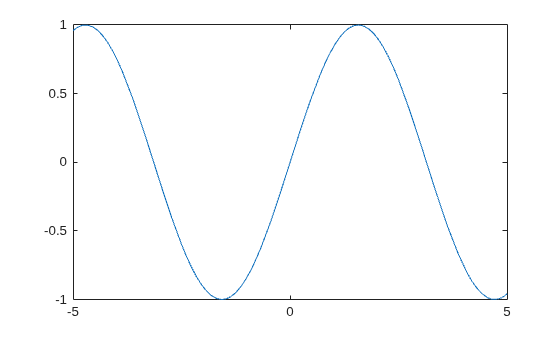
Plot sin(x) over the default x interval [-5 5].
fplot(@(x) sin(x))
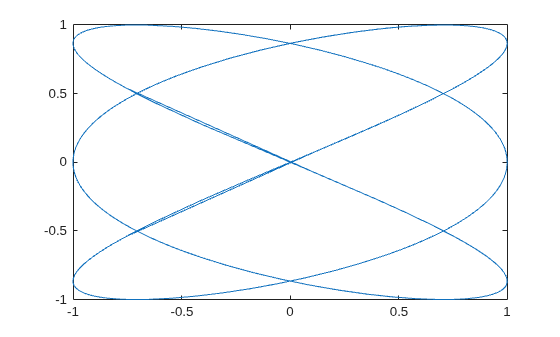
Plot the parametric curve and .
xt = @(t) cos(3*t);
yt = @(t) sin(2*t);
fplot(xt,yt)
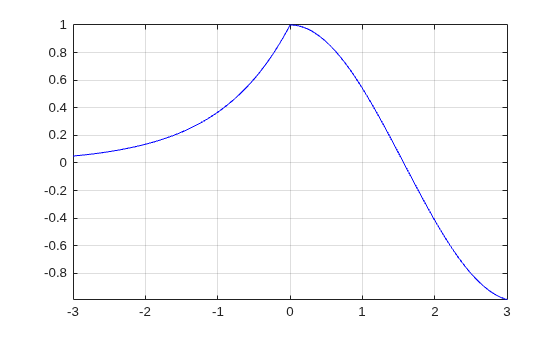
Plot the piecewise function
Plot multiple lines using hold on. Specify the plotting intervals using the second input argument of fplot. Specify the color of the plotted lines as blue using "b". When you plot multiple lines in the same axes, the axis limits adjust to incorporate all the data.
fplot(@(x) exp(x),[-3 0],"b")
hold on
fplot(@(x) cos(x),[0 3],"b")
hold off
grid on
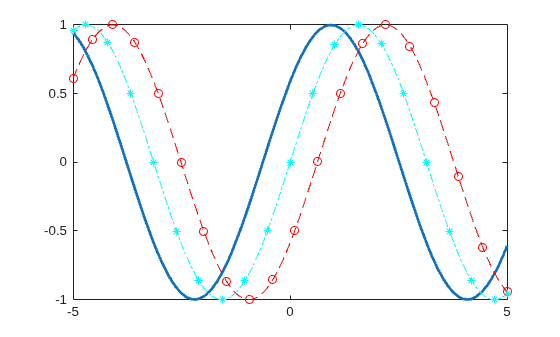
Plot three sine waves with different phases. For the first, use a line width of 2 points. For the second, specify a dashed red line style with circle markers. For the third, specify a cyan, dash-dotted line style with asterisk markers.
fplot(@(x) sin(x+pi/5),Linewidth=2);
hold on
fplot(@(x) sin(x-pi/5),"--or");
fplot(@(x) sin(x),"-.*c")
hold off
Plot sin(x) and assign the function line object to a variable.
fp = fplot(@(x) sin(x))
fp =
  FunctionLine with properties:

     Function: @(x)sin(x)
        Color: [0.0660 0.4430 0.7450]
    LineStyle: '-'
    LineWidth: 0.5000

  Show all properties
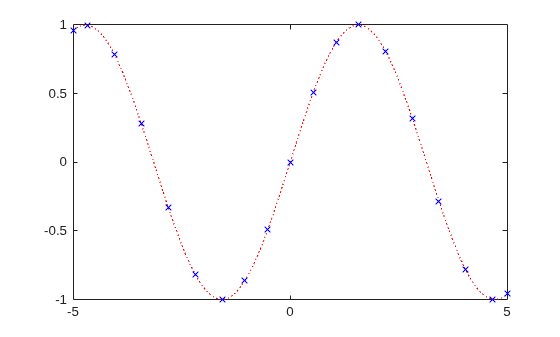
Change the line to a dotted red line by using dot notation to set properties. Add cross markers and set the marker color to blue.
fp.LineStyle = ":";
fp.Color = "r";
fp.Marker = "x";
fp.MarkerEdgeColor = "b";
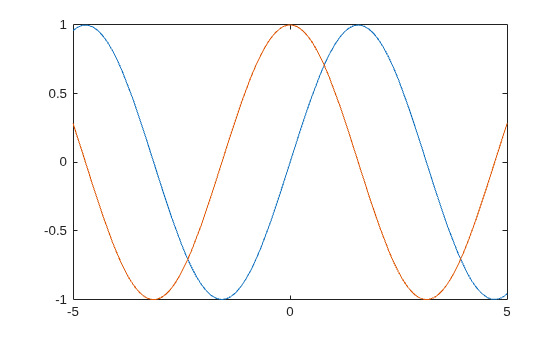
Plot two lines using hold on.
fplot(@(x) sin(x))
hold on
fplot(@(x) cos(x))
hold off
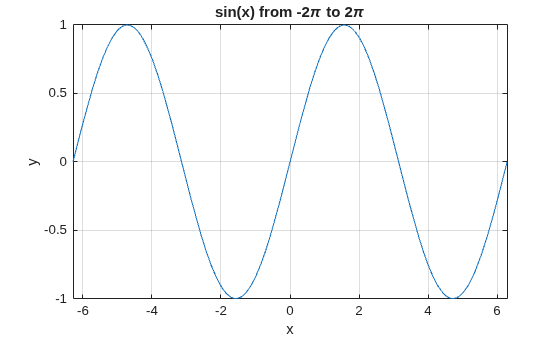
Plot from to using a function handle. Display the grid lines. Then, add a title and label the x-axis and y-axis.
fplot(@sin,[-2*pi 2*pi])
grid on
title("sin(x) from -2\pi to 2\pi")
xlabel("x");
ylabel("y");
Use gca to access the current axes object. Display tick marks along the x-axis at intervals of . Format the x-axis tick values by setting the XTick and XTickLabel properties of the axes object. Similar properties exist for the y-axis.
ax = gca;
ax.XTick = -2*pi:pi/2:2*pi;
ax.XTickLabel = {"-2\pi","-3\pi/2","-\pi","-\pi/2","0", ...
    "\pi/2","\pi","3\pi/2","2\pi"};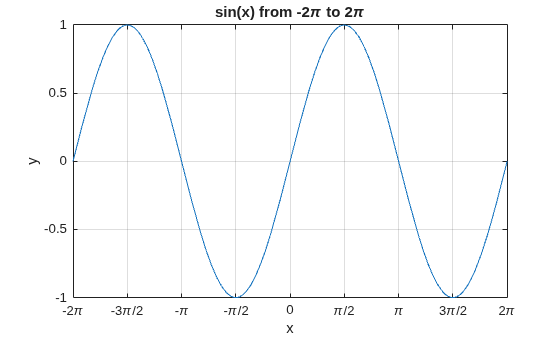
Input Arguments
Function to plot, specified as a function handle to a named or anonymous function.
Specify a function of the form y = f(x).
The function must accept a vector input argument and return a vector
output argument of the same size. Use array operators instead of matrix
operators for the best performance. For example, use .* (times)
instead of * (mtimes).
Note
Support for character vector inputs will be removed in a future release. Use function handles instead.
Example: fplot(@(x) sin(x)) plots sin(x) over the default
interval, [-5, 5].
Interval for x, specified as a two-element
vector of the form [xmin xmax].
Parametric function for x coordinates, specified as a function handle to a named or anonymous function.
Specify a function of the form x = funx(t).
The function must accept a vector input argument and return a vector
output argument of the same size. Use array operators instead of matrix
operators for the best performance. For example, use .* (times)
instead of * (mtimes).
Example: funx = @(t) sin(2*t);
Parametric function for y coordinates, specified as a function handle to a named or anonymous function.
Specify a function of the form y = funy(t).
The function must accept a vector input argument and return a vector
output argument of the same size. Use array operators instead of matrix
operators for the best performance. For example, use .* (times)
instead of * (mtimes).
Example: funy = @(t) cos(3*t);
Interval for t, specified as a two-element
vector of the form [tmin tmax].
Axes object. If you do not specify an axes object, then fplot uses
the current axes (gca).
Line style, marker, and color, specified as a string scalar or character vector containing symbols. The symbols can appear in any order. You do not need to specify all three characteristics (line style, marker, and color). For example, if you omit the line style and specify the marker, then the plot shows only the marker and no line.
Example: "--or" is a red dashed line with circle markers.
| Line Style | Description | Resulting Line |
|---|---|---|
"-" | Solid line |
|
"--" | Dashed line |
|
":" | Dotted line |
|
"-." | Dash-dotted line |
|


| Marker | Description | Resulting Marker |
|---|---|---|
"o" | Circle |
|
"+" | Plus sign |
|
"*" | Asterisk |
|
"." | Point |
|
"x" | Cross |
|
"_" | Horizontal line |
|
"|" | Vertical line |
|
"square" | Square |
|
"diamond" | Diamond |
|
"^" | Upward-pointing triangle |
|
"v" | Downward-pointing triangle |
|
">" | Right-pointing triangle |
|
"<" | Left-pointing triangle |
|
"pentagram" | Pentagram |
|
"hexagram" | Hexagram |
|


| Color Name | Short Name | RGB Triplet | Appearance |
|---|---|---|---|
"red" | "r" | [1 0 0] |
|
"green" | "g" | [0 1 0] |
|
"blue" | "b" | [0 0 1] |
|
"cyan"
| "c" | [0 1 1] |
|
"magenta" | "m" | [1 0 1] |
|
"yellow" | "y" | [1 1 0] |
|
"black" | "k" | [0 0 0] |
|
"white" | "w" | [1 1 1] |
|


Name-Value Arguments
Specify optional pairs of arguments as
Name1=Value1,...,NameN=ValueN, where Name is
the argument name and Value is the corresponding value.
Name-value arguments must appear after other arguments, but the order of the
pairs does not matter.
Example: Marker="o",MarkerFaceColor="red"
The properties listed here are only a subset. For a complete list, see FunctionLine Properties or ParameterizedFunctionLine Properties.
Alternatively, you can specify some common colors by name. This table lists the named color options, the equivalent RGB triplets, and the hexadecimal color codes.
| Color Name | Short Name | RGB Triplet | Hexadecimal Color Code | Appearance |
|---|---|---|---|---|
"red" | "r" | [1 0 0] | "#FF0000" |
|
"green" | "g" | [0 1 0] | "#00FF00" |
|
"blue" | "b" | [0 0 1] | "#0000FF" |
|
"cyan"
| "c" | [0 1 1] | "#00FFFF" |
|
"magenta" | "m" | [1 0 1] | "#FF00FF" |
|
"yellow" | "y" | [1 1 0] | "#FFFF00" |
|
"black" | "k" | [0 0 0] | "#000000" |
|
"white" | "w" | [1 1 1] | "#FFFFFF" |
|
This table lists the default color palettes for plots in the light and dark themes.
| Palette | Palette Colors |
|---|---|
Before R2025a: Most plots use these colors by default. |
|
|
|


You can get the RGB triplets and hexadecimal color codes for these palettes using the orderedcolors and rgb2hex functions. For example, get the RGB triplets for the "gem" palette and convert them to hexadecimal color codes.
RGB = orderedcolors("gem");
H = rgb2hex(RGB);
Before R2024a: Get the hexadecimal color codes using
H = compose("#%02X%02X%02X",round(RGB*255)).
Before R2023b: Get the RGB triplets using RGB =
get(groot,"FactoryAxesColorOrder").
Example: "blue"
Example: [0
0 1]
Example: "#0000FF"
Line style, specified as one of the options listed in this table.
| Line Style | Description | Resulting Line |
|---|---|---|
"-" | Solid line |
|
"--" | Dashed line |
|
":" | Dotted line |
|
"-." | Dash-dotted line |
|
"none" | No line | No line |
Marker symbol, specified as one of the values listed in this table. By default, the object does not display markers. Specifying a marker symbol adds markers at each data point or vertex.
| Marker | Description | Resulting Marker |
|---|---|---|
"o" | Circle |
|
"+" | Plus sign |
|
"*" | Asterisk |
|
"." | Point |
|
"x" | Cross |
|
"_" | Horizontal line |
|
"|" | Vertical line |
|
"square" | Square |
|
"diamond" | Diamond |
|
"^" | Upward-pointing triangle |
|
"v" | Downward-pointing triangle |
|
">" | Right-pointing triangle |
|
"<" | Left-pointing triangle |
|
"pentagram" | Pentagram |
|
"hexagram" | Hexagram |
|
"none" | No markers | Not applicable |
This table shows the default color palettes for plots in the light and dark themes.
You can get the RGB triplets and hexadecimal color codes for these palettes using the
orderedcolors and rgb2hex
functions. For example, get the RGB triplets for the "gem" palette
and convert them to hexadecimal color
codes.
RGB = orderedcolors("gem");
H = rgb2hex(RGB);
Before R2024a: Get the hexadecimal color codes using
H = compose("#%02X%02X%02X",round(RGB*255)).
Before R2023b: Get the RGB triplets using RGB =
get(groot,"FactoryAxesColorOrder").
| Palette | Palette Colors |
|---|---|
Before R2025a: Most plots use these colors by default. |
|
|
|
This table lists the default color palettes for plots in the light and dark themes.
| Palette | Palette Colors |
|---|---|
Before R2025a: Most plots use these colors by default. |
|
|
|
You can get the RGB triplets and hexadecimal color codes for these palettes using the orderedcolors and rgb2hex functions. For example, get the RGB triplets for the "gem" palette and convert them to hexadecimal color codes.
RGB = orderedcolors("gem");
H = rgb2hex(RGB);
Before R2024a: Get the hexadecimal color codes using
H = compose("#%02X%02X%02X",round(RGB*255)).
Before R2023b: Get the RGB triplets using RGB =
get(groot,"FactoryAxesColorOrder").
Output Arguments
Tips
Use element-wise operators for the best performance and to avoid a warning message. For example, use
x.*yinstead ofx*y. For more information, see Array vs. Matrix Operations.When you zoom in on the chart,
fplotreplots the data, which can reveal hidden details.
Extended Capabilities
Version History
Introduced before R2006a

