ind2sub
R2026bConvert linear indices to subscripts
Description
[
returns I1,I2,...,In] = ind2sub(sz,ind)n arrays I1,I2,...,In containing the
equivalent multidimensional subscripts corresponding to the linear indices
ind for a multidimensional array of size sz. Here
sz is a vector with n elements that specifies the
size of each array dimension.
Examples
Convert the linear indices [3 4 5 6] to row and column subscripts in a 3-by-3 matrix. The mapping from linear indices to subscripts (indexing by position) is illustrated in the following.
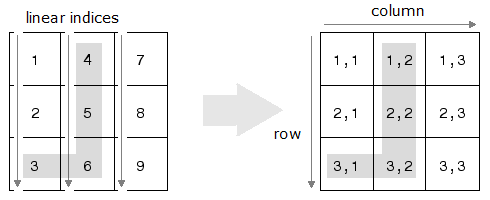
Create input vectors and perform the conversion.
ind = [3 4 5 6];
sz = [3 3];
[row,col] = ind2sub(sz,ind)
row = 1×4

     3     1     2     3
col = 1×4

     1     2     2     2
Convert the linear indices [3 4 5 6] to subscripts in a 2-by-2-by-2 array. The mapping from linear indices to subscripts (indexing by position) for a 2-by-2-by-2 array can be illustrated as in the following.
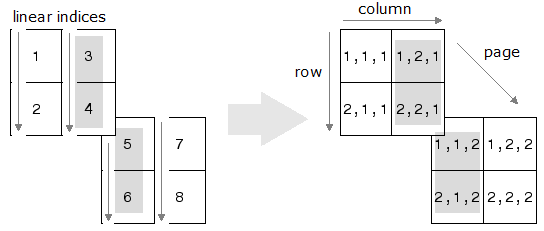
Create input vectors and perform the conversion.
ind = [3 4 5 6];
sz = [2 2 2];
[I1,I2,I3] = ind2sub(sz,ind)
I1 = 1×4

     1     2     1     2
I2 = 1×4

     2     2     1     1
I3 = 1×4

     1     1     2     2
Convert a linear index of a 3-D array to a subscript index.
Create an array, and find the subscript index corresponding to the 14 th element of the array.
A = rand(3,4,2);
[row,col,page] = ind2sub(size(A),14)
row =
2
col =
1
page =
2
Check that both index versions refer to the same element of the array.
A(14)
ans =
0.4854
A(row,col,page)
ans =
0.4854
When using ind2sub for an N-dimensional array, you would typically supply N output arguments for each dimension of the matrix. This example shows the different results when you return fewer output arguments for a 3-dimensional array.
Create the input arguments needed to convert the linear indices 1 through 8 for a 3-dimensional array with size 2-by-2-by-2.
ind = 1:8;
sz = [2 2 2];
Specify three output arguments when using ind2sub to return the row, column, and page subscripts for the 2-by-2-by-2 array.
[row,col,page] = ind2sub(sz,ind)
row = 1×8

     1     2     1     2     1     2     1     2
col = 1×8

     1     1     2     2     1     1     2     2
page = 1×8

     1     1     1     1     2     2     2     2
If you specify only two output arguments, ind2sub ignores the third dimension of the array and returns subscripts for a 2-dimensional array with size 2-by-4 instead.
[row,col] = ind2sub(sz,ind)
row = 1×8

     1     2     1     2     1     2     1     2
col = 1×8

     1     1     2     2     3     3     4     4
If you specify only one output argument, ind2sub ignores the second and third dimensions of the array and returns subscripts for a 1-dimensional array with size 1-by-8 instead.
row = ind2sub(sz,ind)
row = 1×8

     1     2     3     4     5     6     7     8
When converting linear indices to subscript indices using a target matrix size that is smaller than required, the ind2sub function automatically expands the matrix size as necessary.
For example, define linear indices that are outside the matrix size of 3-by-1.
ind = [9 11 13 14]
ind = 1×4

     9    11    13    14
Convert these indices to subscript indices for a 3-by-1 matrix.
[row,col] = ind2sub([3 1],ind)
row = 1×4

     3     2     1     2
col = 1×4

     3     4     5     5
ind2sub does not produce an error for this operation. Instead, ind2sub automatically adds columns and expands the matrix size to 3-by-5 to accommodate the conversion of the specified linear indices to subscript indices.
For comparison, convert the same linear indices to subscript indices for a 3-by-5 matrix. The resulting subscript indices for a 3-by-5 matrix and a 3-by-1 matrix are the same.
[row,col] = ind2sub([3 5],ind)
row = 1×4

     3     2     1     2
col = 1×4

     3     4     5     5
Input Arguments
Output Arguments
Tips
To get the linear indices of matrix elements that satisfy a specific condition for matrix
A, you can use thefindfunction with one output argument. To get the subscript indices, use thefindfunction with two output arguments. For example,[row,col] = ind2sub(size(A),find(A>5))gives the same result as[row,col] = find(A>5).
Algorithms
For an array A, if [I1,…,In] = ind2sub(size(A),ind),
then A(I1(k),…,In(k)) = A(ind(k)) for all k.

