interpft
1-D interpolation (FFT method)
Description
Examples
Interpolate 1-D data using the FFT method and visualize the result.
Generate some sample points in the interval for the function . Use a spacing interval dx to ensure the data is evenly spaced. Plot the sample points.
dx = 3*pi/30;
x = 0:dx:3*pi;
f = sin(x).^2 .* cos(x);
plot(x,f,'o')
Use FFT interpolation to find the function value at 200 query points.
N = 200;
y = interpft(f,N);
Calculate the spacing of the interpolated data from the spacing of the sample points with dy = dx*length(x)/N, where N is the number of interpolation points. Truncate the data in y to match the sampling density of x2.
dy = dx*length(x)/N;
x2 = 0:dy:3*pi;
y = y(1:length(x2));
Plot the results.
hold on
plot(x2,y,'.')
title('FFT Interpolation of Periodic Function')

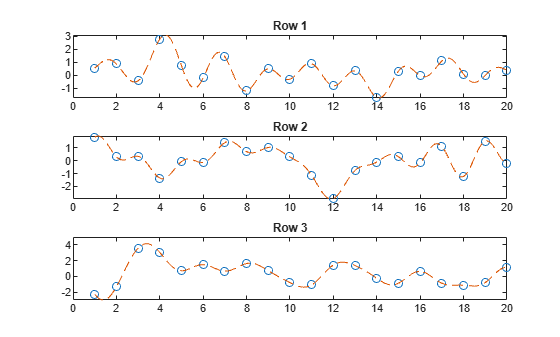
Generate three separate data sets of normally distributed random numbers. Assume the data is sampled at the positive integers, 1:N. Store the data sets as rows in a matrix.
A = randn(3,20);
x = 1:20;
Interpolate the rows of the matrix at 500 query points each. Specify dim = 2 so that interpft works on the rows of A.
N = 500;
y = interpft(A,N,2);
Calculate the spacing interval of the interpolated data dy. Truncate the data in y to match the sampling density of x2.
dy = length(x)/N;
x2 = 1:dy:20;
y = y(:,1:length(x2));
Plot the results.
subplot(3,1,1)
plot(x,A(1,:)','o');
hold on
plot(x2,y(1,:)','--')
title('Row 1')

subplot(3,1,2)
plot(x,A(2,:)','o');
hold on
plot(x2,y(2,:)','--')
title('Row 2')

subplot(3,1,3)
plot(x,A(3,:)','o');
hold on
plot(x2,y(3,:)','--')
title('Row 3')
Input Arguments
Input array, specified as a vector, matrix, or multidimensional
array. The data in X is assumed to be sampled at
an evenly spaced interval of the independent variable. interpft works
best with periodic data.
Data Types: single | double
Complex Number Support: Yes
Number of points, specified as a positive integer scalar.
Data Types: single | double
Dimension to operate along, specified as a positive integer scalar. If no value is specified, then the default is the first array dimension whose size does not equal 1.
interpft(X,n,1)interpolates the columns ofX.
interpft(X,n,2)interpolates the rows ofX.
Example: interpft(X,n,3)
Output Arguments
Algorithms
The interpft function uses the FFT method. The original vector
x is transformed to the Fourier domain using
fft, and then it is transformed back with more points.
Extended Capabilities
Version History
Introduced before R2006a

