lsqr
R2026bSolve system of linear equations — least-squares method
Syntax
Description
x = lsqr(A,b)A*x = b for
x using the Least Squares Method.
lsqr finds a least squares solution for x that
minimizes norm(b-A*x). When A is consistent, the least
squares solution is also a solution of the linear system. When the attempt is successful,
lsqr displays a message to confirm convergence. If
lsqr fails to converge after the maximum number of iterations or
halts for any reason, it displays a diagnostic message that includes the relative residual
norm(b-A*x)/norm(b) and the iteration number at which the method
stopped.
[
returns a flag that specifies whether the algorithm successfully converged. When
x,flag] = lsqr(___)flag = 0, convergence was successful. You can use this output syntax
with any of the previous input argument combinations. When you specify the
flag output, lsqr does not display any diagnostic
messages.
Examples
Solve a rectangular linear system using lsqr with default settings, and then adjust the tolerance and number of iterations used in the solution process.
Create a random sparse matrix A with 50% density. Also create a random vector b for the right-hand side of .
rng default
A = sprand(400,300,.5);
b = rand(400,1);
Solve using lsqr. The output display includes the value of the relative residual error .
x = lsqr(A,b);
lsqr stopped at iteration 20 without converging to the desired tolerance 1e-06
because the maximum number of iterations was reached.
The iterate returned (number 20) has relative residual 0.26.
By default lsqr uses 20 iterations and a tolerance of 1e-6, but the algorithm is unable to converge in those 20 iterations for this matrix. Since the residual is still large, it is a good indicator that more iterations (or a preconditioner matrix) are needed. You also can use a larger tolerance to make it easier for the algorithm to converge.
Solve the system again using a tolerance of 1e-4 and 70 iterations. Specify six outputs to return the relative residual relres of the calculated solution, as well as the residual history resvec and the least-squares residual history lsvec.
[x,flag,relres,iter,resvec,lsvec] = lsqr(A,b,1e-4,70);
flag
flag =
0
Since flag is 0, the algorithm was able to meet the desired error tolerance in the specified number of iterations. You can generally adjust the tolerance and number of iterations together to make tradeoffs between speed and precision in this manner.
Examine the relative residual and least-squares residual of the calculated solution.
relres
relres =
0.2625
lsres = lsvec(end)
lsres =
2.7640e-04
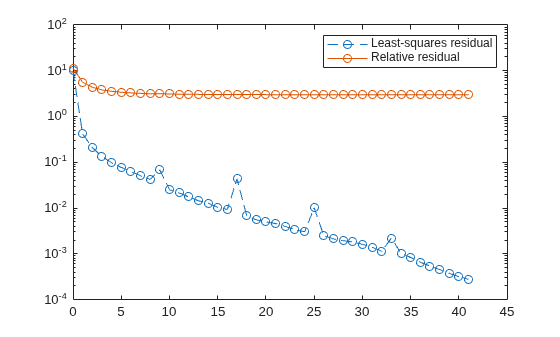
These residual norms indicate that x is a least-squares solution, because relres is not smaller than the specified tolerance of 1e-4. Since no consistent solution to the linear system exists, the best the solver can do is to make the least-squares residual satisfy the tolerance.
Plot the residual histories. The relative residual resvec quickly reaches a minimum and cannot make further progress, while the least-squares residual lsvec continues to be minimized on subsequent iterations.
N = length(resvec);
semilogy(0:N-1,lsvec,'--o',0:N-1,resvec,'-o')
legend("Least-squares residual","Relative residual")
Examine the effect of using a preconditioner matrix with lsqr to solve a linear system.
Load west0479, a real 479-by-479 nonsymmetric sparse matrix.
load west0479
A = west0479;
Define b so that the true solution to is a vector of all ones.
b = sum(A,2);
Set the tolerance and maximum number of iterations.
tol = 1e-12;
maxit = 20;
Use lsqr to find a solution at the requested tolerance and number of iterations. Specify six outputs to return information about the solution process:
xis the computed solution toA*x = b.flis a flag indicating whether the algorithm converged.rris the relative residual of the computed answerx.itis the iteration number whenxwas computed.rvis a vector of the residual history for .lsrvis a vector of the least squares residual history.
[x,fl,rr,it,rv,lsrv] = lsqr(A,b,tol,maxit);
fl
fl =
1
rr
rr =
0.0017
it
it =
20
Since fl = 1, the algorithm did not converge to the specified tolerance within the maximum number of iterations.
To aid with the slow convergence, you can specify a preconditioner matrix. Since A is nonsymmetric, use ilu to generate the preconditioner in factorized form. Specify a drop tolerance to ignore nondiagonal entries with values smaller than 1e-6. Solve the preconditioned system for by specifying L and U as the M1 and M2 inputs to lsqr.
setup = struct('type','ilutp','droptol',1e-6);
[L,U] = ilu(A,setup);
[x1,fl1,rr1,it1,rv1,lsrv1] = lsqr(A,b,tol,maxit,L,U);
fl1
fl1 =
0
rr1
rr1 =
7.0954e-14
it1
it1 =
13
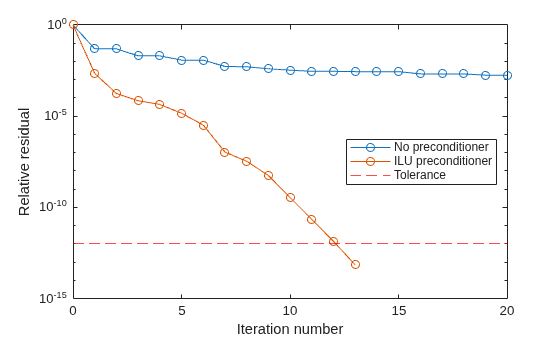
The use of an ilu preconditioner produces a relative residual less than the prescribed tolerance of 1e-12 at the 13th iteration. The output rv1(1) is norm(b), and the output rv1(end) is norm(b-A*x1).
You can follow the progress of lsqr by plotting the relative residuals at each iteration. Plot the residual history of each solution with a line for the specified tolerance.
semilogy(0:length(rv)-1,rv/norm(b),'-o')
hold on
semilogy(0:length(rv1)-1,rv1/norm(b),'-o')
yline(tol,'r--');
legend('No preconditioner','ILU preconditioner','Tolerance','Location','East')
xlabel('Iteration number')
ylabel('Relative residual')
Examine the effect of supplying lsqr with an initial guess of the solution.
Create a random rectangular sparse matrix. Use the sum of each row as the vector for the right-hand side of so that the expected solution for is a vector of ones.
A = sprand(700,900,0.1);
b = sum(A,2);
Use lsqr to solve twice: one time with the default initial guess, and one time with a good initial guess of the solution. Use 75 iterations and the default tolerance for both solutions. Specify the initial guess in the second solution as a vector with all elements equal to 0.99.
maxit = 75;
x1 = lsqr(A,b,[],maxit);
lsqr converged at iteration 64 to a solution with relative residual 8.7e-07.
x0 = 0.99*ones(size(A,2),1);
x2 = lsqr(A,b,[],maxit,[],[],x0);
lsqr converged at iteration 26 to a solution with relative residual 9.6e-07.
With an initial guess close to the expected solution, lsqr is able to converge in fewer iterations.
Returning Intermediate Results
You also can use the initial guess to get intermediate results by calling lsqr in a for-loop. Each call to the solver performs a few iterations and stores the calculated solution. Then you use that solution as the initial vector for the next batch of iterations.
For example, this code performs 100 iterations four times and stores the solution vector after each pass in the for-loop:
x0 = zeros(size(A,2),1);
tol = 1e-8;
maxit = 100;
for k = 1:4
    [x,flag,relres] = lsqr(A,b,tol,maxit,[],[],x0);
    X(:,k) = x;
    R(k) = relres;
    x0 = x;
end
X(:,k) is the solution vector computed at iteration k of the for-loop, and R(k) is the relative residual of that solution.
Solve a linear system by providing lsqr with a function handle that computes A*x and A'*x in place of the coefficient matrix A.
Create a nonsymmetric tridiagonal matrix. Preview the matrix.
A = gallery('wilk',21) + diag(ones(20,1),1)A = 21×21
10 2 0 0 0 0 0 0 0 0 0 0 0 0 0 0 0 0 0 0 0
1 9 2 0 0 0 0 0 0 0 0 0 0 0 0 0 0 0 0 0 0
0 1 8 2 0 0 0 0 0 0 0 0 0 0 0 0 0 0 0 0 0
0 0 1 7 2 0 0 0 0 0 0 0 0 0 0 0 0 0 0 0 0
0 0 0 1 6 2 0 0 0 0 0 0 0 0 0 0 0 0 0 0 0
0 0 0 0 1 5 2 0 0 0 0 0 0 0 0 0 0 0 0 0 0
0 0 0 0 0 1 4 2 0 0 0 0 0 0 0 0 0 0 0 0 0
0 0 0 0 0 0 1 3 2 0 0 0 0 0 0 0 0 0 0 0 0
0 0 0 0 0 0 0 1 2 2 0 0 0 0 0 0 0 0 0 0 0
0 0 0 0 0 0 0 0 1 1 2 0 0 0 0 0 0 0 0 0 0
0 0 0 0 0 0 0 0 0 1 0 2 0 0 0 0 0 0 0 0 0
0 0 0 0 0 0 0 0 0 0 1 1 2 0 0 0 0 0 0 0 0
0 0 0 0 0 0 0 0 0 0 0 1 2 2 0 0 0 0 0 0 0
0 0 0 0 0 0 0 0 0 0 0 0 1 3 2 0 0 0 0 0 0
0 0 0 0 0 0 0 0 0 0 0 0 0 1 4 2 0 0 0 0 0
⋮
Since this tridiagonal matrix has a special structure, you can represent the operation A*x with a function handle. When A multiplies a vector, most of the elements in the resulting vector are zeros. The nonzero elements in the result correspond with the nonzero tridiagonal elements of A.
The expression becomes:
.
The resulting vector can be written as the sum of three vectors:
=.
Likewise, the expression for becomes:
.
.
In MATLAB®, write a function that creates these vectors and adds them together, thus giving the value of A*x or A'*x, depending on the flag input:
function y = afun(x,flag)
if strcmp(flag,'notransp') % Compute A*x
    y = [0; x(1:20)] ...
        + [(10:-1:0)'; (1:10)'].*x ...
        + 2*[x(2:end); 0];
elseif strcmp(flag,'transp') % Compute A'*x
    y = 2*[0; x(1:20)] ...
        + [(10:-1:0)'; (1:10)'].*x ...
        + [x(2:end); 0];
end
end
(This function is saved as a local function at the end of the example.)
Now, solve the linear system by providing lsqr with the function handle that calculates A*x and A'*x. Use a tolerance of 1e-6 and 25 iterations. Specify as the row sums of so that the true solution for is a vector of ones.
b = full(sum(A,2));
tol = 1e-6;
maxit = 25;
x1 = lsqr(@afun,b,tol,maxit)
lsqr converged at iteration 21 to a solution with relative residual 5.4e-13.
x1 = 21×1

    1.0000
    1.0000
    1.0000
    1.0000
    1.0000
    1.0000
    1.0000
    1.0000
    1.0000
    1.0000
    1.0000
    1.0000
    1.0000
    1.0000
    1.0000
      ⋮
Local Functions
function y = afun(x,flag)
if strcmp(flag,'notransp') % Compute A*x
    y = [0; x(1:20)] ...
        + [(10:-1:0)'; (1:10)'].*x ...
        + 2*[x(2:end); 0];
elseif strcmp(flag,'transp') % Compute A'*x
    y = 2*[0; x(1:20)] ...
        + [(10:-1:0)'; (1:10)'].*x ...
        + [x(2:end); 0];
end
end
Input Arguments
Output Arguments
More About
Tips
Convergence of most iterative methods depends on the condition number of the coefficient matrix,
cond(A). WhenAis square, you can useequilibrateto improve its condition number, and on its own this makes it easier for most iterative solvers to converge. However, usingequilibratealso leads to better quality preconditioner matrices when you subsequently factor the equilibrated matrixB = R*P*A*C.You can use matrix reordering functions such as
dissectandsymrcmto permute the rows and columns of the coefficient matrix and minimize the number of nonzeros when the coefficient matrix is factored to generate a preconditioner. This can reduce the memory and time required to subsequently solve the preconditioned linear system.
References
[1] Barrett, R., M. Berry, T. F. Chan, et al., Templates for the Solution of Linear Systems: Building Blocks for Iterative Methods, SIAM, Philadelphia, 1994.
[2] Paige, C. C. and M. A. Saunders, "LSQR: An Algorithm for Sparse Linear Equations And Sparse Least Squares," ACM Trans. Math. Soft., Vol.8, 1982, pp. 43-71.

