trapz
R2026bTrapezoidal numerical integration
Description
Q = trapz( computes the approximate integral of
Y)Y via the trapezoidal method with unit spacing. The size of
Y determines the dimension to integrate along:
If
Yis a vector, thentrapz(Y)is the approximate integral ofY.If
Yis a matrix, thentrapz(Y)integrates over each column and returns a row vector of integration values.If
Yis a multidimensional array, thentrapz(Y)integrates over the first dimension whose size does not equal 1. The size of this dimension becomes 1, and the sizes of other dimensions remain unchanged.
Q = trapz(___, integrates along the
dimension dim)dim using any of the previous syntaxes. You must
specify Y, and optionally can specify X.
If you specify X, then it can be a scalar or a vector with
length equal to size(Y,dim). For example, if
Y is a matrix, then trapz(X,Y,2)
integrates each row of Y.
Examples
Input Arguments
Numeric data, specified as a vector, matrix, or multidimensional
array. By default, trapz integrates along the first
dimension of Y whose size does not equal 1.
Data Types: single | double
Complex Number Support: Yes
Point spacing, specified as 1 (default), a uniform
scalar spacing, or a vector of coordinates.
If
Xis a scalar, then it specifies a uniform spacing between the data points andtrapz(X,Y)is equivalent toX*trapz(Y).If
Xis a vector, then it specifies x-coordinates for the data points andlength(X)must be the same as the size of the integration dimension inY.
Data Types: single | double
Dimension to operate along, specified as a positive integer scalar. If you do not specify the dimension, then the default is the first array dimension whose size does not equal 1.
Consider a two-dimensional input array, Y:
trapz(Y,1)works on successive elements in the columns ofYand returns a row vector.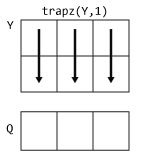
trapz(Y,2)works on successive elements in the rows ofYand returns a column vector.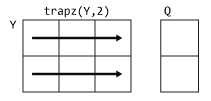
If dim is greater than ndims(Y),
then trapz returns an array of zeros of the same
size as Y.
More About
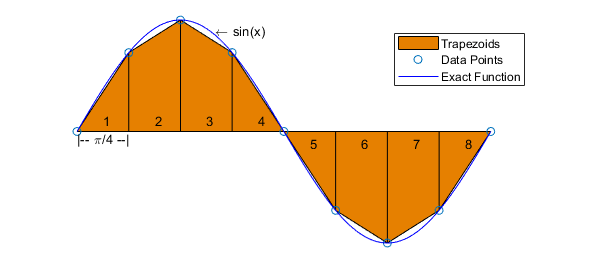
trapz performs numerical integration via the trapezoidal
method. This method approximates the integration over an interval by breaking the
area down into trapezoids with more easily computable areas. For example, here is a
trapezoidal integration of the sine function using eight evenly-spaced
trapezoids:
For an integration with N+1 evenly spaced
points, the approximation is
where the spacing between each point is equal to the scalar value . By default MATLAB® uses a spacing of 1.
If the spacing between the N+1 points is not constant, then the formula
generalizes to
where , and is the spacing between each consecutive pair of points.
Tips
Use
trapzandcumtrapzto perform numerical integrations on discrete data sets. Useintegral,integral2, orintegral3instead if a functional expression for the data is available.trapzreduces the size of the dimension it operates on to 1, and returns only the final integration value.cumtrapzalso returns the intermediate integration values, preserving the size of the dimension it operates on.
Extended Capabilities
Version History
Introduced before R2006a

