unwrap
R2026bShift phase angles
Description
Q = unwrap( unwraps the radian phase angles
in a vector P)P. Whenever the jump between consecutive angles is greater
than or equal to π radians, unwrap shifts the angles
by adding multiples of ±2π until the jump is less than
π. If P is a matrix, unwrap
operates columnwise. If P is a multidimensional array,
unwrap operates on the first dimension whose size is larger than
1.
Examples
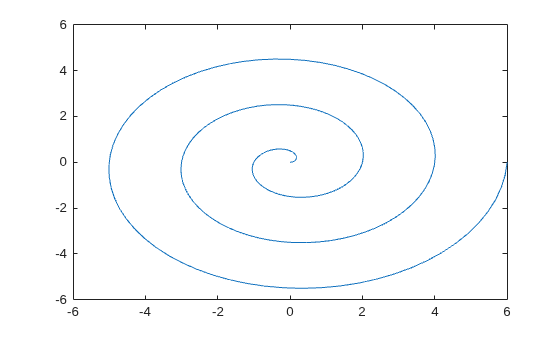
Define the - and -coordinates of a spiral with phase angle from 0 to . Plot the spiral.
t = linspace(0,6*pi,201);
x = t/pi.*cos(t);
y = t/pi.*sin(t);
plot(x,y)
Find the phase angle of the spiral from the - and -coordinates using the atan2 function. The atan2 function returns the angle values within the closed interval from to .
P = atan2(y,x);
plot(t,P)
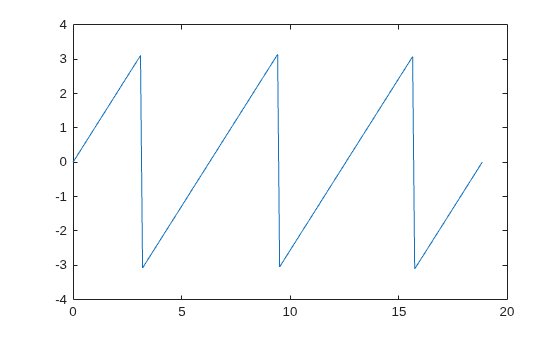
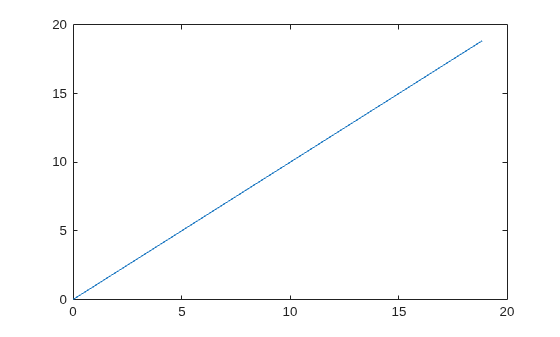
Note that this plot has discontinuities. Use unwrap to eliminate the discontinuities. unwrap adds multiples of when the phase difference between consecutive elements of P are greater than or equal to the jump threshold radians. The shifted phase angle Q lies in the interval from 0 to .
Q = unwrap(P);
plot(t,Q)
Shift the phase angle of a frequency response. The phase curve has two jumps. The first jump is 3.4250 radians between W = 3 and W = 3.4, and the second jump is 6.3420 radians between W = 5 and W = 5.4. Plot the phase curve.
clear; close all;
W = [0:0.4:3, 3.4:0.4:5, 5.4:0.4:7];
P = [-1.5723
     -1.5747
     -1.5790
     -1.5852
     -1.5922
     -1.6044
     -1.6269
     -1.6998
      1.7252
      1.5989
      1.5916
      1.5708
      1.5582
     -4.7838
     -4.8143
     -4.8456
     -4.8764
     -4.9002];
plot(W,P,'bo-')
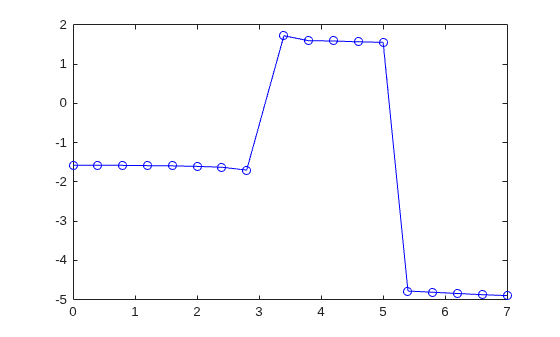
Use unwrap to shift the phase angle using the default jump threshold radians. Plot the shifted phase curve. Both jumps are shifted since they are greater than the jump threshold radians.
plot(W,unwrap(P),'ro-')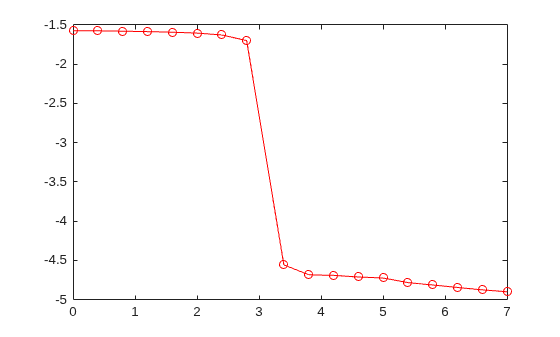
Now shift the phase angle using a jump threshold of 5 radians. Plot the shifted phase curve. The first jump is not shifted since it is less than the jump threshold 5 radians.
plot(W,unwrap(P,5),'ro-')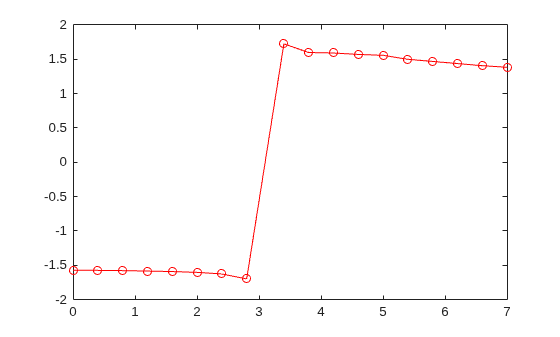
Define a two-column matrix P that contains phase angles.
P = [0 7.07; 0.19 0.98; 6.67 1.18; 0.59 1.37; 0.78 1.56]
P = 5×2

         0    7.0700
    0.1900    0.9800
    6.6700    1.1800
    0.5900    1.3700
    0.7800    1.5600
The phase angles P(1,2) = 7.07 and P(3,1) = 6.67 have phase differences that are larger than compared to the rest of the data.
Unwrap the phase angles by first comparing the elements columnwise. Specify the dim argument as 1. Use the default jump threshold by specifying the second argument as [].
dim = 1;
P1 = unwrap(P,[],dim)
P1 = 5×2

         0    7.0700
    0.1900    7.2632
    0.3868    7.4632
    0.5900    7.6532
    0.7800    7.8432
To shift phase angles by rows instead of by columns, specify dim as 2 instead of 1.
dim = 2;
P2 = unwrap(P1,[],dim)
P2 = 5×2

         0    0.7868
    0.1900    0.9800
    0.3868    1.1800
    0.5900    1.3700
    0.7800    1.5600
Input Arguments
Input array, specified as a vector, matrix, or multidimensional array.
Data Types: single | double
Jump threshold to apply phase shift, specified as a scalar. A jump threshold less than π has the same effect as the default threshold π.
Data Types: single | double
Dimension to operate along, specified as a positive integer scalar. If no value is specified, then the default is the first array dimension whose size does not equal 1.
unwrap(P,[],1)operates along the columns ofPand returns the shifted phase angle of each column.![unwrap(P,[],1) column-wise operation](unwrap_dim_1.png)
unwrap(P,[],2)operates along the rows ofPand returns the shifted phase angle of each row.![unwrap(P,[],2) row-wise operation](unwrap_dim_2.png)
If dim is greater than ndims(P), then
unwrap(P,[],dim) returns P.
Data Types: single | double | int8 | int16 | int32 | int64 | uint8 | uint16 | uint32 | uint64
Output Arguments
Extended Capabilities
Version History
Introduced before R2006a

