| Description |
% fast and accurate state-of-the-art
% bivariate kernel density estimator
% with diagonal bandwidth matrix.
% The kernel is assumed to be Gaussian.
% The two bandwidth parameters are
% chosen optimally without ever
% using/assuming a parametric model for the data or any "rules of thumb".
% Unlike many other procedures, this one
% is immune to accuracy failures in the estimation of
% multimodal densities with widely separated modes (see examples).
% INPUTS: data - an N by 2 array with continuous data
% n - size of the n by n grid over which the density is computed
% n has to be a power of 2, otherwise n=2^ceil(log2(n));
% the default value is 2^8;
% MIN_XY,MAX_XY- limits of the bounding box over which the density is computed;
% the format is:
% MIN_XY=[lower_Xlim,lower_Ylim]
% MAX_XY=[upper_Xlim,upper_Ylim].
% The dafault limits are computed as:
% MAX=max(data,[],1); MIN=min(data,[],1); Range=MAX-MIN;
% MAX_XY=MAX+Range/4; MIN_XY=MIN-Range/4;
% OUTPUT: bandwidth - a row vector with the two optimal
% bandwidths for a bivaroate Gaussian kernel;
% the format is:
% bandwidth=[bandwidth_X, bandwidth_Y];
% density - an n by n matrix containing the density values over the n by n grid;
% density is not computed unless the function is asked for such an output;
% X,Y - the meshgrid over which the variable "density" has been computed;
% the intended usage is as follows:
% surf(X,Y,density)
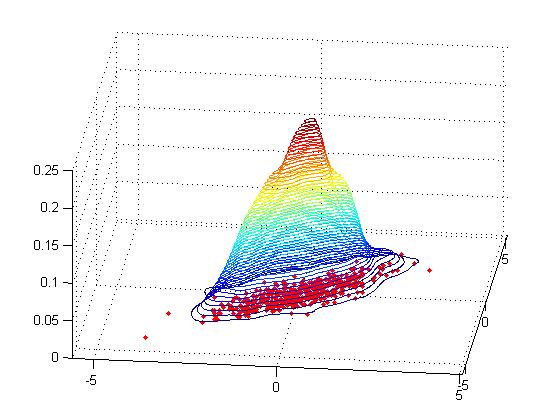
% Example (simple Gaussian mixture)
% clear all
% % generate a Gaussian mixture with distant modes
% data=[randn(500,2);
% randn(500,1)+3.5, randn(500,1);];
% % call the routine
% [bandwidth,density,X,Y]=kde2d(data);
% % plot the data and the density estimate
% contour3(X,Y,density,50), hold on
% plot(data(:,1),data(:,2),'r.','MarkerSize',5)
%
% Example (Gaussian mixture with distant modes):
%
% clear all
% % generate a Gaussian mixture with distant modes
% data=[randn(100,1), randn(100,1)/4;
% randn(100,1)+18, randn(100,1);
% randn(100,1)+15, randn(100,1)/2-18;];
% % call the routine
% [bandwidth,density,X,Y]=kde2d(data);
% % plot the data and the density estimate
% surf(X,Y,density,'LineStyle','none'), view([0,60])
% colormap hot, hold on, alpha(.8)
% set(gca, 'color', 'blue');
% plot(data(:,1),data(:,2),'w.','MarkerSize',5)
%
% Example (Sinusoidal density):
%
% clear all
% X=rand(1000,1); Y=sin(X*10*pi)+randn(size(X))/3; data=[X,Y];
% % apply routine
% [bandwidth,density,X,Y]=kde2d(data);
% % plot the data and the density estimate
% surf(X,Y,density,'LineStyle','none'), view([0,70])
% colormap hot, hold on, alpha(.8)
% set(gca, 'color', 'blue');
% plot(data(:,1),data(:,2),'w.','MarkerSize',5)
%
% Notes: If you have a more accurate density estimator
% (as measured by which routine attains the smallest
% L_2 distance between the estimate and the true density) or you have
% problems running this code, please email me at botev@maths.uq.edu.au
% Reference: Z. I. Botev, J. F. Grotowski and D. P. Kroese
% "KERNEL DENSITY ESTIMATION VIA DIFFUSION" ,Submitted to the
% Annals of Statistics, 2009 |