Random Integer Generator
R2026bGenerate integers randomly distributed in specified range
Random Integer Generator block
To add a block to a model, double-click the canvas and start typing the block name. Then, select the block from the list.
Libraries:
Communications Toolbox /
Comm Sources /
Random Data Sources
Description
The Random Integer Generator block generates uniformly distributed random integers in the range [0, M-1], where M is specified by the Set size parameter. Use this block to generate random binary-valued or integer-valued data.
For information on achieving independent results for individual simulations run in parallel and on improving execution speed, see Tips.
Examples
Demonstrate that sequences output from the Random Integer Generator block differ when you set the seed source to Auto. Show the output sequences repeat when you set the seed source to Parameter and the seed value is not changed. Show the output sequence changes when you set the seed source to Parameter and you change the seed value.
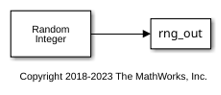
Run the slex_rng_seed_source model twice and compare the output sequence.
Seed source = Auto
     6     1
     7     7
     1     7
     7     3
     5     6
     0     1
     2     3
     4     7
     7     6
     7     7
Change the Seed source to Parameter. Run the slex_rng_seed_source model twice with the seed value set to 0. Compare the results with previous results.
Seed source = Parameter, Seed = 0
     6     1     6     6
     7     7     7     7
     1     7     1     1
     7     3     7     7
     5     6     5     5
     0     1     0     0
     2     3     2     2
     4     7     4     4
     7     6     7     7
     7     7     7     7
Run after changing the seed value to 1993. Compare the results with previous results.
Seed = 1993
     6     1     6     6     0
     7     7     7     7     1
     1     7     1     1     7
     7     3     7     7     2
     5     6     5     5     1
     0     1     0     0     1
     2     3     2     2     4
     4     7     4     4     5
     7     6     7     7     4
     7     7     7     7     1
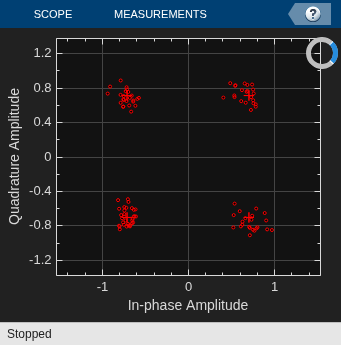
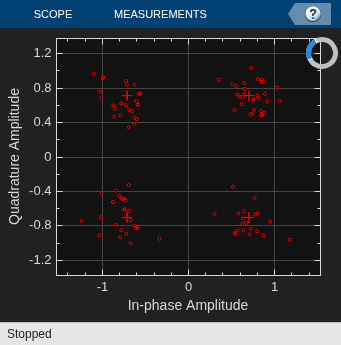
Apply QPSK modulation to a signal of random data. Pass the modulated signal through an additive white Gaussian noise (AWGN) channel. Plot the signal constellation.
The doc_qpsk_mod model generates QPSK data, applies the AWGN, and displays the resulting constellation diagram.

Run the model with the Eb/N0 of the AWGN Channel block set to 15 dB. The constellation diagram shows the QPSK symbol samples with AWGN.
Change the Eb/N0 from 15 dB to 10 dB. The noise level increases as shown by the greater distance between the samples in the constellation diagram.
The cm_ex_viterbi_decode_binary_seq model generates a binary sequence using the Random Integer Generator block. The sequence is encoded with the Convolutional Encoder block and then impaired with the Binary Symmetric Channel block. The Viterbi Decoder block decodes the data sequence and the bit error rate is computed.
The InitFcn callback is used to initialize workspace parameters for samples per frame, BSC error probability, and the Viterbi decoder traceback depth. The signal delay between the transmitted and received signal is equal to the traceback depth. The signal delay is needed for the error rate calculation.
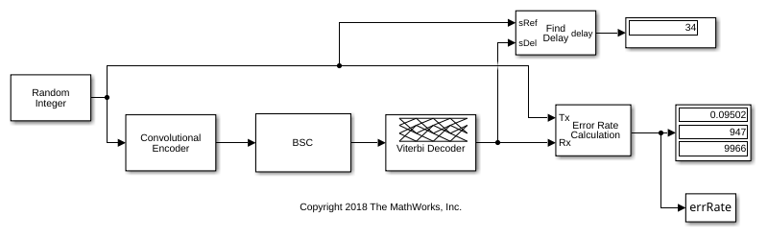
To produce a binary bit stream, the Random Integer Generator block specifies a set size of 2, and output type of boolean.
The computed error rate approximates the Error probability specified in the Binary Symmetric Channel block.
Computed error rate = 0.095023
Limitations
To use this block in a For Each Subsystem (Simulink) you must set Source of seed to
Autoand the model toNormalorAcceleratorsimulation mode. This ensures that each run will generate independent noise samples.
Ports
Output
Parameters
Block Characteristics
Data Types |
|
Multidimensional Signals |
|
Variable-Size Signals |
|
More About
Tips
Independent random numbers
To achieve independent and identically distributed (IID) streams when running simulations in parallel using the
parsim(Simulink) function, such as for Monte Carlo simulation runs, set Source of seed toParameterand make sure that all blocks have different Seed values.If workers use the same seed for this block, they can generate the same random stream of numbers, which can lead to misleading results. This can occur when you configure the model to run in rapid accelerator mode, and in this block set the Simulate using parameter to
Code generationand the Source of seed parameter toAuto.
For more information, see Choosing a Simulation Mode (Simulink).
Execution speed
To optimize execution speed:
When samples per frame (SPF) = 1 for long simulation runs (>>100k steps), set Simulate using to
Code generationand set Source of seed toAuto. This combination provides the fastest per-step execution.When SPF >> 1, set Simulate using to
Interpreted executionand set Source of seed toAuto. This combination provides the fastest total simulation time and there is no compiler dependency.

