LMI-Based Multirate Kalman Filter Design (IEEE ACCESS 2026)

This package provides MATLAB implementations for optimal Kalman filter design in multirate systems.

https://ieeexplore.ieee.org/document/11460152

You are now following this Submission

OVERVIEW
This package provides MATLAB implementations for optimal Kalman filter design in multirate systems where sensors operate at different sampling rates. The code uses Linear Matrix Inequality (LMI) optimization with cyclic reformulation to handle the challenging case where measurement noise covariance becomes semidefinite (not positive definite).
Key innovation: Standard DARE-based Kalman filter methods fail when the measurement noise covariance R is singular. This LMI-based approach naturally handles semidefinite R through dual LQR formulation, enabling stable and optimal filter design.
MAIN FEATURES
- Handles semidefinite measurement noise covariance (R ≽ 0)
- Unified LMI framework for multiple design objectives
- Optimal Kalman filter design minimizing estimation error
- Multi-objective design with eigenvalue placement (guaranteed convergence rate)
- Multi-objective design with l2-induced norm constraint (robust worst-case performance)
- Offline computation of periodic steady-state Kalman gains
- Trade-off analysis tools for performance vs robustness/convergence
APPLICATION EXAMPLE
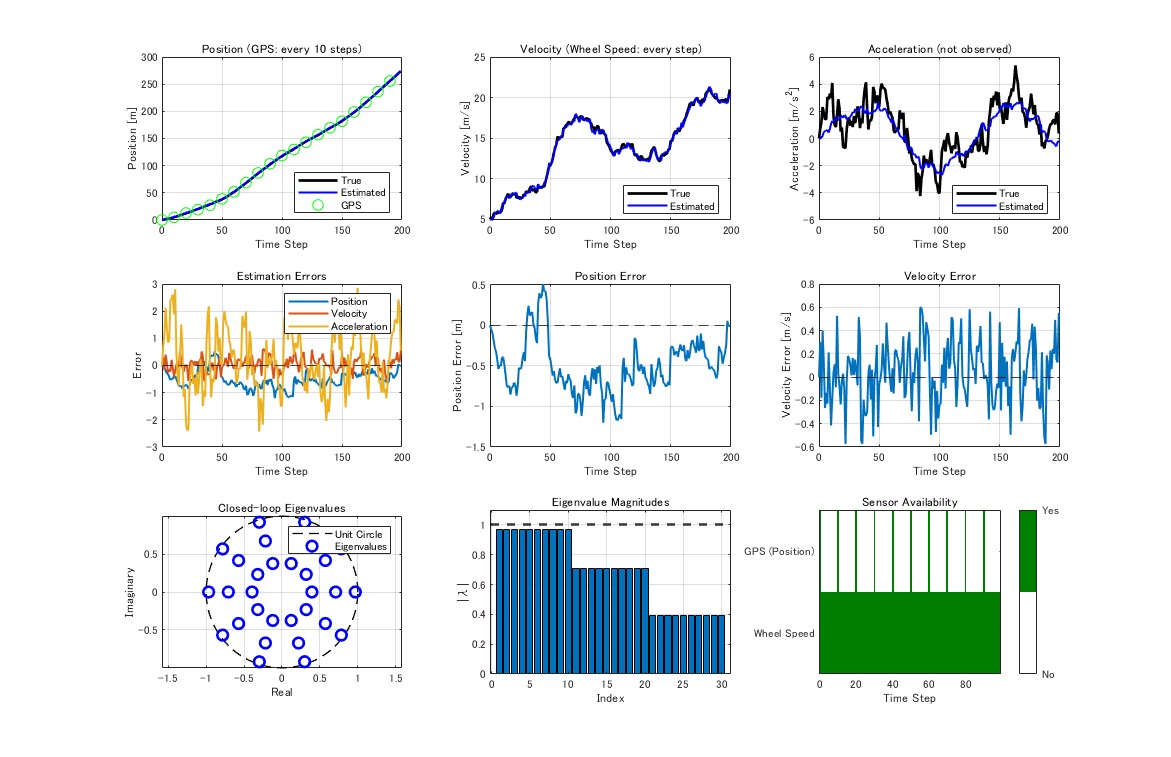
Automotive navigation system fusing GPS (1 Hz) and wheel speed sensor (10 Hz):
- State: [position; velocity; acceleration]
- Achieves position RMSE of 0.600 m and velocity RMSE of 0.268 m/s
- Handles intermittent GPS measurements naturally
INCLUDED FILES
1. MultirateKF_LMI_Rcyc_success_02.m
- Basic optimal Kalman filter design
- Minimizes estimation error covariance
- Includes simulation with automotive navigation example
- Outputs: periodic gains, RMSE performance, stability analysis
2. MultirateKF_02_eig.m
- Multi-objective design with eigenvalue placement
- Guarantees convergence rate |λ| < r_bar
- Trade-off analysis: performance vs convergence speed
- Outputs: trade-off curves, comparative gain analysis
3. MultirateKF_03_l2.m
- Multi-objective design with l2-induced norm constraint
- Limits worst-case disturbance amplification ||G||_l2 < γ_bar
- Trade-off analysis: average vs worst-case performance
- Outputs: trade-off curves, robustness comparison
QUICK START
Simply run any of the three main scripts in MATLAB:
>> MultirateKF_LMI_Rcyc_success_02 % Basic optimal design
>> MultirateKF_02_eig % With eigenvalue constraints
>> MultirateKF_03_l2 % With l2-induced norm constraints
Each script is self-contained and includes:
- System definition (automotive navigation example)
- Cyclic reformulation construction
- LMI-based filter design
- Simulation and visualization
- Performance analysis
TECHNICAL BACKGROUND
In multirate systems, the measurement equation is:
y(k) = S_k * C * x(k) + S_k * v(k)
where S_k is a diagonal selection matrix indicating sensor availability. This leads to periodic time-varying dynamics even when the plant is time-invariant.
Cyclic reformulation transforms the periodic system into time-invariant form:
x̌(k+1) = Ǎ * x̌(k) + B̌ * u(k) + w̌(k)
y̌(k) = Č * x̌(k) + v̌(k)
However, the cyclic measurement noise covariance becomes:
Ř_cyc = diag(S_0*R*S_0^T, ..., S_{N-1}*R*S_{N-1}*T)
When sensors are unavailable (S_k has zeros), Ř_cyc is semidefinite, not positive definite. Standard DARE solvers require positive definite R and will fail.
The LMI approach reformulates the problem using dual LQR theory and solves via semidefinite programming, naturally handling the semidefinite covariance.
UNIFIED LMI STRUCTURE
All three design methods share a common block matrix structure:
[X, XA+YC, XQ^{1/2}, YR^{1/2}]
[*, (2,2), 0, 0 ]
[*, 0, (3,3), 0 ] > 0
[*, 0, 0, (4,4) ]
The (2,2), (3,3), (4,4) blocks change based on design objective:
- Optimal Kalman: (2,2)=X, (3,3)=I, (4,4)=I
- Eigenvalue: (2,2)=r²X, (3,3)=I, (4,4)=I
- l2-induced norm: (2,2)=X-I, (3,3)=γ²I, (4,4)=γ²I
Variables: X (Lyapunov matrix, X = P^{-1}), Y = -XL (observer gain)
Objective: minimize trace(W) where W ≽ X^{-1}
Gain recovery: L = -X^{-1} * Y
REQUIREMENTS
- MATLAB R2020b or later
- Robust Control Toolbox (for LMI optimization via mincx)
- Control System Toolbox (for basic system analysis)
RESULTS SUMMARY
Automotive navigation example (GPS 1Hz + wheel speed 10Hz):
- Position RMSE: 0.600 m
- Velocity RMSE: 0.268 m/s
- Acceleration RMSE: 1.165 m/s²
- Closed-loop stability: max|λ| = 0.967
Trade-off analysis (eigenvalue placement):
- Relaxed constraint (r̄=0.90): 128% increase in trace(W)
- Strict constraint (r̄=0.75): 2237% increase in trace(W)
Conclusion: Faster convergence requires significant performance sacrifice
Trade-off analysis (l2-induced norm):
- Moderate constraint (γ̄=1.5×γ_opt): 28% increase in trace(W)
- Tight constraint (γ̄=1.01×γ_opt): 92% increase in trace(W)
Conclusion: Better worst-case robustness moderately degrades average performance
RELATED PUBLICATION
This code accompanies the paper:
BLOG ARTICLE
GitHub Repository:
https://github.com/Hiroshi-Okajima/multirate-kalman-filter
Blog Articles: State Observer and State Estimation: A Comprehensive Guide (covers Kalman filter, H-infinity filter, multi-rate observer, and MCV observer) | System Identification: From Data to Dynamical Models (multirate system identification for model acquisition) | Model Error Compensator (MEC): Enhance the Robustness (combining identified models with MEC for robust control) | MATLAB File Exchange (Author Profile) | Control Engineering Video Portal (500+ videos)
LICENSE
CC BY 4.0 - Creative Commons Attribution 4.0 International
You are free to share and adapt with appropriate attribution.
AUTHOR
Hiroshi Okajima
Graduate School of Science and Technology
Kumamoto University, Japan
Email: okajima@cs.kumamoto-u.ac.jp
ACKNOWLEDGMENTS
Code documentation created with assistance from Claude (Anthropic). All technical content, research methodology, and results are the author's original work.

Cite As

Hiroshi Okajima (2026). LMI-Based Multirate Kalman Filter Design (IEEE ACCESS 2026) (https://www.mathworks.com/matlabcentral/fileexchange/183162-lmi-based-multirate-kalman-filter-design-ieee-access-2026), MATLAB Central File Exchange. Retrieved .

General Information

MATLAB Release Compatibility

  • Compatible with any release

Platform Compatibility

  • Windows
  • macOS
  • Linux
Version Published Release Notes Action
1.1.4

Add information

1.0.4

IEEE ACCESS

1.0.3

add links

1.0.2

Add information

1.0.1

Add web page

1.0.0