
You are now following this Submission
- You will see updates in your followed content feed
- You may receive emails, depending on your communication preferences
Implements Tarjan's algorithm for finding strongly connected components of directed graphs. In a strongly connected component (SCC), there is a path from every node to every other node. SCCs are disjoint. Nodes whose in-degree or out-degree are zero or are part of acyclic graphs form SCCs all by themselves.
Accepts an adjacency matrix as input. For best performance, the matrix should be sparse.
Also returns an index list reporting SCC membership for each node.
Example of use:
>> E = sparse([2 3 4 5 5 6 6 7 8 4 9 5 10 6 9], ...
[1 2 2 3 4 3 5 6 4 8 8 9 9 10 6], ...
ones(1,15));
>> figure; spy(E)
>> c = tarjan(E)
c =
[1x4 double] [1x2 double] [7] [3] [2] [1]
>> c{1}
ans =
5 6 9 10
>>
>>
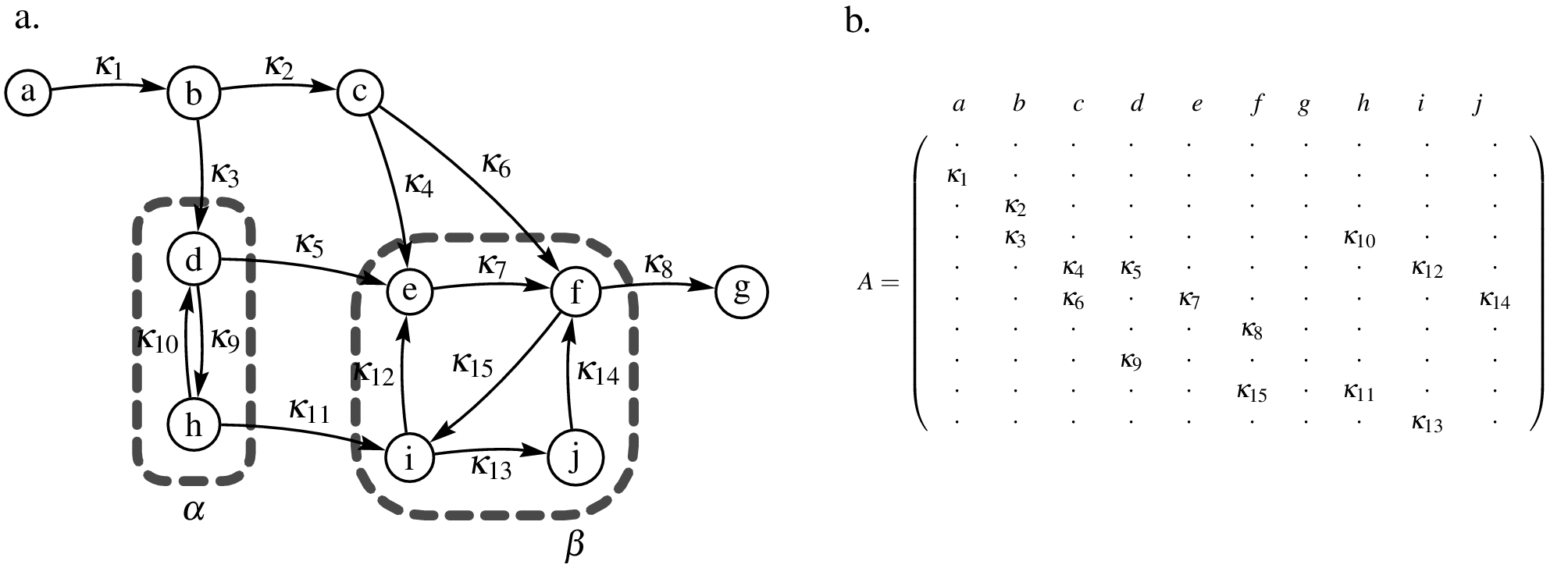
In the example, E is an adjacency matrix for a directed graph (visualized in the screenshot image), and the nodes with indices 5, 6, 9, and 10 form the largest strongly connected component in the graph.
Implements the wikipedia pseudocode [1] more or less exactly. Matlab doesn't have an easy way to share private variables across recursive function calls so this function uses globals. (I know!)
Cite As
Brandon Kuczenski (2026). tarjan(e) (https://www.mathworks.com/matlabcentral/fileexchange/50707-tarjan-e), MATLAB Central File Exchange. Retrieved .
Acknowledgements
Inspired: LoopDetect
General Information
- Version 1.2.0.0 (2.79 KB)
MATLAB Release Compatibility
- Compatible with any release
Platform Compatibility
- Windows
- macOS
- Linux
