
michaelgrund/stacksplit
StackSplit is a plugin for the MATLAB toolbox SplitLab (Wüstefeld et al., 2008).

You are now following this Submission
- You will see updates in your followed content feed
- You may receive emails, depending on your communication preferences

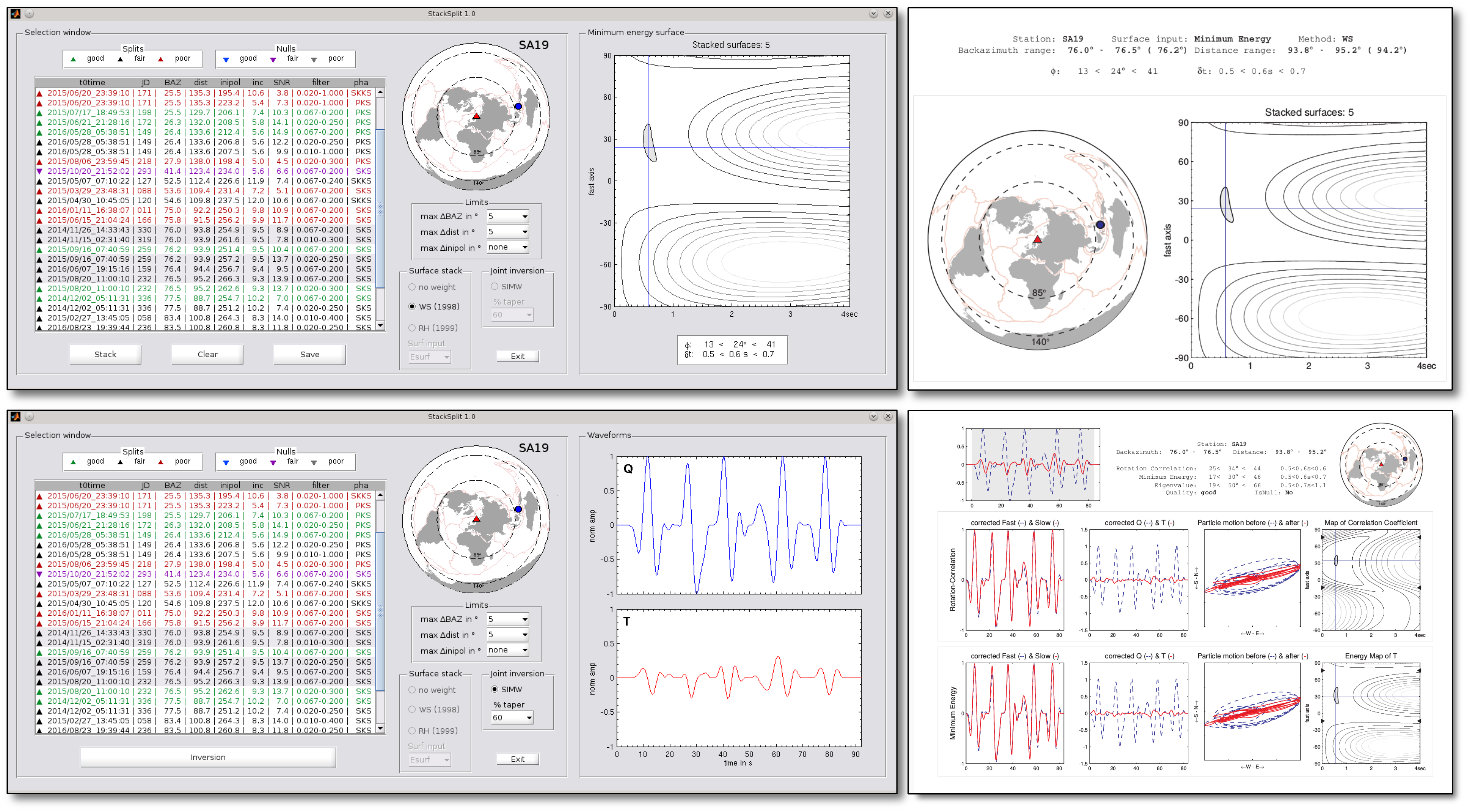
StackSplit is a plugin for the MATLAB toolbox SplitLab (Wüstefeld et al., 2008) which allows applying multi-event techniques for shear wave splitting measurements (SWS) directly within the main program.
For details regarding installation and usage, see the UserGuide.
If you make use of StackSplit in your work, please acknowledge my paper in which the program is described:
- Grund, M. (2017), StackSplit - a plugin for multi-event shear wave splitting analyses in SplitLab, Computers & Geosciences, 105, 43-50, https://doi.org/10.1016/j.cageo.2017.04.015.
Optionally, you can also cite the Zenodo DOI given above, which refers to the latest version of this GitHub repository.
StackSplit grants easy access to four stacking schemes with which single SWS measurements made with SplitLab can be processed:
-
WS: stacking of error surfaces, normalized on the minimum/maximum (depending on input) of each single surface (Wolfe & Silver, 1998)
-
RH: modified WS method with weight depending on the SNR of each measurement and normalization regarding the available backazimuth directions (Restivo & Helffrich, 1999)
-
no weight: stacking of error surfaces without weighting following the PhD thesis of Wüstefeld (2007)
-
SIMW: simultaneous inversion of multiple waveforms in the time domain (Roy et al., 2017)
For details regarding the different StackSplit versions, see the Changelog.
Did you find a bug or have suggestions for improvements? Simply open a new issue or pull request here on GitHub.
-
SplitLab 1.2.1: Updated and expanded version (recommended to use with StackSplit)
-
SplitLab 1.0.5: Original version (most likely works with StackSplit)
-
SplitLab 1.9.0: Most recent version (not compatible with StackSplit yet)
-
SplitPy: Shear wave splitting analysis in Python (based on SplitLab)
-
SWSPy: A Python package for performing shear wave splitting in an automated manner
-
SeisSplit.jl: Shear wave splitting analysis in Julia
- Restivo, A. & Helffrich, G. (1999), Teleseismic shear wave splitting measurements in noisy environments, Geophysical Journal International 137, 821-830, https://doi.org/10.1046/j.1365-246x.1999.00845.x.
- Roy, C., Winter, A., Ritter, J. R. R., Schweitzer, J. (2017), On the improvement of SKS splitting measurements by the simultaneous inversion of multiple waveforms (SIMW), Geophysical Journal International, 208, 1508–1523, https://doi.org/10.1093/gji/ggw470.
- Wolfe, C. J. & Silver, P. G. (1998), Seismic anisotropy of oceanic upper mantle: Shear wave splitting methodologies and observations, Journal of Geophysical Research 103(B1), 749-771, https://doi.org/10.1029/97JB02023.
- Wüstefeld, A. (2007), Methods and applications of shear wave splitting: The East European Craton. Ph.D. thesis, Univ. de Montpellier, France, http://splitting.gm.univ-montp2.fr/.
- Wüstefeld, A., Bokelmann, G., Zaroli, C., Barruol, G. (2008), SplitLab: A shear-wave splitting environment in Matlab, Computers & Geosciences 34, 515–528, https://doi.org/10.1016/j.cageo.2007.08.002.
Cite As
Michael Grund (2026). michaelgrund/stacksplit (https://github.com/michaelgrund/stacksplit), GitHub. Retrieved .
General Information
- Version 3.0 (1.8 MB)
-
 View License on GitHub
MATLAB Release Compatibility
- Compatible with any release
Platform Compatibility
- Windows
- macOS
- Linux
Versions that use the GitHub default branch cannot be downloaded
| Version | Published | Release Notes | Action |
|---|---|---|---|
| 3.0 | For changes, modifications and updates see the Changelog on GitHub. |
||
| 1.4.0.0 | save results also in a GMT-ready text format |
||
| 1.3.0.0 | added full journal reference |
||
| 1.2.0.0 | Updated screenshot figure since one listbox entry (inipol) was missing |
||
| 1.1.0.0 | added documentation |
||
| 1.0.0.0 |

