dsearchn
Nearest point search
Description
Examples
Create a matrix P of 2-D data points and a matrix PQ of 2-D query points. Find the nearest data point to each query point, and compute the corresponding distances.
rng default;
P = rand([10 2]);
PQ = [0.5 0.5; 0.1 0.7; 0.8 0.7];
[k,dist] = dsearchn(P,PQ);
Plot the data points and query points, and highlight the data point nearest to each query point.
plot(P(:,1),P(:,2),"ko")
hold on
plot(PQ(:,1),PQ(:,2),"*g")
hold on
plot(P(k,1),P(k,2),"*r")
legend("Data Points", ...
       "Query Points", ...
       "Nearest Points", ...
        Location="sw")
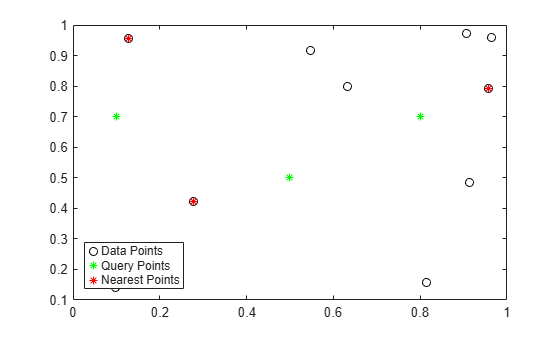
Display the distances.
dist
dist = 3×1

    0.2349
    0.2586
    0.1825
Input Arguments
Output Arguments
References
[1] Barber, C.B., D.P. Dobkin, and H.T. Huhdanpaa. “The Quickhull Algorithm for Convex Hulls.” ACM Transactions on Mathematical Software, Vol. 22, No. 4, Dec. 1996, p 469–483.
Extended Capabilities
Version History
Introduced before R2006a

