delaunayn
R2026bN-D Delaunay triangulation
Description
T = delaunayn( computes
a set of simplices such that no data points of X)X are contained in any
circumspheres of the simplices. The set of simplices forms the Delaunay triangulation.
X is an m-by-n array representing
m points in n-dimensional space.
T is a numt-by-(n+1) array where
each row contains the indices into X of the vertices of the corresponding
simplex.
Examples
This example generates an n-dimensional Delaunay triangulation, where n = 3.
d = [-1 1];
[x,y,z] = meshgrid(d,d,d);  % A cube
x = [x(:);0];
y = [y(:);0];
z = [z(:);0];
% [x,y,z] are corners of a cube plus the center.
X = [x(:) y(:) z(:)];
Tes = delaunayn(X)
Tes = 12×4

     4     3     9     1
     4     9     2     1
     7     9     3     1
     7     5     9     1
     7     9     4     3
     7     8     4     9
     6     2     9     1
     6     9     5     1
     6     4     9     2
     6     4     8     9
     6     9     7     5
     6     8     7     9
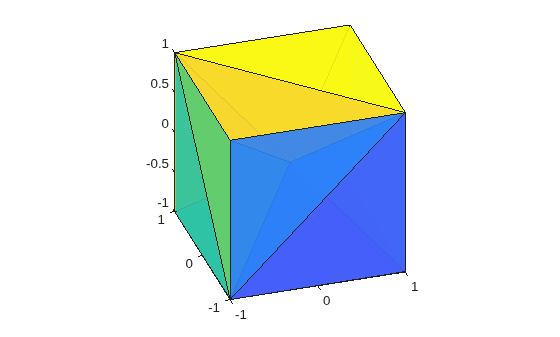
You can use tetramesh to visualize the tetrahedrons that form the corresponding simplex. camorbit rotates the camera position to provide a meaningful view of the figure.
tetramesh(Tes,X);
camorbit(20,0)
Input Arguments
Tips
Algorithms
delaunayn is based on Qhull. For more information, see http://www.qhull.org/. For
copyright information, see http://www.qhull.org/COPYING.txt.
Extended Capabilities
Version History
Introduced before R2006a
See Also
delaunayTriangulation | convhulln | tetramesh | voronoin | camorbit

