polyfit
R2026bPolynomial curve fitting
Syntax
Description
[
provides the option to apply normalization when fitting. If you set
coeffs,fitStats,centerScale]
= polyfit(x,y,n,Normalize=tf)Normalize to true,
polyfit centers x at
0 and scales it to have a standard deviation of
1 according to the transformation In this case, polyfit also returns the
centerScale output as a two-element vector that contains the
center and scaling values, which are mean(x) and
std(x). If you set Normalize to
false, polyfit does not transform
x, and centerScale is a two-element vector
that contains 0 and 1. (since R2026b)
Before R2026b: Normalization is controlled implicitly by the number of output arguments. Returning a third output argument enables normalization automatically. See Version History for more information.
Examples
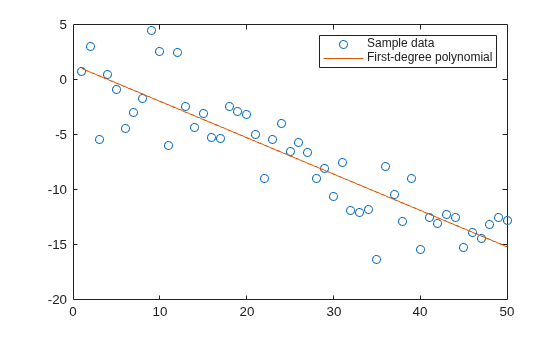
Fit a simple linear regression model to a set of discrete 2-D data points.
Create two vectors of sample data points (x, y). Fit a first-degree polynomial to the data.
x = 1:50;
y = -0.3*x + 2*randn(1,50);
coeffs = polyfit(x,y,1);
Evaluate the fitted polynomial at the points in x. Plot the resulting linear regression model with the data.
f = polyval(coeffs,x);

plot(x,y,"o")
hold on
plot(x,f)
legend("Sample data","First-degree polynomial")
hold off
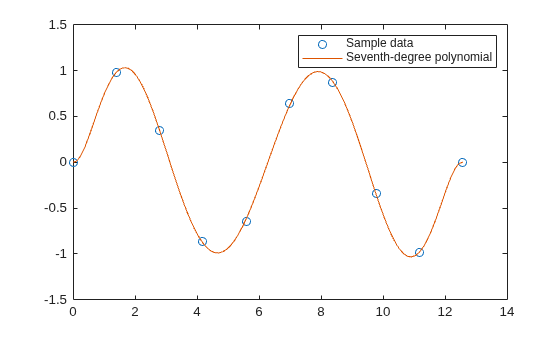
Generate 10 equally spaced points along a sine curve in the interval [0,4*pi].
x = linspace(0,4*pi,10);
y = sin(x);
Fit a seventh-degree polynomial to the data.
coeffs = polyfit(x,y,7);
Evaluate the fitted polynomial on a finer grid and plot the results.
x2 = linspace(0,4*pi);
yfit = polyval(coeffs,x2);

plot(x,y,"o")
hold on
plot(x2,yfit)
legend("Sample data","Seventh-degree polynomial")
hold off
Create a vector of 5 equally spaced points in the interval [0,1], and evaluate at those points.
x = linspace(0,1,5);
y = 1./(1+x);
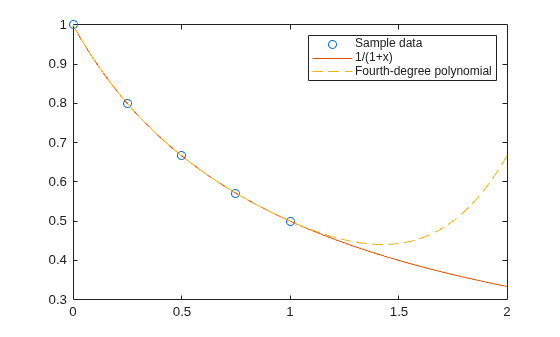
Fit a fourth-degree polynomial to the data. In general, for n points, you can fit a polynomial of degree n-1 to exactly pass through the points.
coeffs = polyfit(x,y,4);
Evaluate the original function and the polynomial fit on a finer grid of points between 0 and 2.
x2 = linspace(0,2);
yfcn = 1./(1+x2);
yfit = polyval(coeffs,x2);
Plot the function values and the polynomial fit in the wider interval [0,2], with the points used to obtain the polynomial fit highlighted as circles. The polynomial fit is good in the original [0,1] interval, but quickly diverges from the original function outside of that interval.
plot(x,y,"o")
hold on
plot(x2,yfcn)
plot(x2,yfit,"--")
legend("Sample data","1/(1+x)","Fourth-degree polynomial")
hold off
First generate a vector of equally spaced points in the interval [0,2.5], and then evaluate erf(x) at those points.
x = (0:0.1:2.5)';
y = erf(x);
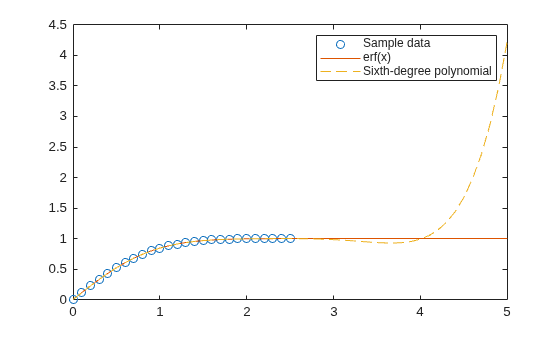
Fit a sixth-degree polynomial to the data.
coeffs = polyfit(x,y,6)
coeffs = 1×7

    0.0084   -0.0983    0.4217   -0.7435    0.1471    1.1064    0.0004
To see how good the fit is, evaluate the polynomial at the data points and generate a table showing the data, fit, and error.
yfit = polyval(coeffs,x);
T = table(x,y,yfit,y-yfit,VariableNames=["X" "Y" "Fit" "FitError"])
T = 26×4 table
     X        Y          Fit         FitError
    ___    _______    __________    ___________

      0          0    0.00044117    -0.00044117
    0.1    0.11246       0.11185     0.00060836
    0.2     0.2227       0.22231     0.00039189
    0.3    0.32863       0.32872    -9.7429e-05
    0.4    0.42839        0.4288    -0.00040661
    0.5     0.5205       0.52093    -0.00042568
    0.6    0.60386       0.60408    -0.00022824
    0.7     0.6778       0.67775     4.6383e-05
    0.8     0.7421       0.74183     0.00026992
    0.9    0.79691       0.79654     0.00036515
      1     0.8427       0.84238      0.0003164
    1.1    0.88021       0.88005     0.00015948
    1.2    0.91031       0.91035    -3.9919e-05
    1.3    0.93401       0.93422      -0.000211
    1.4    0.95229       0.95258    -0.00029933
    1.5    0.96611       0.96639    -0.00028097
      ⋮
In this interval, the interpolated values and the actual values are fairly close. Create a plot to show that outside this interval, the extrapolated values quickly diverge from the actual data.
x2 = (0:0.1:5)';
fcnextrap = erf(x2);
fitextrap = polyval(coeffs,x2);

plot(x,y,"o")
hold on
plot(x2,fcnextrap)
plot(x2,fitextrap,"--")
xlim([0 5])
legend("Sample data","erf(x)","Sixth-degree polynomial")
hold off
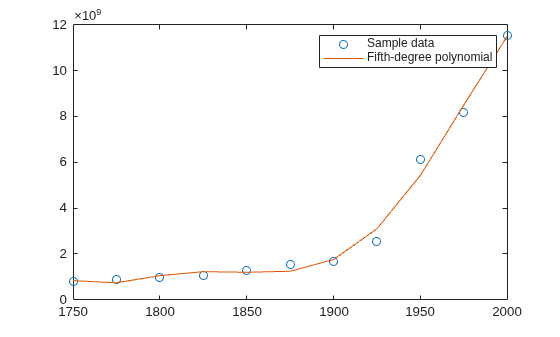
Create sample population data for the years 1750 - 2000 and plot the data points.
x = 1750:25:2000;
y = 1e6*[791 856 978 1050 1262 1544 1650 2532 6122 8170 11560];
Use polyfit to fit a fifth-degree polynomial to the data. You can improve numerical conditioning by normalizing the query vector before fitting a polynomial. This example normalizes the year data and computes a fifth-degree polynomial fit. The function also returns the center and scale used for normalization.
[coeffsNorm,~,centerScale] = polyfit(x,y,5,Normalize=true);
Normalize the query points to the same center and scale, and then evaluate the polynomial by specifying centerScale when calling the polyval function. Then, plot the results.
yfit = polyval(coeffsNorm,x,[],centerScale);

plot(x,y,"o")
hold on
plot(x,yfit)
legend("Sample data","Fifth-degree polynomial")
hold off
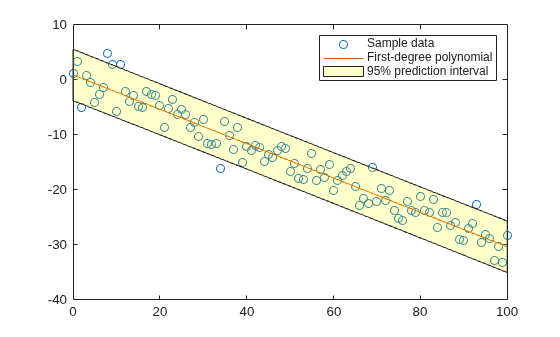
Fit a linear model to a set of data points and plot the results, including an estimate of a 95% prediction interval.
Create a few vectors of sample data points (x, y). Use polyfit to fit a first-degree polynomial to the data. Specify two outputs to return the coefficients for the linear fit as well as the error estimation structure.
x = 0:100;
y = -0.3*x + 2*randn(1,101);
[coeffs,fitStats] = polyfit(x,y,1);
Evaluate the first-degree polynomial at the points in x. Specify the error estimation structure as the third input so that polyval calculates an estimate of the standard error. The standard error estimate is returned in delta.
[yfit,delta] = polyval(coeffs,x,fitStats);
Plot the original data, linear fit, and 95% prediction interval .
plot(x,y,"o")
hold on
plot(x,yfit)

xinterval = [x flip(x)];
yinterval = [yfit-2*delta flip(yfit)+2*delta];
interval = fill(xinterval,yinterval,"yellow",FaceAlpha=0.2);

legend("Sample data","First-degree polynomial","95% prediction interval")
hold off
Input Arguments
Output Arguments
Limitations
In problems with many points, increasing the degree of the polynomial fit using
polyfitdoes not always result in a better fit. High-order polynomials can be oscillatory between the data points, leading to a poorer fit to the data. In those cases, you might use a low-order polynomial fit (which tends to be smoother between points) or a different technique, depending on the problem.Polynomials are unbounded, oscillatory functions by nature. Therefore, they are not well-suited to extrapolating bounded data or monotonic (consistently increasing or consistently decreasing) data.
Algorithms
polyfit uses x to form
a Vandermonde matrix V with n+1 columns
and m = length(x) rows, resulting in the linear
system
which polyfit solves with coeffs = V\y. Since the
columns in the Vandermonde matrix are powers of the vector x, the
condition number of V is often large for high-order fits, resulting
in a singular coefficient matrix. In those cases, specifying
Normalize=true can improve the numerical properties of the system
to produce a more reliable fit.

