polyval
R2026bPolynomial evaluation
Syntax
Description
y = polyval(coeffs,x)coeffs
at each point in x. The vector coeffs has
length n+1 and contains the coefficients of an
nth-degree polynomial p in
descending powers:
The polynomial coefficients in coeffs can be calculated for
different purposes by functions like polyint, polyder, and polyfit, but you can specify any
vector for the coefficients.
To evaluate a polynomial in a matrix sense, use polyvalm instead.
y = polyval(coeffs,x,[],centerScale)[
evaluates the polynomial at the normalized points , where y,delta]
= polyval(coeffs,x,fitStats,centerScale)centerScale is produced by
polyfit. Use the second syntax to evaluate a fitted
polynomial and compute error estimates, with coefficients, fit statistics, and
normalization parameters obtained from polyfit.
Examples
Evaluate the polynomial at the points . The polynomial coefficients can be represented by the vector [3 2 1].
coeffs = [3 2 1];
x = [5 7 9];
y = polyval(coeffs,x)
y = 1×3

    86   162   262
Evaluate the definite integral
Create a vector to represent the polynomial integrand . The term is absent and thus has a coefficient of 0.
coeffs = [3 0 -4 10 -25];
Use polyint to integrate the polynomial using a constant of integration equal to 0.
q = polyint(coeffs)
q = 1×6

    0.6000         0   -1.3333    5.0000  -25.0000         0
Find the value of the integral by evaluating q at the limits of integration.
a = -1;
b = 3;
I = diff(polyval(q,[a b]))
I =
49.0667
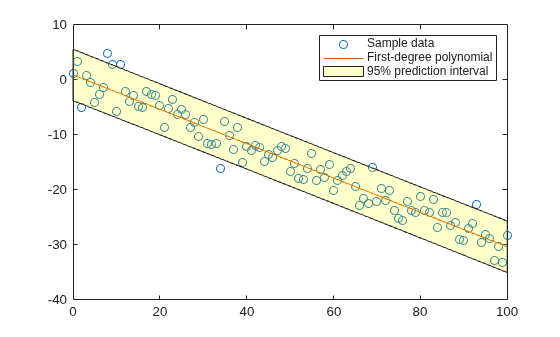
Fit a linear model to a set of data points and plot the results, including an estimate of a 95% prediction interval.
Create a few vectors of sample data points (x, y). Use polyfit to fit a first-degree polynomial to the data. Specify two outputs to return the coefficients for the linear fit as well as the error estimation structure.
x = 0:100;
y = -0.3*x + 2*randn(1,101);
[coeffs,fitStats] = polyfit(x,y,1);
Evaluate the first-degree polynomial at the points in x. Specify the error estimation structure as the third input so that polyval calculates an estimate of the standard error. The standard error estimate is returned in delta.
[yfit,delta] = polyval(coeffs,x,fitStats);
Plot the original data, linear fit, and 95% prediction interval .
plot(x,y,"o")
hold on
plot(x,yfit)

xinterval = [x flip(x)];
yinterval = [yfit-2*delta flip(yfit)+2*delta];
interval = fill(xinterval,yinterval,"yellow",FaceAlpha=0.2);

legend("Sample data","First-degree polynomial","95% prediction interval")
hold off
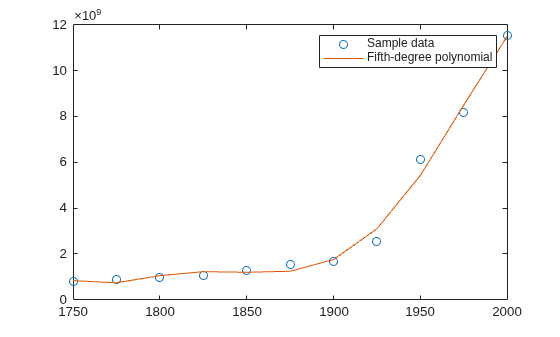
Create sample population data for the years 1750 - 2000 and plot the data points.
x = 1750:25:2000;
y = 1e6*[791 856 978 1050 1262 1544 1650 2532 6122 8170 11560];
Use polyfit to fit a fifth-degree polynomial to the data. You can improve numerical conditioning by normalizing the query vector before fitting a polynomial. This example normalizes the year data and computes a fifth-degree polynomial fit. The function also returns the center and scale used for normalization.
[coeffsNorm,~,centerScale] = polyfit(x,y,5,Normalize=true);
Normalize the query points to the same center and scale, and then evaluate the polynomial by specifying centerScale when calling the polyval function. Then, plot the results.
yfit = polyval(coeffsNorm,x,[],centerScale);

plot(x,y,"o")
hold on
plot(x,yfit)
legend("Sample data","Fifth-degree polynomial")
hold off
Input Arguments
Output Arguments
Extended Capabilities
Version History
Introduced before R2006a

