quiver3
R2026b3-D quiver or vector plot

Syntax
Description
quiver3(
plots arrows with directional components X,Y,Z,U,V,W)U, V,
and W at the Cartesian coordinates specified by
X, Y, and Z. For example,
the first arrow originates from the point X(1),
Y(1), and Z(1), extends in the direction of the
x-axis according to U(1), extends in the direction
of the y-axis according to V(1), and extends in the
direction of the z-axis according to W(1). By
default, the quiver3 function scales the arrow lengths so that they
do not overlap.
quiver3(
plots arrows with directional components specified by Z,U,V,W)U,
V, and W at equally spaced points along the
surface Z.
If
Zis a vector, then the x-coordinates of the arrows range from 1 to the number of elements inZand the y-coordinates are all 1.If
Zis a matrix, then the x-coordinates of the arrows range from 1 to the number of columns inZand the y-coordinates range from 1 to the number of rows inZ.
quiver3(___, adjusts the
length of arrows:scale)
When
scaleis a positive number, thequiver3function automatically adjusts the lengths of arrows so they do not overlap, then stretches them by a factor ofscale. For example, ascaleof 2 doubles the length of arrows, and ascaleof 0.5 halves the length of arrows.When
scaleis'off'or0, such asquiver3(X,Y,Z,U,V,W,'off'), then automatic scaling is disabled.
quiver3(___,
fills the markers specified by LineSpec,'filled')LineSpec.
quiver3(___,
specifies quiver properties using one or more name-value arguments. For a list of
properties, see Quiver Properties. Specify name-value
arguments after all other input arguments. Name-value arguments apply to all of the arrows
in the quiver plot.Name=Value)
q = quiver3(___) returns a Quiver
object. This object is useful for controlling the properties of the quiver plot after
creating it.
Examples
Load sample data that represents air currents over North America. For this example, select a subset of the data.
load wind
X = x(5:10,20:25,6:10);
Y = y(5:10,20:25,6:10);
Z = z(5:10,20:25,6:10);
U = u(5:10,20:25,6:10);
V = v(5:10,20:25,6:10);
W = w(5:10,20:25,6:10);
Create a 3-D quiver plot of the subset you selected. The vectors X, Y, and Z represent the location of the base of each arrow, and U, V, and W represent the directional components of each arrow. By default, the quiver3 function shortens the arrows so they do not overlap. Call axis equal to use equal data unit lengths along each axis. This makes the arrows point in the correct direction.
quiver3(X,Y,Z,U,V,W)
axis equal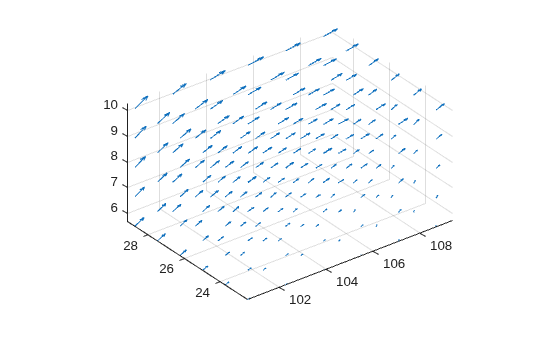
By default, the quiver3 function shortens arrows so they do not overlap. To disable automatic scaling so that arrow lengths are determined entirely by U, V, and W, set the scale argument to 0.
For example, first return the x-, y-, and z-coordinates of a unit sphere with 10-by-10 faces. Calculate the directional components of its surface normals using the surfnorm function. Then, create a 3-D quiver plot with no automatic scaling.
[X,Y,Z] = sphere(10);
[U,V,W] = surfnorm(X,Y,Z);
quiver3(X,Y,Z,U,V,W,0)
axis equal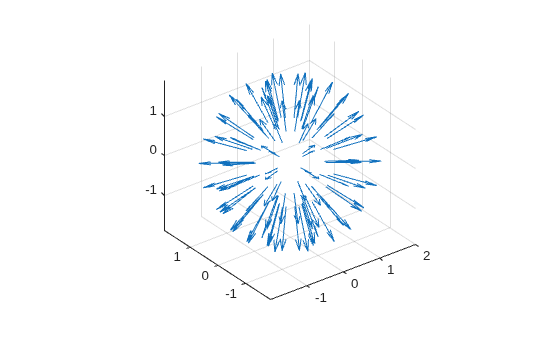
For comparison, create the plot with automatic scaling. Note that the arrows are shorter and do not overlap.
figure
quiver3(X,Y,Z,U,V,W)
axis equal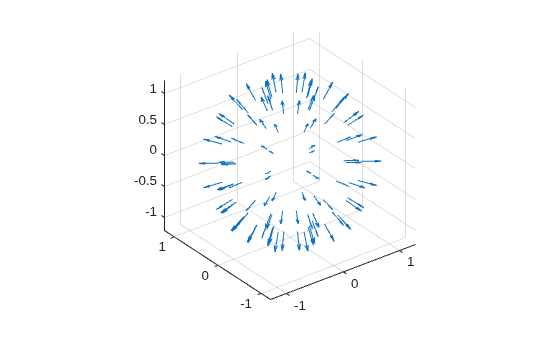
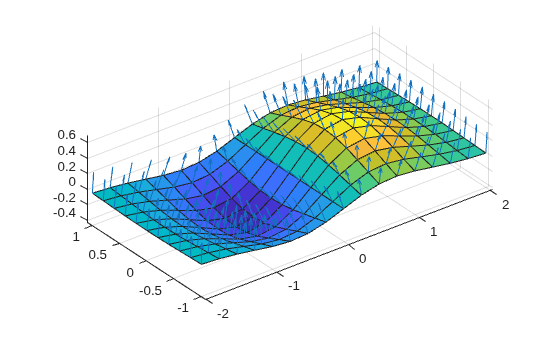
Plot vectors that are normal to the surface defined by the function . Use the quiver3 function to plot the vectors and the surf function to plot the surface.
First, create a grid of x- and y-values that are equally spaced. Use them to calculate z. Then, find the normal vectors.
[X,Y] = meshgrid(-2:0.25:2,-1:0.2:1);
Z = X.*exp(-X.^2 - Y.^2);
[U,V,W] = surfnorm(X,Y,Z);
Display the vectors as a 3-D quiver plot. Then, display the surface in the same axes. Adjust the display so that the vectors appear normal to the surface by calling axis equal.
quiver3(X,Y,Z,U,V,W)
hold on
surf(X,Y,Z)
axis equal
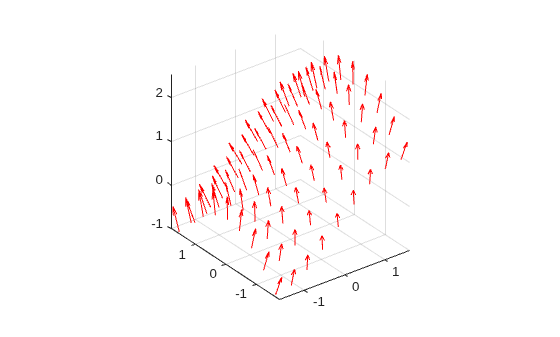
Create a 3-D quiver plot and specify a color for the arrows.
For example, first return the x-, y-, and z- coordinates of a surface. Calculate the directional components of its surface normals using the surfnorm function.
[X,Y] = meshgrid(-pi/2:pi/8:pi/2,-pi/2:pi/8:pi/2);
Z = sin(X) + cos(Y);
[U,V,W] = surfnorm(Z);
Then, create a 3-D quiver plot with red arrows.
quiver3(X,Y,Z,U,V,W,"r")
axis equal
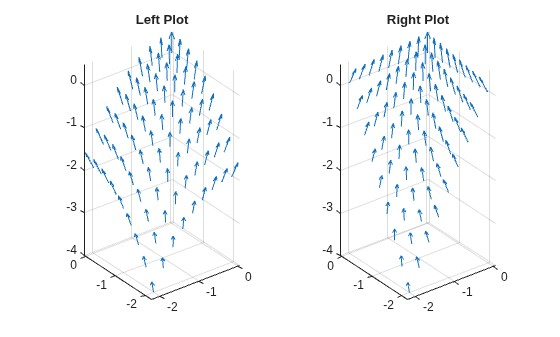
Starting in R2019b, you can display a tiling of plots using the tiledlayout and nexttile functions. Call the tiledlayout function to create a 1-by-2 tiled chart layout. Call the nexttile function to create an axes object and return the object as ax1. Create the left plot by passing ax1 to the quiver3 function. Add a title to the plot by passing the axes to the title function. Repeat the process to create the right plot.
[X,Y] = meshgrid(-2:0.25:0,-2:0.25:0);
Z1 = -0.5*(X.^2 + Y.^2);
[U1,V1,W1] = surfnorm(Z1);
Z2 = -X.*Y;
[U2,V2,W2] = surfnorm(Z2);

tiledlayout(1,2)

% Left plot
ax1 = nexttile;
quiver3(ax1,X,Y,Z1,U1,V1,W1)
axis equal
title(ax1,"Left Plot")

% Right plot
ax2 = nexttile;
quiver3(ax2,X,Y,Z2,U2,V2,W2)
axis equal
title(ax2,"Right Plot")
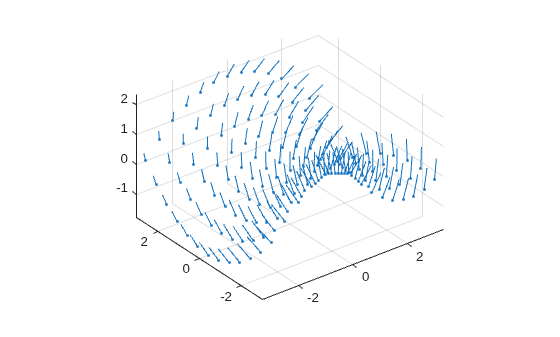
Create a 3-D quiver plot and return the quiver object. Then, remove the arrowheads and add dot markers at the base of each arrow.
[X,Y] = meshgrid(-3:0.5:3,-3:0.5:3);
Z = 0.2*(Y.^2 - X.^2);
[U,V,W] = surfnorm(Z);

q = quiver3(X,Y,Z,U,V,W);
axis equal
q.ShowArrowHead = 'off';
q.Marker = ".";
Input Arguments
x-coordinates of the bases of arrows, specified as a scalar, a vector, or a matrix.
If X and Y are vectors and
Z, U, V, and
W are matrices, then quiver3 expands
X and Y into matrices. In this case,
size(Z), size(U), size(V),
and size(W) must equal [length(Y) length(X)]. For
more information about expanding vectors into matrices, see meshgrid.
If X and Y are matrices, then
X,
Y, Z, U,
V, and W must be the same size.
y-coordinates of the bases of arrows, specified as a scalar, a vector, or a matrix.
If X and Y are vectors and
Z, U, V, and
W are matrices, then quiver3 expands
X and Y into matrices. In this case,
size(Z), size(U), size(V),
and size(W) must equal [length(Y) length(X)]. For
more information about expanding vectors into matrices, see meshgrid.
If X and Y are matrices, then
X,
Y, Z, U,
V, and W must be the same size.
Line style, marker, and color, specified as a character vector or string containing symbols. The symbols can appear in any order. You do not need to specify all three characteristics (line style, marker, and color).
If you specify a marker using LineSpec, then
quiver3 does not display arrowheads. To specify a marker and
display arrowheads, set the Marker property instead.
Example: "--or" is a red dashed line with circle
markers
| Line Style | Description | Resulting Line |
|---|---|---|
"-" | Solid line |
|
"--" | Dashed line |
|
":" | Dotted line |
|
"-." | Dash-dotted line |
|


| Marker | Description | Resulting Marker |
|---|---|---|
"o" | Circle |
|
"+" | Plus sign |
|
"*" | Asterisk |
|
"." | Point |
|
"x" | Cross |
|
"_" | Horizontal line |
|
"|" | Vertical line |
|
"square" | Square |
|
"diamond" | Diamond |
|
"^" | Upward-pointing triangle |
|
"v" | Downward-pointing triangle |
|
">" | Right-pointing triangle |
|
"<" | Left-pointing triangle |
|
"pentagram" | Pentagram |
|
"hexagram" | Hexagram |
|


| Color Name | Short Name | RGB Triplet | Appearance |
|---|---|---|---|
"red" | "r" | [1 0 0] |
|
"green" | "g" | [0 1 0] |
|
"blue" | "b" | [0 0 1] |
|
"cyan"
| "c" | [0 1 1] |
|
"magenta" | "m" | [1 0 1] |
|
"yellow" | "y" | [1 1 0] |
|
"black" | "k" | [0 0 0] |
|
"white" | "w" | [1 1 1] |
|


Arrow scaling factor, specified as a nonnegative number or 'off'.
By default, the quiver3 function automatically scales the arrows so
they do not overlap. The quiver3 function applies the scaling
factor after it automatically scales the arrows.
Specifying scale is the same as setting the
AutoScaleFactor property of the quiver object. For example,
specifying scale as 2 doubles the length of the
arrows. Specifying scale as 0.5 halves the
length of the arrows.
To disable automatic scaling, specify scale as
'off' or 0. When you specify either of these
values, the AutoScale property of the quiver object is set to
'off' and the length of the arrow is determined entirely by
U, V, and W.
Target axes, specified as an Axes object. If you do not specify the
axes, then the quiver3 function uses the current axes.
Name-Value Arguments
Tips
To create a 3-D quiver plot using cylindrical or spherical coordinates, first convert them
to Cartesian coordinates using the pol2cart or sph2cart function.
Extended Capabilities
Version History
Introduced before R2006a

