How Deep Learning HDL Toolbox Compiles the GRU Layer
R2026bTo manually deploy a gated recurrent unit (GRU) layer network to your target board, learn
how the compile method of
the dlhdl.Workflow object interprets the GRU layer in a network. When you
compile GRU layers, Deep Learning HDL Toolbox™ splits the GRU layer into components, generates instructions and memory offsets
for those components.
The compile method of the dlhdl.Workflow translates the:
Reset gate into
gru.rhInput and update gate into
gru.wh
Then, the compile method:
Inserts a depth concatenation layer between the layer preceding the GRU layer and the gates of the GRU layer.
Generates sigmoid, hyperbolic tangent, multiplication, and addition layers to replace the mathematical operations of the GRU layer.
When the network has multiple stacked GRU layers, the compile method uses
the GRU layer name when generating the translated instructions. For example, if the network
has three stacked GRU layers named gru_1, gru_2, and
gru_3, the output of the compile method is
gru_1.wh, gru_1.rh, gru_2.wh,
gru_2.rh, and so on. The compiler schedules the different components of
the GRU layer, such as fully connected layers, sigmoid blocks, tanh blocks, and so on, into
different kernels in the deep learning processor architecture.
This image shows how the compile method translates the GRU layer:
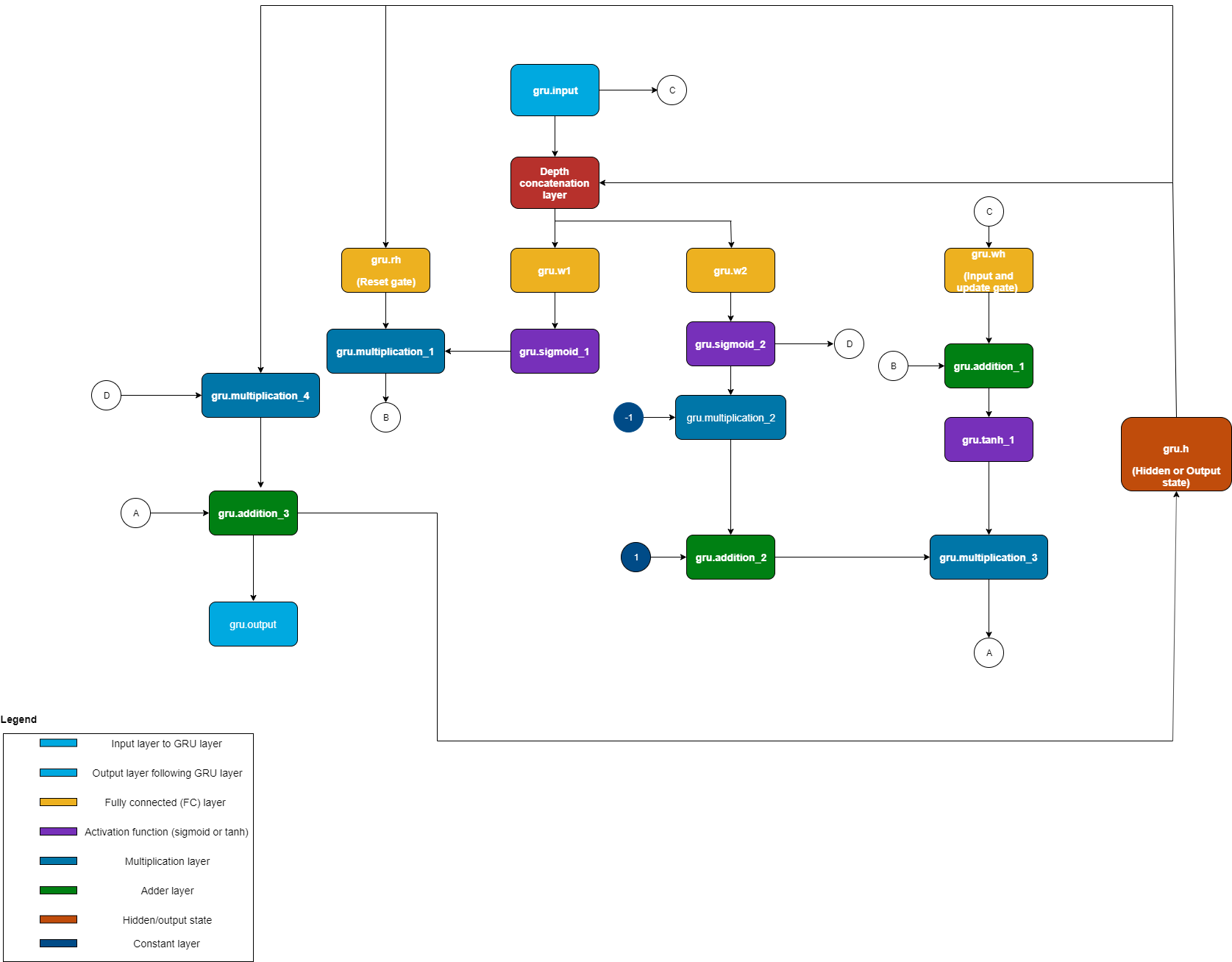
To see the output of the compile method for a GRU layer network, see
Run Sequence Forecasting Using a GRU Layer on an FPGA.
Deep Learning Processor Configuration for Recurrent Layers
When you want to generate a custom bitstream for deploying a recurrent layer network, you must:
Set the fully connected (FC) layer
ModuleGenerationproperty toon.In the custom module, set the
Addition,Multiplication,TanhLayer, andSigmoidproperties toon. If the LSTM layer, state activation function is set torelu, set theTanhLayerproperty tooff.
This code output shows you the deep learning processor configuration for a shipping recurrent layer bitstream.
hPC = dlhdl.ProcessorConfig(Bitstream = "zcu102_lstm_single")hPC =
Processing Module "conv"
ModuleGeneration: 'off'
Processing Module "fc"
ModuleGeneration: 'on'
SoftmaxBlockGeneration: 'off'
GELUBlockGeneration: 'off'
FCThreadNumber: 4
InputMemorySize: 25088
OutputMemorySize: 4096
Processing Module "custom"
ModuleGeneration: 'on'
Addition: 'on'
MishLayer: 'off'
Multiplication: 'on'
Resize2D: 'off'
Sigmoid: 'on'
SwishLayer: 'off'
TanhLayer: 'on'
InputMemorySize: 40
OutputMemorySize: 120
Processor Top Level Properties
RunTimeControl: 'register'
RunTimeStatus: 'register'
InputStreamControl: 'register'
OutputStreamControl: 'register'
SetupControl: 'register'
ProcessorDataType: 'single'
UseVendorLibrary: 'on'
LayerNormalizationBlock: 'off'
System Level Properties
TargetPlatform: 'Xilinx Zynq UltraScale+ MPSoC ZCU102 Evaluation Kit'
TargetFrequency: 250
SynthesisTool: 'Xilinx Vivado'
ReferenceDesign: 'AXI-Stream DDR Memory Access : 3-AXIM'
SynthesisToolChipFamily: 'Zynq UltraScale+'
SynthesisToolDeviceName: 'xczu9eg-ffvb1156-2-e'
SynthesisToolPackageName: ''
SynthesisToolSpeedValue: ''
