dfilt.fftfir
Discrete-time, overlap-add, FIR filter
Syntax
Hd = dfilt.fftfir(b,len)

Hd = dfilt.fftfir(b)

Hd = dfilt.fftfir
Description
This object uses the overlap-add method of block FIR filtering, which is very efficient for streaming data.
Hd = dfilt.fftfir(b,len) returns
a discrete-time, FFT, FIR filter, Hd, with numerator
coefficients, b and block length, len.
The block length is the number of input points to use for each overlap-add
computation.
Hd = dfilt.fftfir(b) returns
a discrete-time, FFT, FIR filter, Hd, with numerator
coefficients, b and block length, len=100.
Hd = dfilt.fftfir returns
a default, discrete-time, FFT, FIR filter, Hd,
with the numerator b=1 and block length, len=100.
This filter passes the input through to the output unchanged.
Note
When you use a dfilt.fftfir object to filter,
the input signal length must be an integer multiple of the object's
block length, len. The resulting number of FFT
points = (filter length + the block length - 1). The filter is most
efficient if the number of FFT points is a power of 2.
The fftfir uses an overlap-add block processing
algorithm, which is represented as follows,
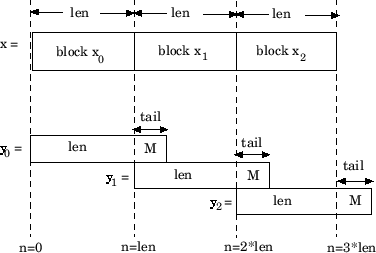
where len is the block length and M is
the length of the numerator-1, (length(b)-1),
which is also the number of states. The output of each convolution
is a block that is longer than the input block by a tail of (length(b)-1)
samples. These tails overlap the next block and are added to it.
The states reported by dfilt.fftfir are the tails
of the final convolution.
Examples
Create an FFT FIR discrete-time filter with coefficients from a 30th order lowpass equiripple design:
b = firpm(30,[0 .1 .2 .5]*2,[1 1 0 0]);
Hd = dfilt.fftfir(b);
% To obtain frequency domain coefficients
% used in filtering
Coeffs = fftcoeffs(Hd);
Version History
Introduced in R2011a

