CT Integrator
R2026bCT Integrator block
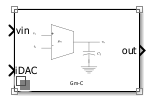
To add a block to a model, double-click the canvas and start typing the block name. Then, select the block from the list.
Libraries:
Mixed-Signal Blockset /
ADC /
Building Blocks
Description
Use the CT Integrator block to accurately model the behavior of continuous-time delta-sigma modulators (CT DSMs). The block provides anti-aliasing benefits and supports higher bandwidth and lower power designs compared to its discrete-time counterpart. The block allows you to choose from three different implementation models: Gm-MC (OTA coupled with Miller capacitance), Gm-C (OTA-C integrator), and active-RC integrator.
To support realistic system‑level simulation, the block includes a range of practical circuit‑level non-idealities such as finite gain or bandwidth, pole-zero behavior, saturation, slew-rate limiting, distortion, and optional thermal and amplifier noises.
Ports
Input
Input voltage, specified as a scalar in V.
Dependencies
To enable this port, set the Type of integrator parameter
to Gm-C or Gm-MC.
Data Types: double
Input current from a DAC, specified as a scalar in A.
Dependencies
To enable this port, set the Type of integrator parameter
to Gm-C.
Data Types: double
Input voltage, specified as a scalar in V.
Dependencies
To enable this port, set the Type of integrator parameter
to Active-RC and Number of inputs
to 1, 2, or
3.
Data Types: double
Input voltage, specified as a scalar in V.
Dependencies
To enable this port, set the Type of integrator parameter
to Active-RC and Number of inputs
to 2 or 3.
Data Types: double
Input voltage, specified as a scalar in V.
Dependencies
To enable this port, set the Type of integrator parameter
to Active-RC and Number of inputs
to 3.
Data Types: double
Output
Integrator output voltage, returned as a scalar in V.
Data Types: double
Parameters
To edit block parameters interactively, use the Property Inspector. From the Simulink® Toolstrip, on the Simulation tab, in the Prepare gallery, select Property Inspector.
Integrator implementation model, specified as:
Gm-MC— Miller capacitance integrator with switchable poles, signal distortion, and optional thermal white noise.Gm-C— OTA‑C integrator with one or two-pole configuration, output saturation, signal distortion, and optional thermal noise.Active-RC— Active-RC integrator with fixed two-pole configuration, transistor-level effects, signal distortion, and amplifier and resistor noise.
Programmatic Use
Block parameter:
TypeofCTIntegrator |
| Type: character vector |
Values:
Gm-MC | Gm-C |
Active-RC |
Default:
Gm-C |
Data Types: char
Distortion mode, specified as:
| Distortion Mode | Integrator Type | Parameter Name | |
|---|---|---|---|
None | No nonlinearity model | Gm-C | distortionModegmC |
| Gm-MC | DistortionMode | ||
| Active-RC | distMode | ||
Large-signal | Saturation-based nonlinearity model | Gm-C | distortionModegmC |
| Saturation-based nonlinearity model | Gm-MC | DistortionMode | |
| Gain-compression and slew-rate based nonlinearity model | Active-RC | distMode | |
Small-signal | Polynomial nonlinearity model | Gm-C | distortionModegmC |
| Gm-MC | DistortionMode | ||
| Active-RC | distMode |
Programmatic Use
Block parameter:
distortionModegmC |
| Type: character vector |
Values:
None | Large-signal |
Small-signal |
Default:
Small-signal |
Data Types: char
Number of poles in the integrator transfer function. For Gm-C and Gm-MC type
integrators, you can switch the number of poles between
Single and Double. For the
active-RC integrator, the number of poles is fixed at two.
Dependencies
To enable this parameter, set Type of integrator to
Gm-C or Gm-MC.
Programmatic Use
Block parameter:
NumPole |
| Type: character vector |
Values:
Single | Double |
Default:
Single |
Location of the second parasitic pole when you select the double-pole model,
specified as a positive real scalar. For Gm-C type integrator, the default value is
1e5. For Gm-MC type integrator, the default value is
1e11.
Dependencies
To enable this parameter, set Type of integrator to
Gm-C or Gm-MC.
Programmatic Use
Block parameter:
HighFreqPolegmC | HighFreqPole |
| Type: character vector |
| Values: positive real scalar |
Default:
1e5 |
Data Types: double
Lower and upper output voltage clamp values, specified as a 2-element vector.
Dependencies
To enable this parameter, set Type of integrator to
Gm-C.
Programmatic Use
Block parameter:
OutputSatLim |
| Type: character vector |
| Values: 2-element vector |
Default:
[-5,5] |
Data Types: double
Option to include thermal noise in the integrator model. By default, this option is deselected.
Dependencies
To enable this parameter, set Type of integrator to
Gm-C.
Lower and upper input voltage clamp values for large-signal distortion, specified as a 2-element vector.
Dependencies
To enable this parameter, set Type of integrator to
Gm-C and Distortion mode to
Large-signal.
Programmatic Use
Block parameter:
InputSatLim |
| Type: character vector |
| Values: 2-element vector |
Default:
[-3,3] |
Data Types: double
Second-order polynomial distortion coefficient, specified as a real scalar.
Dependencies
To enable this parameter, set Type of integrator to
Gm-C or Gm-MC and
Distortion mode to
Small-signal.
Programmatic Use
Block parameter:
NonlinCoeff2gmC | NonlinCoeff2 |
| Type: character vector |
| Values: real scalar |
Default:
0 |
Data Types: double
Third-order polynomial distortion coefficient, specified as a real scalar.
Dependencies
To enable this parameter, set Type of integrator to
Gm-C or Gm-MC and
Distortion mode to
Small-signal.
Programmatic Use
Block parameter:
NonlinCoeff3gmC | NonlinCoeff3 |
| Type: character vector |
| Values: real scalar |
Default:
1e-3 | 1e-5 |
Data Types: double
Absolute temperature used to calculate the thermal noise power, specified as a positive real scalar.
Dependencies
To enable this parameter, set Type of integrator to
Gm-C or Gm-MC.
Programmatic Use
Block parameter:
OperatingTemp | OpTemp |
| Type: character vector |
| Values: positive real scalar |
Default:
300 |
Data Types: double
Sampling rate of the discrete noise source driving the continuous-time model, specified as a positive real scalar.
Dependencies
To enable this parameter, set Type of integrator to
Gm-C.
Programmatic Use
Block parameter:
SamplingFrequency |
| Type: character vector |
| Values: positive real scalar |
Default:
1e4 |
Data Types: double
OTA
Transconductance of the OTA setting in the integrator gain, specified as a positive real scalar.
Dependencies
To enable this parameter, set Type of integrator to
Gm-C.
Programmatic Use
Block parameter:
Transconductance |
| Type: character vector |
| Values: positive real scalar |
Default:
1e-3 |
Data Types: double
DC voltage gain of the transconductor, specified as a positive real scalar.
Dependencies
To enable this parameter, set Type of integrator to
Gm-C.
Programmatic Use
Block parameter:
DCVoltageGain |
| Type: character vector |
| Values: positive real scalar |
Default:
1e3 |
Data Types: double
Capacitance
Integration capacitance, specified as a positive real scalar. The block uses this value to determine the time-constant τ.
Dependencies
To enable this parameter, set Type of integrator to
Gm-C.
Programmatic Use
Block parameter:
IntegratorCap |
| Type: character vector |
| Values: positive real scalar |
Default:
5e-12 |
Data Types: double
Fractional random mismatch applied to the integrator capacitance, specified as a nonnegative real scalar.
Dependencies
To enable this parameter, set Type of integrator to
Gm-C.
Programmatic Use
Block parameter:
CapTolerance |
| Type: character vector |
| Values: nonnegative real scalar |
Default:
0.1 |
Data Types: double
Lower and upper output clamp values for the integrator, specified as a 2-element vector.
Dependencies
To enable this parameter, set Type of integrator to
Gm-MC.
Programmatic Use
Block parameter:
IntegrationLimits |
| Type: character vector |
| Values: 2-element vector |
Default:
[-5,5] |
Data Types: double
OTA transconductance for calculating the small-signal distortion coefficients, specified as a positive real scalar.
Dependencies
To enable this parameter, set Type of integrator to
Gm-MC and Distortion mode to
Small-signal.
Programmatic Use
Block parameter:
Gm |
| Type: character vector |
| Values: positive real scalar |
Default:
2e-4 |
Data Types: double
Positive output voltage clamp for the large-signal distortion model, specified as a positive real scalar in V.
Dependencies
To enable this parameter, set Type of integrator to
Gm-MC and Distortion mode to
Large-signal.
Programmatic Use
Block parameter:
VoltageLimPos |
| Type: character vector |
| Values: positive real scalar |
Default:
3 |
Data Types: double
Negative output voltage clamp for the large-signal distortion model, specified as a real scalar in V.
Dependencies
To enable this parameter, set Type of integrator to
Gm-MC and Distortion mode to
Large-signal.
Programmatic Use
Block parameter:
VoltageLimNeg |
| Type: character vector |
| Values: real scalar |
Default:
-3 |
Data Types: double
Option to include thermal noise in the integrator model. By default, this option is deselected.
Dependencies
To enable this parameter, set Type of integrator to
Gm-MC.
Amplifiers
Finite DC voltage gain of the OTA, specified as a positive real scalar.
Dependencies
To enable this parameter, set Type of integrator to
Gm-MC.
Programmatic Use
Block parameter:
DCGainOTA |
| Type: character vector |
| Values: positive real scalar |
Default:
10 |
Data Types: double
Finite DC voltage gain of the operational amplifier on the feedback path, specified as a positive real scalar.
Dependencies
To enable this parameter, set Type of integrator to
Gm-MC.
Programmatic Use
Block parameter:
DCGainOpAmp |
| Type: character vector |
| Values: positive real scalar |
Default:
100 |
Data Types: double
Unity gain bandwidth of the first and second amplifier stages, specified as a 2-element vector.
Dependencies
To enable this parameter, set Type of integrator to
Gm-MC.
Programmatic Use
Block parameter:
UnityGainBW |
| Type: character vector |
| Values: 2-element vector |
Default:
[1e3, 1e4] |
Data Types: double
Capacitance
Fractional mismatch of the parasitic capacitance from its nominal value, specified as a nonnegative real scalar.
Dependencies
To enable this parameter, set Type of integrator to
Gm-MC.
Programmatic Use
Block parameter:
EpsilonCapPar |
| Type: character vector |
| Values: nonnegative real scalar |
Default:
1e-2 |
Data Types: double
Fractional mismatch of the load capacitance from its nominal value, specified as a nonnegative real scalar.
Dependencies
To enable this parameter, set Type of integrator to
Gm-MC.
Programmatic Use
Block parameter:
EpsilonCapLoad |
| Type: character vector |
| Values: nonnegative real scalar |
Default:
1e-2 |
Data Types: double
Fractional mismatch in the ratio of integration capacitance to parasitic capacitance, specified as a nonnegative real scalar.
Dependencies
To enable this parameter, set Type of integrator to
Gm-MC.
Programmatic Use
Block parameter:
EpsilonCapRatio |
| Type: character vector |
| Values: nonnegative real scalar |
Default:
5e-2 |
Data Types: double
Number of signal input ports for the active-RC integrator. You can have between one and three input ports.
Dependencies
To enable this parameter, set Type of integrator to
Active-RC.
Programmatic Use
Block parameter:
numInputs |
| Type: character vector |
Values:
1 | 2 |
3 |
Default:
2 |
Data Types: double
Positive rail supply voltage, specified as a positive real scalar in V. The block uses this parameter to calculate the internal bias and swing limits.
Dependencies
To enable this parameter, set Type of integrator to
Active-RC.
Programmatic Use
Block parameter:
supplyVoltage |
| Type: character vector |
| Values: positive real scalar |
Default:
1.8 |
Data Types: double
Option to include amplifier noise for the active-RC integrator. By default, this option is deselected.
Dependencies
To enable this parameter, set Type of integrator to
Active-RC.
Second-order input polynomial distortion coefficient for the small-signal mode, specified as a real scalar
Dependencies
To enable this parameter, set Type of integrator to
Active-RC and Distortion mode to
Small-signal.
Programmatic Use
Block parameter:
secondOrderDistortionCoeff |
| Type: character vector |
| Values: real scalar |
Default:
0 |
Data Types: double
Third-order input polynomial distortion coefficient for the small-signal mode, specified as a real scalar
Dependencies
To enable this parameter, set Type of integrator to
Active-RC and Distortion mode to
Small-signal.
Programmatic Use
Block parameter:
thirdOrderDistortionCoeff |
| Type: character vector |
| Values: real scalar |
Default:
0 |
Data Types: double
Option to include resistor noise for the active-RC integrator. By default, this option is deselected.
Dependencies
To enable this parameter, set Type of integrator to
Active-RC.
Random number generator seed for the noise sources, specified as a positive real scalar
Dependencies
To enable this parameter, set Type of integrator to
Active-RC and either Enable amplifier
noise or Enable resistor noise parameter to
on.
Programmatic Use
Block parameter:
noiseSeed |
| Type: character vector |
| Values: positive real scalar |
Default:
123 |
Data Types: double
Sampling rate of the discrete noise source driving the continuous-time integrator, specified as a positive real scalar.
Dependencies
To enable this parameter, set Type of integrator to
Active-RC and either Enable amplifier
noise or Enable resistor noise parameter to
on.
Programmatic Use
Block parameter:
samplingFreq |
| Type: character vector |
| Values: positive real scalar |
Default:
1e-3 |
Data Types: double
Amplifier
Open loop DC gain of the operational amplifier, specified as a positive real scalar in dB.
Dependencies
To enable this parameter, set Type of integrator to
Active-RC.
Programmatic Use
Block parameter:
opAmpDCGain |
| Type: character vector |
| Values: positive real scalar |
Default:
80 |
Data Types: double
Frequency at which the op-amp gain drops to unity or 0 dB, specified as a positive real scalar in Hz.
Dependencies
To enable this parameter, set Type of integrator to
Active-RC.
Programmatic Use
Block parameter:
opAmpUnityGainBandwidth |
| Type: character vector |
| Values: positive real scalar |
Default:
500e6 |
Data Types: double
Maximum single-ended output voltage swing of the amplifier, specified as a nonnegative real scalar.
Dependencies
To enable this parameter, set Type of integrator to
Active-RC.
Programmatic Use
Block parameter:
maxOutputSwing |
| Type: character vector |
| Values: nonnegative real scalar |
Default:
1 |
Data Types: double
Phase margin at the unity gain frequency, specified as a positive real scalar in degrees. It affects the stability and pole placement.
Dependencies
To enable this parameter, set Type of integrator to
Active-RC.
Programmatic Use
Block parameter:
phaseMargin |
| Type: character vector |
| Values: positive real scalar |
Default:
60 |
Data Types: double
Maximum rate of change of the amplifier output voltage, specified as a positive real scalar.
Dependencies
To enable this parameter, set Type of integrator to
Active-RC.
Programmatic Use
Block parameter:
slewRate |
| Type: character vector |
| Values: positive real scalar |
Default:
4e11 |
Data Types: double
RC Network
Input resistor values for each integrator branch, specified as a scalar, a 2-element vector, or a 3-element vector.
Dependencies
To enable this parameter, set Type of integrator to
Active-RC.
Programmatic Use
Block parameter:
integratingRes |
| Type: character vector |
| Values: scalar | 2-element vector | 3-element vector |
Default:
[1e4, 1e4, 1e4] |
Data Types: double
RC time constant that sets the unity gain frequency, specified as a positive real scalar in seconds.
Dependencies
To enable this parameter, set Type of integrator to
Active-RC.
Programmatic Use
Block parameter:
integratorTimeConstants |
| Type: character vector |
| Values: positive real scalar |
Default:
5e-08 |
Data Types: double
Output load resistance of the second amplifier stage, specified as a positive real scalar.
Dependencies
To enable this parameter, set Type of integrator to
Active-RC.
Programmatic Use
Block parameter:
loadRes |
| Type: character vector |
| Values: positive real scalar |
Default:
5e3 |
Data Types: double
Parasitic capacitance at the amplifier input, specified as a nonnegative real scalar in F.
Dependencies
To enable this parameter, set Type of integrator to
Active-RC.
Programmatic Use
Block parameter:
parasiticInputCap |
| Type: character vector |
| Values: nonnegative real scalar |
Default:
1e-14 |
Data Types: double
Parasitic capacitance at the amplifier output, specified as a nonnegative real scalar in F.
Dependencies
To enable this parameter, set Type of integrator to
Active-RC.
Programmatic Use
Block parameter:
parasiticOutputCap |
| Type: character vector |
| Values: nonnegative real scalar |
Default:
1e-14 |
Data Types: double
Transistor Effects
MOSFET channel length modulation parameter, specified as a nonnegative real scalar. It affects the output resistance.
Dependencies
To enable this parameter, set Type of integrator to
Active-RC.
Programmatic Use
Block parameter:
channelLenModulation |
| Type: character vector |
| Values: nonnegative real scalar |
Default:
0.02 |
Data Types: double
Gate-to-source voltage above threshold for bias transistors, specified as a positive real scalar in V.
Dependencies
To enable this parameter, set Type of integrator to
Active-RC.
Programmatic Use
Block parameter:
gateODVoltage |
| Type: character vector |
| Values: positive real scalar |
Default:
0.3 |
Data Types: double
Minimum drain-to-source voltage to keep the current source transistors in saturation, specified as a positive real scalar.
Dependencies
To enable this parameter, set Type of integrator to
Active-RC.
Programmatic Use
Block parameter:
currentSourceSaturationVoltage |
| Type: character vector |
| Values: positive real scalar |
Default:
0.3 |
Data Types: double
Version History
Introduced in R2026b
MATLAB Command
You clicked a link that corresponds to this MATLAB command:
Run the command by entering it in the MATLAB Command Window. Web browsers do not support MATLAB commands.


Select a Web Site
Choose a web site to get translated content where available and see local events and offers. Based on your location, we recommend that you select: .
You can also select a web site from the following list
How to Get Best Site Performance
Select the China site (in Chinese or English) for best site performance. Other MathWorks country sites are not optimized for visits from your location.
Americas
- América Latina (Español)
- Canada (English)
- United States (English)
Europe
- Belgium (English)
- Denmark (English)
- Deutschland (Deutsch)
- España (Español)
- Finland (English)
- France (Français)
- Ireland (English)
- Italia (Italiano)
- Luxembourg (English)
- Netherlands (English)
- Norway (English)
- Österreich (Deutsch)
- Portugal (English)
- Sweden (English)
- Switzerland
- United Kingdom (English)