hisl_0061: Unique identifiers for clarity
R2026bUse unique identifiers for signals and across scopes within a chart
Usage: High-Integrity System Modeling
Guideline ID: hisl_0061
Rules
| hisl_0061: Unique identifiers for clarity | |
|---|---|
| A | When developing a model, use unique identifiers for Simulink® signals. Rationale Improve readability of a graphical model and mapping between identifiers in the model and generated code. Verification Check Stateflow charts for uniquely defined data objects (Simulink Check) |
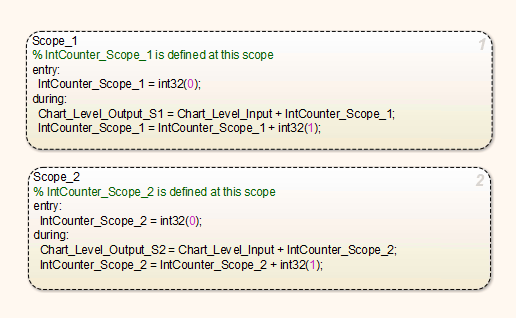
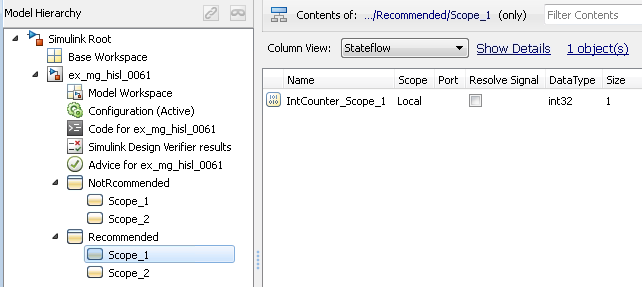
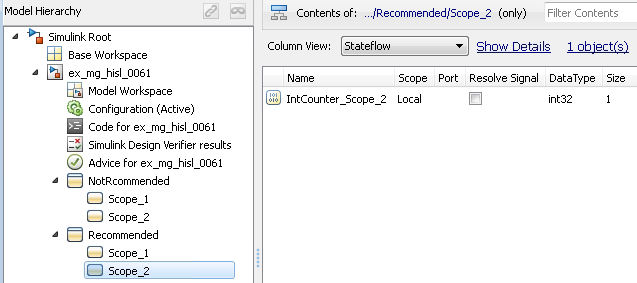
| B | When developing a model, define unique identifiers across multiple scopes within a chart. Rationale Improve readability of a graphical model and mapping between identifiers in the model and generated code. Verification Check Stateflow charts for uniquely defined data objects (Simulink Check) Example — Correct To
clarify the model, create unique identifiers. In the following
example, state
The identifier
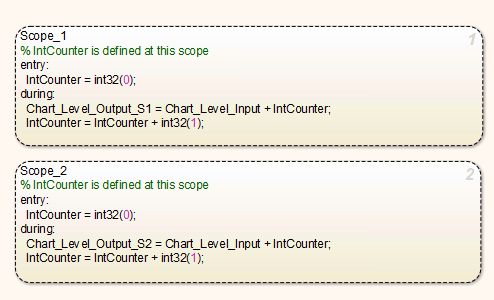
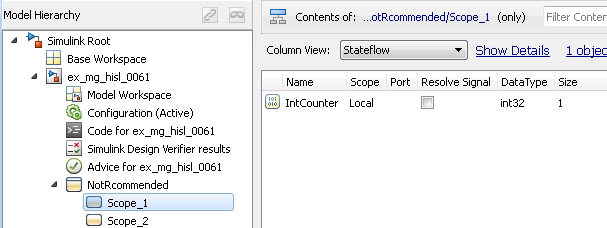
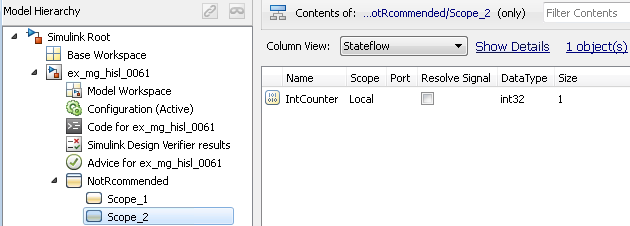
Example — Incorrect In
the following example, two states
The identifier
|
Tips
The code generator resolves conflicts between identifiers so that symbols in the generated code are unique. The process is called name mangling.
Industry Standards
DO-331, Section MB.6.3.2.b 'Low-level requirements are accurate and consistent'
IEC 61508-3, Table A.3 (2) 'Strongly typed programming language'
IEC 61508-3, Table A.3 (3) - Language subset
IEC 61508-3, Table A.4 (5) - Design and coding standards
IEC 62304, 5.5.3 - Software Unit acceptance criteria
ISO 26262-6, Table 1 (1b) - 'Use of language subsets'
ISO 26262-6, Table 1 (1e) - 'Use of well-trusted design principles'
ISO 26262-6, Table 1 (1f) - 'Use of unambiguous graphical representation'
ISO 26262-6, Table 1 (1g) - 'Use of style guides'
ISO 26262-6, Table 1 (1h) - 'Use of naming conventions'
ISO 26262-6, Table 6 (1d) - 'No multiple use of variable names'
EN 50128, Table A.3 (1) - Defensive Programming
EN 50128, Table A.4 (8) 'Strongly Typed Programming Language'
EN 50128, Table A.4 (11) - 'Language Subset'
EN 50128, Table A.12 (1) 'Coding Standard'
EN 50128, Table A.12 (2) 'Coding Style Guide'
EN 50657, Table A.3 (1) - Defensive Programming
EN 50657, Table A.4 (8) 'Strongly Typed Programming Language'
EN 50657, Table A.4 (11) - 'Language Subset'
EN 50657, Table A.12 (1) 'Coding Standard'
EN 50657, Table A.12 (2) 'Coding Style Guide'
EN 50716, Table A.3 (1) - Defensive Programming
EN 50716, Table A.12 (1) 'Coding Standard'
EN 50716, Table A.12 (2) 'Coding Style Guide'
Version History
Introduced in R2010bSee Also
Model Configuration Set Customization (Embedded Coder)

