griddata
R2026bInterpolate 2-D or 3-D scattered data
Syntax
Description
vq = griddata(x,y,v,xq,yq)(x,y,v). The griddata function
interpolates the surface at the query points specified by (xq,yq) and
returns the interpolated values, vq. The surface
always passes through the data points defined by x and y.
Examples
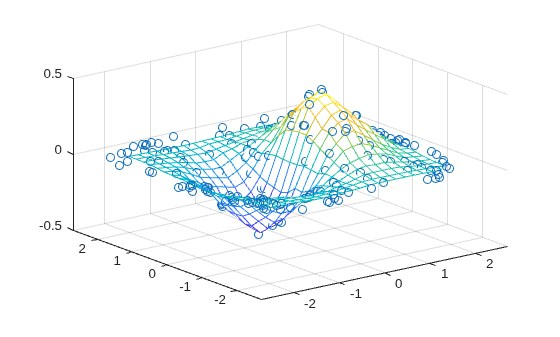
Interpolate random scattered data on a uniform grid of query points.
Sample a function at 200 random points between -2.5 and 2.5. The resulting vectors x, y, and v contain scattered sample points and data values at those points.
rng default
xy = -2.5 + 5*rand([200 2]);
x = xy(:,1);
y = xy(:,2);
v = x.*exp(-x.^2-y.^2);
Define a grid of query points and interpolate the scattered data over the grid.
[xq,yq] = meshgrid(-2:.2:2, -2:.2:2);
vq = griddata(x,y,v,xq,yq);
Plot the gridded data as a mesh and the scattered data as dots.
mesh(xq,yq,vq)
hold on
plot3(x,y,v,"o")
xlim([-2.7 2.7])
ylim([-2.7 2.7])
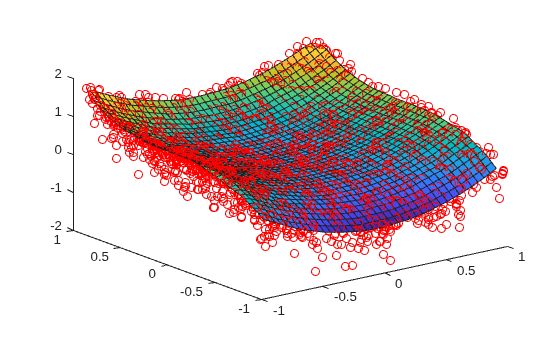
Interpolate a 3-D slice of a 4-D function that is sampled at randomly scattered points.
Sample a 4-D function at 2500 random points between -1 and 1. The vectors x, y, and z contain the nonuniform sample points.
x = 2*rand(2500,1) - 1;
y = 2*rand(2500,1) - 1;
z = 2*rand(2500,1) - 1;
v = x.^2 + y.^3 - z.^4;
Create a grid with xy points in the range [-1, 1], and set . Interpolating on this grid of 2-D query points (xq,yq,0) produces a 3-D interpolated slice (xq,yq,0,vq) of the 4-D data set (x,y,z,v).
d = -1:0.05:1;
[xq,yq,zq] = meshgrid(d,d,0);
Interpolate the scattered data on the grid. Plot the results.
vq = griddata(x,y,z,v,xq,yq,zq);
plot3(x,y,v,"ro")
hold on
surf(xq,yq,vq)
hold off
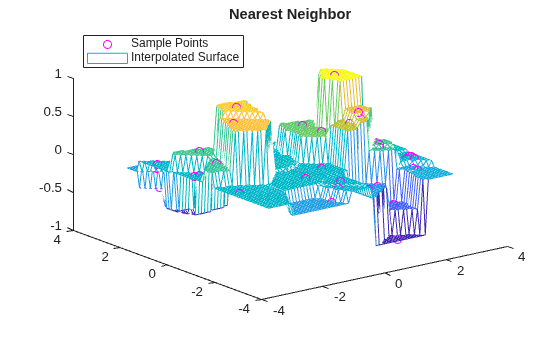
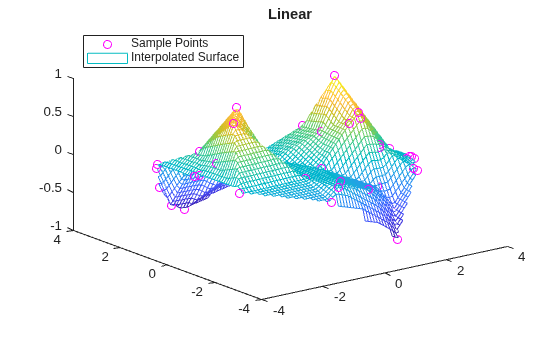
Compare the results of several different interpolation algorithms offered by griddata.
Create a sample data set of 50 scattered points. The number of points is artificially small to highlight the differences between the interpolation methods.
x = -3 + 6*rand(50,1);
y = -3 + 6*rand(50,1);
v = sin(x).^4 .* cos(y);
Create a grid of query points.
[xq,yq] = meshgrid(-3:0.1:3);
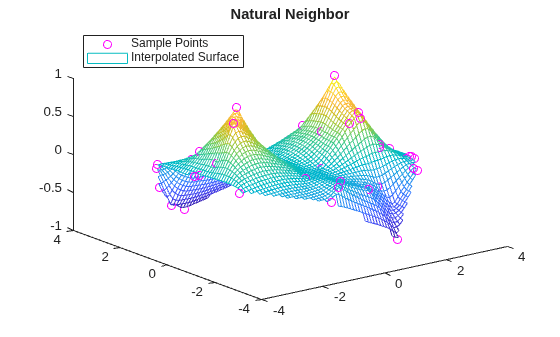
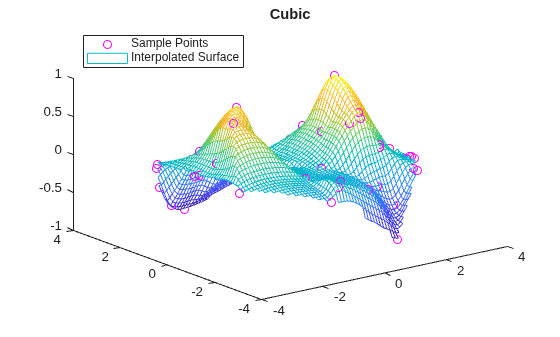
Interpolate the sample data using the "nearest", "linear", "natural", and "cubic" methods. Plot the results for comparison.
z1 = griddata(x,y,v,xq,yq,"nearest");
plot3(x,y,v,"mo")
hold on
mesh(xq,yq,z1)
title("Nearest Neighbor")
legend("Sample Points","Interpolated Surface","Location","NorthWest")
z2 = griddata(x,y,v,xq,yq,"linear");
figure
plot3(x,y,v,"mo")
hold on
mesh(xq,yq,z2)
title("Linear")
legend("Sample Points","Interpolated Surface","Location","NorthWest")
z3 = griddata(x,y,v,xq,yq,"natural");
figure
plot3(x,y,v,"mo")
hold on
mesh(xq,yq,z3)
title("Natural Neighbor")
legend("Sample Points","Interpolated Surface","Location","NorthWest")
z4 = griddata(x,y,v,xq,yq,"cubic");
figure
plot3(x,y,v,"mo")
hold on
mesh(xq,yq,z4)
title("Cubic")
legend("Sample Points","Interpolated Surface","Location","NorthWest")
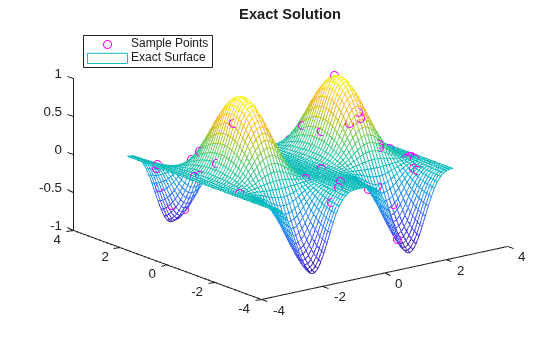
Plot the exact solution.
figure
plot3(x,y,v,"mo")
hold on
mesh(xq,yq,sin(xq).^4 .* cos(yq))
title("Exact Solution")
legend("Sample Points","Exact Surface","Location","NorthWest")
Input Arguments
Output Arguments
Tips
Scattered data interpolation with
griddatauses a Delaunay triangulation of the data, so can be sensitive to scaling issues inx,y, andz. When this occurs, you can usenormalizeto rescale the data and improve the results. See Normalize Data with Differing Magnitudes for more information.
Extended Capabilities
Version History
Introduced before R2006a

