structfun
R2026bApply function to each field of scalar structure
Description
A = structfun(func,S)func to each field of scalar structure
S, one field at a time. structfun then
concatenates the outputs from func into the column vector
A. The input argument func is a function
handle to a function that takes one input argument and returns a scalar. The output
from func must always be the same data type to use this syntax.
If the function outputs have different data types, you must set the
UniformOutput name-value argument to
false. The number of elements in A equals the
number of fields in S.
You cannot specify the order in which structfun calculates the
elements of A or rely on them being done in any particular
order.
A = structfun(func,S,Name,Value)func with additional options specified by one or more
Name,Value pair arguments. For example, to return output
values in a structure, specify 'UniformOutput',false. You can
return A as a structure when func returns
values that cannot be concatenated into an array. The returned structure has the
same fields as S.
[A1,...,Am] = structfun(___) returns multiple
output arrays A1,...,Am when func returns
m output values. func can return output
arguments that have different data types, but the data type of each output must be
the same each time func is called. You can use this syntax with
any of the input arguments of the previous syntaxes.
Examples
Create a scalar structure with fields that contain numeric arrays of different sizes.
S.f1 = 1:10;
S.f2 = [2; 4; 6];
S.f3 = []
S = struct with fields:
    f1: [1 2 3 4 5 6 7 8 9 10]
    f2: [3×1 double]
    f3: []
Calculate the mean of each numeric array, and return the means in an array.
A = structfun(@mean,S)
A = 3×1

    5.5000
    4.0000
       NaN
Create a scalar structure in which each field contains an array of random numbers.
S.X = rand(1,10);
S.Y = rand(1,10);
S.Z = rand(1,10)
S = struct with fields:
    X: [0.8147 0.9058 0.1270 0.9134 0.6324 0.0975 0.2785 0.5469 0.9575 0.9649]
    Y: [0.1576 0.9706 0.9572 0.4854 0.8003 0.1419 0.4218 0.9157 0.7922 0.9595]
    Z: [0.6557 0.0357 0.8491 0.9340 0.6787 0.7577 0.7431 0.3922 0.6555 0.1712]
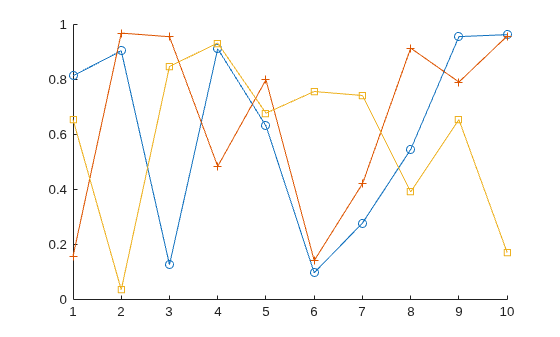
Plot the arrays. Return an array of chart line objects from the plot function and use them to add different markers to each set of data points. structfun can return arrays of any data type, so long as objects of that data type can be concatenated.
figure
hold on
p = structfun(@plot,S);
p(1).Marker = 'o';
p(2).Marker = '+';
p(3).Marker = 's';
hold off
Create a scalar structure with fields that contain matrices.
S.f1 = 1:10;
S.f2 = [2 3; 4 5; 6 7];
S.f3 = rand(4,4)
S = struct with fields:
    f1: [1 2 3 4 5 6 7 8 9 10]
    f2: [3×2 double]
    f3: [4×4 double]
Calculate the means of each matrix. mean returns vectors containing the mean of each column, so the means cannot be returned as an array. To return the means in a structure, specify the 'UniformOutput',false name-value pair.
A = structfun(@mean,S,'UniformOutput',false)A = struct with fields:
f1: 5.5000
f2: [4 5]
f3: [0.6902 0.3888 0.7627 0.5962]
Create a scalar structure.
S.f1 = 1:10;
S.f2 = [2 3; 4 5; 6 7];
S.f3 = rand(4,4)
S = struct with fields:
    f1: [1 2 3 4 5 6 7 8 9 10]
    f2: [3×2 double]
    f3: [4×4 double]
Calculate the sizes of each array in S. The number of rows and columns are each in 3-by-1 numeric arrays.
[nrows,ncols] = structfun(@size,S)
nrows = 3×1

     1
     3
     4
ncols = 3×1

    10
     2
     4
Input Arguments
Name-Value Arguments
Output Arguments
Extended Capabilities
Version History
Introduced before R2006a
See Also
cellfun | arrayfun | cell2mat | spfun | splitapply

