pre6GEqualizeMMSE
Description
Add-On Required: This feature requires the 6G Exploration Library for 5G Toolbox add-on.
[
performs minimum mean squared error (MMSE) equalization on received symbols
eqSym,csi] = pre6GEqualizeMMSE(rxSym,Hest,nVar)rxSym for 6G research and prototyping. The function uses the
channel estimate Hest and noise variance estimate
nVar to recover the transmitted symbols
eqSym and returns soft channel state information
csi.
Examples
Create carrier, reference signal, and physical channel configuration objects.
carrier = pre6GCarrierConfig; carrier.NSizeGrid = 52; carrier.SubcarrierSpacing = 30; rs = pre6GReferenceSignalConfig; rs.PRBSet = 0:carrier.NSizeGrid-1; rs.SubcarrierLocations = 0:2:11; rs.SymbolLocations = [0 7]; ch = pre6GPhysicalChannelConfig; ch.PRBSet = 0:carrier.NSizeGrid-1;
Get reference signal indices for the configurations and specify that the physical channel does not use those indices.
rsInd = pre6GReferenceSignalIndices(carrier,rs); ch.ReservedRE = rsInd-1;
Get physical channel indices and resource information. Generate a random codeword and create physical channel symbols.
[chInd,chInfo] = pre6GPhysicalChannelIndices(carrier,ch);
cw = randi([0 1],chInfo.G,1,"int8");
sym = pre6GPhysicalChannel(carrier,ch,cw);Create an empty resource grid. Map the physical channel and reference signal symbols onto the grid.
rsSym = pre6GReferenceSignal(carrier,rs); txGrid = pre6GResourceGrid(carrier,1); txGrid(rsInd) = rsSym; txGrid(chInd) = sym;
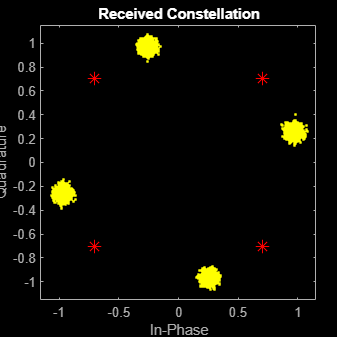
OFDM-modulate the resource grid. Pass the time-domain waveform through a channel that adds AWGN with a signal-to-noise ratio of 25 dB and applies a 60° phase rotation.
txWaveform = pre6GOFDMModulate(carrier,txGrid);
snr = 25;
H = exp(1i*pi/3);
rxWaveform = awgn(H*txWaveform,snr,"measured");OFDM-demodulate the waveform. Perform practical channel estimation using the reference signal configuration.
rxGrid = pre6GOFDMDemodulate(carrier,rxWaveform); [H,nVar] = pre6GChannelEstimate(carrier,rs,rxGrid);
Prepare the channel estimate for use in equalization by reshaping it to a column vector with length equal to the number of resource elements and extracting the indices that correspond to data symbols. Extract the data symbols from the received resource grid.
hestVector = reshape(H,[numel(H) 1]); Hest = hestVector(chInd(:,1)); rxSym = rxGrid(chInd);
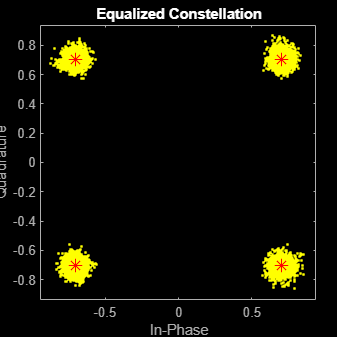
Equalize the received symbols. Plot the received constellation before and after equalization.
[eqSym,csi] = pre6GEqualizeMMSE(rxSym,Hest,nVar); refConst = qammod(0:3,4,UnitAveragePower=true); scatterplot(rxSym,1,0); hold on; plot(real(refConst),imag(refConst),"r*",MarkerSize=10); hold off; title("Received Constellation");
scatterplot(eqSym,1,0); hold on; plot(real(refConst),imag(refConst),"r*",MarkerSize=10); hold off; title("Equalized Constellation");
Input Arguments
Received symbols, specified as an NRE-by-R-by-B complex array, where:
NRE is the number of resource elements extracted from the received resource grid.
R is the number of receive antennas.
B is the batch size.
The number of resource elements and receive antennas must match the first and
second dimensions of Hest.
Data Types: single | double
Complex Number Support: Yes
Channel estimate, specified as an NRE-by-R-by-P-by-B complex array, where:
NRE is the number of resource elements.
R is the number of receive antennas.
P is the number of layers (transmit streams).
B is the batch size.
The channel estimate contains the estimated channel frequency response at the
resource element locations corresponding to rxSym. Obtain the
channel estimate by using the pre6GChannelEstimate or pre6GPerfectChannelEstimate function.
Data Types: single | double
Complex Number Support: Yes
Noise variance estimate, specified as one of these values:
Nonnegative scalar — The function applies the same noise variance to all batch elements.
1-by-B nonnegative row vector — The function applies a separate noise variance to each batch element, where B is the batch size.
Obtain the noise variance estimate from the second output of the pre6GChannelEstimate function.
Data Types: single | double
Output Arguments
Equalized symbols, returned as an NRE-by-P-by-B complex array, where NRE is the number of resource elements, P is the number of layers, and B is the batch size.
The MMSE equalizer estimates the transmitted symbols by minimizing the mean squared error between the estimated and actual transmitted signals.
Data Types: single | double
Complex Number Support: Yes
Soft channel state information, returned as an
NRE-by-P-by-B
real-valued array. Each element quantifies the reliability of the corresponding
equalized symbol in eqSym. Use csi to
compute soft bits for channel decoding by scaling log-likelihood ratios.
Data Types: single | double
Extended Capabilities
The pre6GEqualizeMMSE function
fully supports GPU arrays. To run the function on a GPU, specify the input data as a gpuArray (Parallel Computing Toolbox). For more information, see Run MATLAB Functions on a GPU (Parallel Computing Toolbox).
Version History
Introduced in R2026a
See Also
Functions
Objects
MATLAB Command
You clicked a link that corresponds to this MATLAB command:
Run the command by entering it in the MATLAB Command Window. Web browsers do not support MATLAB commands.
Select a Web Site
Choose a web site to get translated content where available and see local events and offers. Based on your location, we recommend that you select: .
You can also select a web site from the following list
How to Get Best Site Performance
Select the China site (in Chinese or English) for best site performance. Other MathWorks country sites are not optimized for visits from your location.
Americas
- América Latina (Español)
- Canada (English)
- United States (English)
Europe
- Belgium (English)
- Denmark (English)
- Deutschland (Deutsch)
- España (Español)
- Finland (English)
- France (Français)
- Ireland (English)
- Italia (Italiano)
- Luxembourg (English)
- Netherlands (English)
- Norway (English)
- Österreich (Deutsch)
- Portugal (English)
- Sweden (English)
- Switzerland
- United Kingdom (English)