trainlm
R2026b(To be removed) Levenberg-Marquardt backpropagation
trainlm will be removed in a future release. For more information,
see Transition Legacy Neural Network Code to dlnetwork Workflows.
For advice on updating your code, see Version History.
Description
net.trainFcn = 'trainlm' sets the network
trainFcn property.
[
trains the network with trainedNet,tr] = train(net,...)trainlm.
trainlm is a network training function that updates weight and
bias values according to Levenberg-Marquardt optimization.
trainlm is often the fastest backpropagation algorithm in the
toolbox, and is highly recommended as a first-choice supervised algorithm, although
it does require more memory than other algorithms.
Training occurs according to trainlm training parameters, shown
here with their default values:
net.trainParam.epochs— Maximum number of epochs to train. The default value is 1000.net.trainParam.goal— Performance goal. The default value is 0.net.trainParam.max_fail— Maximum validation failures. The default value is6.net.trainParam.min_grad— Minimum performance gradient. The default value is1e-7.net.trainParam.mu— Initialmu. The default value is 0.001.net.trainParam.mu_dec— Decrease factor formu. The default value is 0.1.net.trainParam.mu_inc— Increase factor formu. The default value is 10.net.trainParam.mu_max— Maximum value formu. The default value is1e10.net.trainParam.show— Epochs between displays (NaNfor no displays). The default value is 25.net.trainParam.showCommandLine— Generate command-line output. The default value isfalse.net.trainParam.showWindow— Show training GUI. The default value istrue.net.trainParam.time— Maximum time to train in seconds. The default value isinf.
Validation vectors are used to stop training early if the network performance on
the validation vectors fails to improve or remains the same for
max_fail epochs in a row. Test vectors are used as a further
check that the network is generalizing well, but do not have any effect on
training.
Examples
This example shows how to train a neural network using the trainlm train function.
Here a neural network is trained to predict body fat percentages.
[x, t] = bodyfat_dataset;
net = feedforwardnet(10, 'trainlm');
net = train(net, x, t);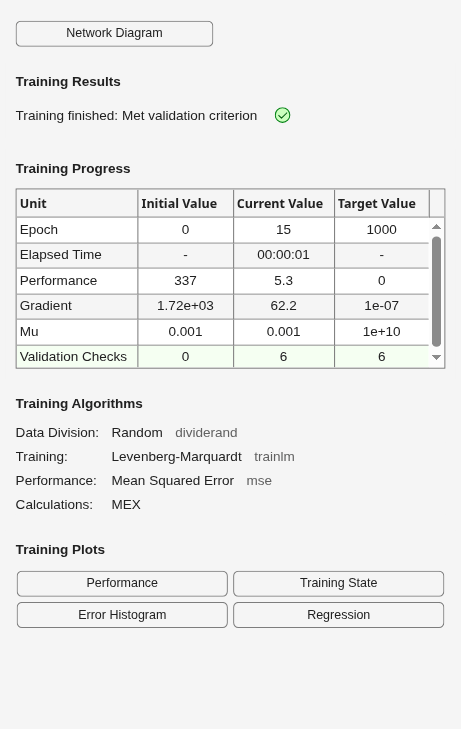
y = net(x);
Input Arguments
Output Arguments
Limitations
This function uses the Jacobian for calculations, which assumes that performance is a
mean or sum of squared errors. Therefore, networks trained with this function must use
either the mse or sse performance function.
More About
Algorithms
trainlm supports training with validation and test vectors if the
network’s NET.divideFcn property is set to a data division function.
Validation vectors are used to stop training early if the network performance on the
validation vectors fails to improve or remains the same for max_fail
epochs in a row. Test vectors are used as a further check that the network is
generalizing well, but do not have any effect on training.
trainlm can train any network as long as its weight, net input, and
transfer functions have derivative functions.
Backpropagation is used to calculate the Jacobian jX of performance
perf with respect to the weight and bias variables
X. Each variable is adjusted according to
Levenberg-Marquardt,
jj = jX * jX
je = jX * E
dX = -(jj+I*mu) \ je
where E is all errors and I is the identity
matrix.
The adaptive value mu is increased by mu_inc
until the change above results in a reduced performance value. The change is then made
to the network and mu is decreased by
mu_dec.
Training stops when any of these conditions occurs:
The maximum number of
epochs(repetitions) is reached.The maximum amount of
timeis exceeded.Performance is minimized to the
goal.The performance gradient falls below
min_grad.muexceedsmu_max.Validation performance (validation error) has increased more than
max_failtimes since the last time it decreased (when using validation).
Version History
Introduced before R2006aSee Also
Time Series
Modeler | fitrnet (Statistics and Machine Learning Toolbox) | fitcnet (Statistics and Machine Learning Toolbox) | trainnet | trainingOptions | dlnetwork

