FIR Rate Converter
R2026bUpsample, filter, and downsample input signal
FIR Rate Converter block
To add a block to a model, double-click the canvas and start typing the block name. Then, select the block from the list.
Libraries:
DSP HDL Toolbox /
Filtering
Description
The FIR Rate Converter block upsamples, filters, and downsamples input signals. It is optimized for HDL code generation and operates on one sample of each channel at a time. The block implements a polyphase architecture to avoid unnecessary arithmetic operations and high intermediate sample rates.
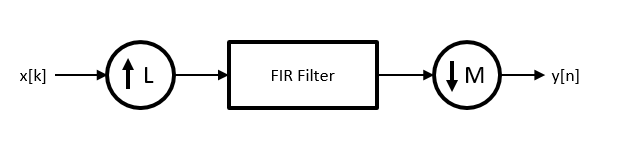
The block upsamples the input signal by an integer factor of L, applies it to a FIR filter, and downsamples the input signal by an integer factor of M.
You can use the input and output control ports to pace the flow of samples. In the default configuration, the block uses input and output valid control signals. For additional flow control, you can enable a ready output signal.
The ready output port indicates that the block can accept a new input
data sample. When L ≥ M, you can use the
ready signal to achieve continuous output data samples. If you apply a
new input sample each time the block returns ready signal as
1, the block returns a valid output sample on every time step.
When you disable the ready port, you can apply a valid data sample
only every ceil(L/M) time steps. For example, if:
L/M = 4/5, then you can apply a new input sample on every time step.
L/M = 3/2, then you can apply a new input sample on every other time step.
Note
You can also generate HDL code for this hardware-optimized algorithm, without creating a Simulink® model, by using the DSP HDL IP Designer app. The app provides the same interface and configuration options as the Simulink block.
Examples
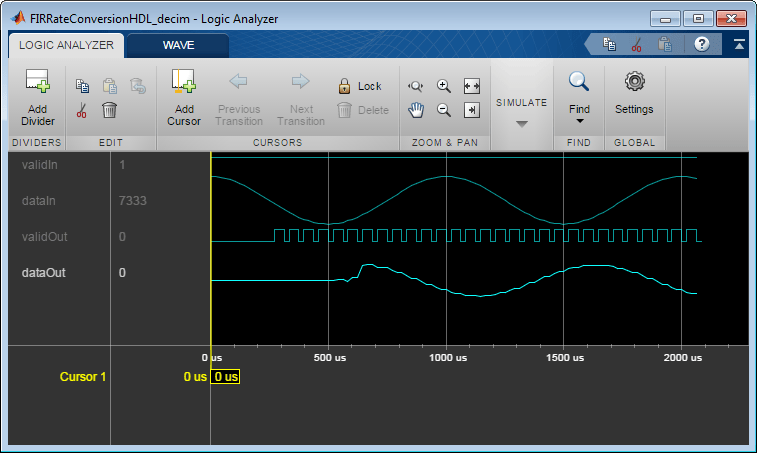
Downsample a Signal
Convert a signal from 48 kHz to 32 kHz using the FIR Rate Converter block.
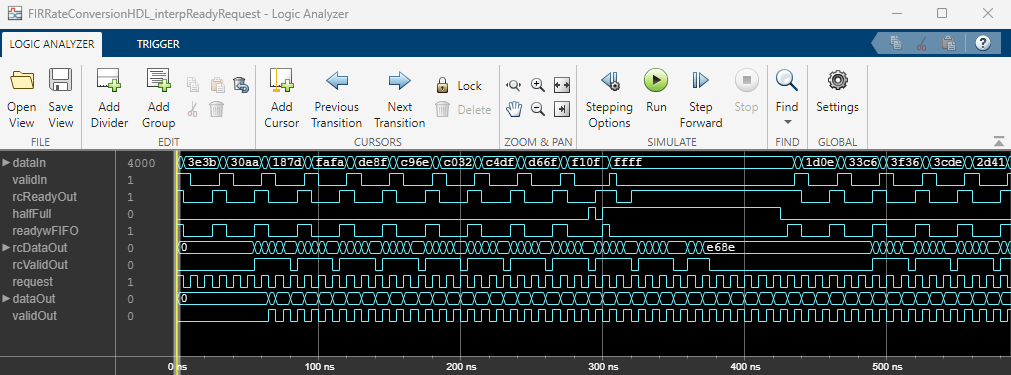
Control Data Rate Using Ready Signal
Implement backpressure and regulate output rate in an interpolator system.
Ports
Input
Output
Parameters
Algorithms
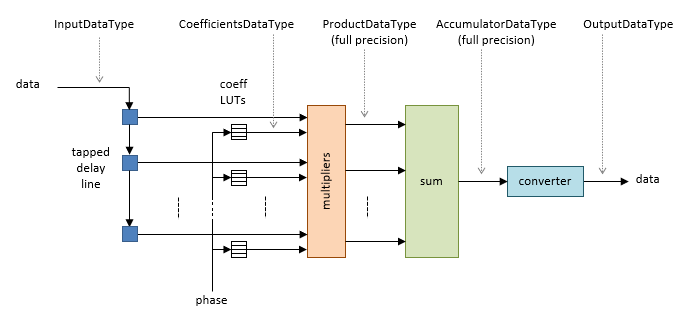
The FIR Rate Converter block implements a fully parallel polyphase filter architecture. The diagram shows where the block casts the data types based on your configuration.