Minimizing an Expensive Optimization Problem Using Parallel Computing Toolbox
R2026bThis example shows how to speed up the minimization of an expensive optimization problem using functions in Optimization Toolbox™ and Global Optimization Toolbox. In the first part of the example solve the optimization problem by evaluating functions in a serial fashion, and in the second part of the example, solve the same problem using the parallel for loop (parfor) feature by evaluating functions in parallel. Compare the time taken by the optimization function in both cases.
Expensive Optimization Problem
For the purpose of this example, solve a problem in four variables, where the objective and constraint functions are made artificially expensive by pausing.
function f = expensive_objfun(x)
% Simulate an expensive function by pausing.
pause(0.1)
% Evaluate objective function.
f = exp(x(1)) * (4*x(3)^2 + 2*x(4)^2 + 4*x(1)*x(2) + 2*x(2) + 1);
end

function [ineqnonlin,eqnonlin] = expensive_confun(x)
% Simulate an expensive function by pausing.
pause(0.1);
% Evaluate constraints.
ineqnonlin = [1.5 + x(1)*x(2)*x(3) - x(1) - x(2) - x(4);
     -x(1)*x(2) + x(4) - 10];
% No nonlinear equality constraints:
eqnonlin = [];
end
Minimize Using fmincon
Measure the time taken by fmincon in serial so that you can compare it to the parallel time.
startPoint = [-1 1 1 -1];
options = optimoptions("fmincon",Display="iter");
startTime = tic;
xsol = fmincon(@expensive_objfun,startPoint,[],[],[],[],[],[],@expensive_confun,options);
                                            First-order      Norm of
 Iter F-count            f(x)  Feasibility   optimality         step   Wall-Clock Time
    0       5    1.839397e+00    1.500e+00    3.211e+00                   1.279887 sec
    1      11   -9.760099e-01    3.708e+00    7.902e-01    2.362e+00      2.601500 sec
    2      16   -1.480976e+00    0.000e+00    8.344e-01    1.069e+00      3.720673 sec
    3      21   -2.601599e+00    0.000e+00    8.390e-01    1.218e+00      4.811719 sec
    4      29   -2.823630e+00    0.000e+00    2.598e+00    1.118e+00      6.557058 sec
    5      34   -3.905338e+00    0.000e+00    1.210e+00    7.302e-01      7.644621 sec
    6      39   -6.212992e+00    3.934e-01    7.372e-01    2.405e+00      8.744090 sec
    7      44   -5.948761e+00    0.000e+00    1.784e+00    1.905e+00      9.823068 sec
    8      49   -6.940062e+00    1.233e-02    7.668e-01    7.553e-01     10.931370 sec
    9      54   -6.973887e+00    0.000e+00    2.549e-01    3.920e-01     12.034141 sec
   10      59   -7.142993e+00    0.000e+00    1.903e-01    4.735e-01     13.130811 sec
   11      64   -7.155325e+00    0.000e+00    1.365e-01    2.626e-01     14.232188 sec
   12      69   -7.179122e+00    0.000e+00    6.336e-02    9.115e-02     15.326799 sec
   13      74   -7.180116e+00    0.000e+00    1.069e-03    4.670e-02     16.439166 sec
   14      79   -7.180409e+00    0.000e+00    7.799e-04    2.815e-03     17.542941 sec
   15      84   -7.180410e+00    0.000e+00    6.607e-06    3.121e-04     18.646592 sec

Local minimum found that satisfies the constraints.

Optimization completed because the objective function is non-decreasing in
feasible directions, to within the value of the optimality tolerance,
and constraints are satisfied to within the value of the constraint tolerance.

<stopping criteria details>
time_fmincon_sequential = toc(startTime);
fprintf("Serial fmincon optimization takes %g seconds.\n",time_fmincon_sequential);
Serial fmincon optimization takes 18.6909 seconds.
Minimize Using Genetic Algorithm
Since ga usually takes many more function evaluations than fmincon, remove the expensive constraint from this problem and perform unconstrained optimization instead. Pass empty matrices [] for constraints. In addition, limit the maximum number of generations to 15 for ga so that ga can terminate in a reasonable amount of time. Measure the time taken by ga so that you can compare it to the parallel ga evaluation. Note that running ga requires Global Optimization Toolbox.
rng default % for reproducibility
try
    gaAvailable = false;
    nvar = 4;
    gaoptions = optimoptions("ga",MaxGenerations=15,Display="iter");
    startTime = tic;
gasol = ga(@expensive_objfun,nvar,[],[],[],[],[],[],[],gaoptions);
    time_ga_sequential = toc(startTime);
fprintf("Serial ga optimization takes %g seconds.\n",time_ga_sequential);
    gaAvailable = true;
catch ME
    warning(message("optim:optimdemos:optimparfor:gaNotFound"));
end
Single objective optimization:
4 Variables

Options:
CreationFcn:       @gacreationuniform
CrossoverFcn:      @crossoverscattered
SelectionFcn:      @selectionstochunif
MutationFcn:       @mutationgaussian

                                  Best           Mean      Stall
Generation      Func-count        f(x)           f(x)    Generations
    1              100      -5.546e+05       1.483e+15        0
    2              147      -5.581e+17      -1.116e+16        0
    3              194      -7.556e+17       6.679e+22        0
    4              241      -7.556e+17      -7.195e+16        1
    5              288      -9.381e+27      -1.876e+26        0
    6              335      -9.673e+27      -7.497e+26        0
    7              382      -4.511e+36      -9.403e+34        0
    8              429      -5.111e+36      -3.011e+35        0
    9              476      -7.671e+36       9.346e+37        0
   10              523       -1.52e+43      -3.113e+41        0
   11              570      -2.273e+45       -4.67e+43        0
   12              617      -2.589e+47      -6.281e+45        0
   13              664      -2.589e+47      -1.015e+46        1
   14              711      -8.149e+47      -5.855e+46        0
   15              758      -9.503e+47       -1.29e+47        0
ga stopped because it exceeded options.MaxGenerations.
Serial ga optimization takes 83.0343 seconds.
Start Parallel Computing
The finite differencing used by the functions in Optimization Toolbox to approximate derivatives is done in parallel using the parfor feature if Parallel Computing Toolbox™ is available and there is a parallel pool of workers. Similarly, ga, gamultiobj, and patternsearch solvers in Global Optimization Toolbox evaluate functions in parallel. To use the parfor feature, use the parpool function to set up the parallel environment. The computer on which this example is published has four cores, so parpool starts four MATLAB® workers. If there is already a parallel pool when you run this example, use that pool; see the documentation for parpool for more information.
if max(size(gcp)) == 0 % parallel pool needed
    parpool % create the parallel pool
end
Minimize Using Parallel fmincon
To minimize the expensive optimization problem using the parallel fmincon function, you must explicitly indicate that the objective and constraint functions can be evaluated in parallel and that you want fmincon to use its parallel functionality wherever possible. Currently, finite differencing can be done in parallel. Measure the time taken by parallel fmincon so that you can compare it to the serial fmincon run.
options = optimoptions(options,UseParallel="auto");
startTime = tic;
xsol = fmincon(@expensive_objfun,startPoint,[],[],[],[],[],[],@expensive_confun,options);
First-order Norm of
Iter F-count f(x) Feasibility optimality step Wall-Clock Time
0 5 1.839397e+00 1.500e+00 3.211e+00 0.654924 sec
1 11 -9.760099e-01 3.708e+00 7.902e-01 2.362e+00 1.363940 sec
2 16 -1.480976e+00 0.000e+00 8.344e-01 1.069e+00 1.847586 sec
3 21 -2.601599e+00 0.000e+00 8.390e-01 1.218e+00 2.331480 sec
4 29 -2.823630e+00 0.000e+00 2.598e+00 1.118e+00 3.436424 sec
5 34 -3.905338e+00 0.000e+00 1.210e+00 7.302e-01 4.567306 sec
6 39 -6.212992e+00 3.934e-01 7.372e-01 2.405e+00 5.046320 sec
7 44 -5.948761e+00 0.000e+00 1.784e+00 1.905e+00 5.524131 sec
8 49 -6.940062e+00 1.233e-02 7.668e-01 7.553e-01 6.017354 sec
9 54 -6.973887e+00 0.000e+00 2.549e-01 3.920e-01 6.488429 sec
10 59 -7.142993e+00 0.000e+00 1.903e-01 4.735e-01 6.987864 sec
11 64 -7.155325e+00 0.000e+00 1.365e-01 2.626e-01 7.482078 sec
12 69 -7.179122e+00 0.000e+00 6.336e-02 9.115e-02 7.974717 sec
13 74 -7.180116e+00 0.000e+00 1.069e-03 4.670e-02 8.456963 sec
14 79 -7.180409e+00 0.000e+00 7.799e-04 2.815e-03 8.924590 sec
15 84 -7.180410e+00 0.000e+00 6.607e-06 3.121e-04 9.405234 sec
Local minimum found that satisfies the constraints.
Optimization completed because the objective function is non-decreasing in
feasible directions, to within the value of the optimality tolerance,
and constraints are satisfied to within the value of the constraint tolerance.
<stopping criteria details>
time_fmincon_parallel = toc(startTime);
fprintf("Parallel fmincon optimization takes %g seconds.\n",time_fmincon_parallel);
Parallel fmincon optimization takes 9.44338 seconds.
Minimize Using Parallel Genetic Algorithm
To minimize the expensive optimization problem using the ga function, you must explicitly indicate that the objective function can be evaluated in parallel and that you want ga to use its parallel functionality wherever possible. To use the parallel ga you must ensure that the Vectorized option is set to the default ("off"). Measure the time taken by ga so that you can compare it to the serial ga run. Though this run may be different from the serial one because ga uses a random number generator, the number of expensive function evaluations is the same in both runs. Note that running ga requires Global Optimization Toolbox.
rng default % To get the same evaluations as the previous run
if gaAvailable
    gaoptions = optimoptions(gaoptions,UseParallel="auto");
    startTime = tic;
gasol = ga(@expensive_objfun,nvar,[],[],[],[],[],[],[],gaoptions);
    time_ga_parallel = toc(startTime);
fprintf("Parallel ga optimization takes %g seconds.\n",time_ga_parallel);
end
Single objective optimization:
4 Variables

Options:
CreationFcn:       @gacreationuniform
CrossoverFcn:      @crossoverscattered
SelectionFcn:      @selectionstochunif
MutationFcn:       @mutationgaussian

                                  Best           Mean      Stall
Generation      Func-count        f(x)           f(x)    Generations
    1              100      -5.546e+05       1.483e+15        0
    2              147      -5.581e+17      -1.116e+16        0
    3              194      -7.556e+17       6.679e+22        0
    4              241      -7.556e+17      -7.195e+16        1
    5              288      -9.381e+27      -1.876e+26        0
    6              335      -9.673e+27      -7.497e+26        0
    7              382      -4.511e+36      -9.403e+34        0
    8              429      -5.111e+36      -3.011e+35        0
    9              476      -7.671e+36       9.346e+37        0
   10              523       -1.52e+43      -3.113e+41        0
   11              570      -2.273e+45       -4.67e+43        0
   12              617      -2.589e+47      -6.281e+45        0
   13              664      -2.589e+47      -1.015e+46        1
   14              711      -8.149e+47      -5.855e+46        0
   15              758      -9.503e+47       -1.29e+47        0
ga stopped because it exceeded options.MaxGenerations.
Parallel ga optimization takes 22.6135 seconds.
Compare Serial and Parallel Times
X = [time_fmincon_sequential time_fmincon_parallel];
Y = [time_ga_sequential time_ga_parallel];
t = [0 1];
plot(t,X,"--",t,Y,"-")
ylabel("Time in seconds")
legend("fmincon","ga")
ax = gca;
ax.XTick = [0 1];
ax.XTickLabel = ["Serial" "Parallel"];
axis([0 1 0 ceil(max([X Y]))])
title("Serial Vs. Parallel Times")
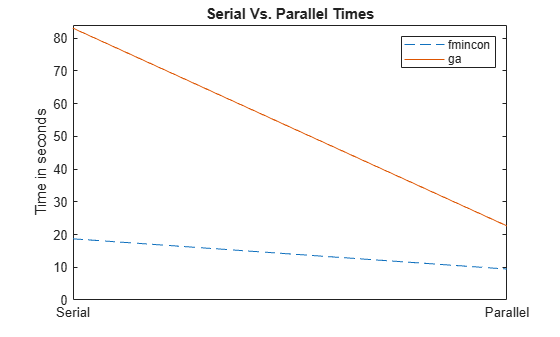
Utilizing parallel function evaluation via parfor improved the efficiency of both fmincon and ga. The improvement is typically better for expensive objective and constraint functions.

