Projection
Project layers by performing principal component analysis (PCA) on the layer activations using a data set representative of the training data and applying linear projections on the layer learnable parameters. Forward passes of a projected deep neural network are typically faster when you deploy the network to embedded hardware using library-free C/C++ code generation.
For a detailed overview of the compression techniques available in Deep Learning Toolbox™ Model Compression Library, see Reduce Memory Footprint of Deep Neural Networks.

Functions
compressNetworkUsingProjection | Compress neural network using projection (Since R2022b) |
neuronPCA | Principal component analysis of neuron activations (Since R2022b) |
unpackProjectedLayers | Unpack projected layers of neural network (Since R2023b) |
ProjectedLayer | Compressed neural network layer using projection (Since R2023b) |
gruProjectedLayer | Gated recurrent unit (GRU) projected layer for recurrent neural network (RNN) (Since R2023b) |
lstmProjectedLayer | Long short-term memory (LSTM) projected layer for recurrent neural network (RNN) (Since R2022b) |
Topics
- Compress Neural Network Using Projection
Compress a neural network using projection and principal component analysis (PCA).
- Train Smaller Neural Network Using Knowledge Distillation
Reduce the memory footprint of a deep neural network using knowledge distillation. (Since R2023b)
Featured Examples
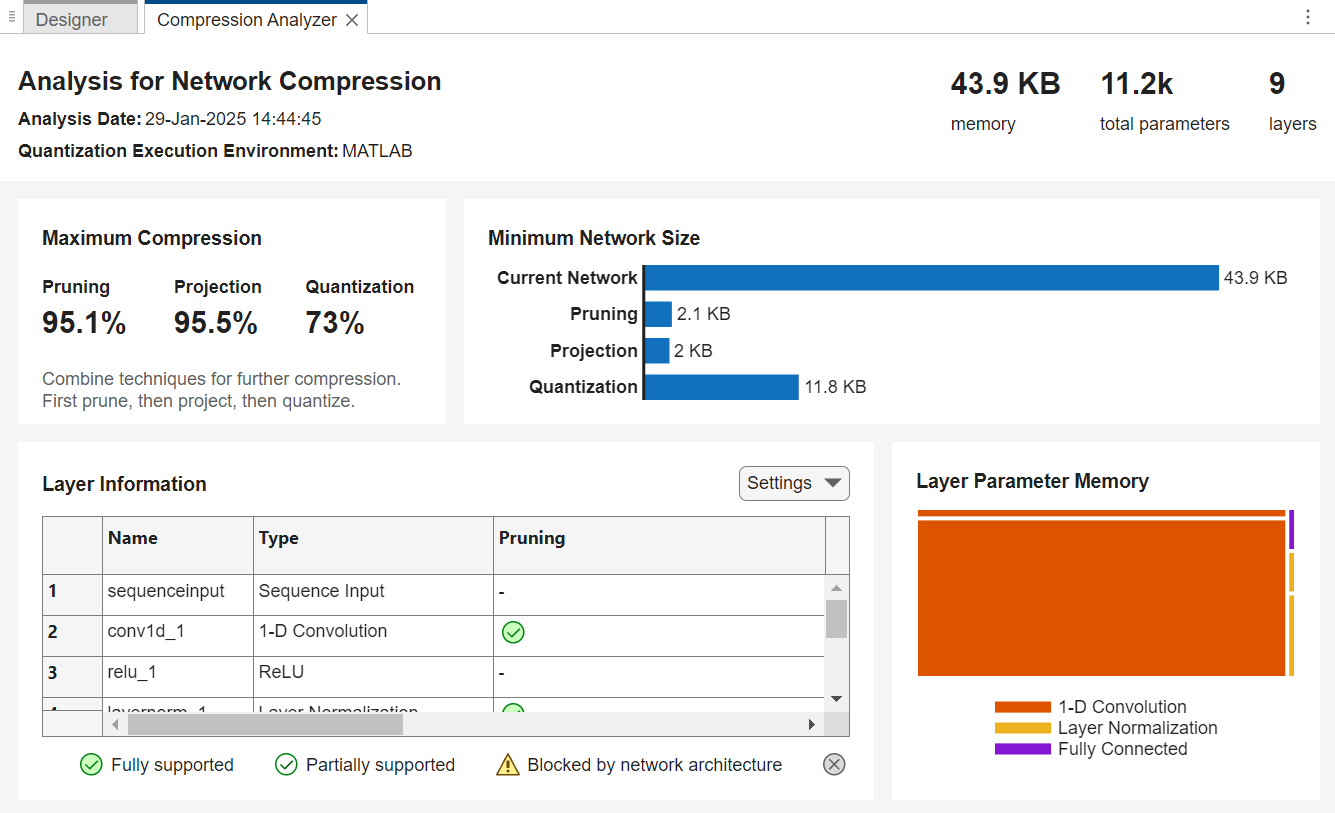
Analyze and Compress 1-D Convolutional Neural Network
Analyze 1-D convolutional network for compression and compress it using Taylor pruning and projection.
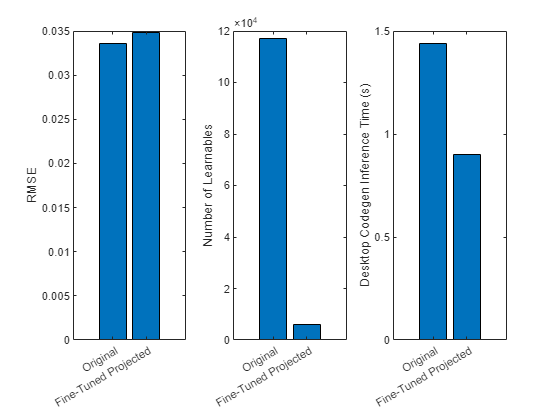
Evaluate Code Generation Inference Time of Compressed Deep Neural Network
Compare the inference time of a compressed deep neural network for battery state of charge estimation.

