bwdist
R2026bDistance transform of binary image
Description
[
also returns the closest-pixel map in the form of an index array,
D,idx] = bwdist(___)idx, using any combination of input arguments from the
previous syntaxes. Each element of idx contains the linear
index of the nearest nonzero pixel of BW. The closest-pixel map
is also called the feature map, feature transform, or nearest-neighbor
transform.
Examples
This example shows how to compute the Euclidean distance transform of a binary image, and the closest-pixel map of the image.
Create a binary image.
bw = zeros(5,5);
bw(2,2) = 1;
bw(4,4) = 1
bw = 5×5

     0     0     0     0     0
     0     1     0     0     0
     0     0     0     0     0
     0     0     0     1     0
     0     0     0     0     0
Calculate the distance transform.
[D,IDX] = bwdist(bw)
D = 5×5 single matrix

    1.4142    1.0000    1.4142    2.2361    3.1623
    1.0000         0    1.0000    2.0000    2.2361
    1.4142    1.0000    1.4142    1.0000    1.4142
    2.2361    2.0000    1.0000         0    1.0000
    3.1623    2.2361    1.4142    1.0000    1.4142
IDX = 5×5 uint32 matrix

    7    7    7    7    7
    7    7    7    7   19
    7    7    7   19   19
    7    7   19   19   19
    7   19   19   19   19
In the nearest-neighbor matrix IDX the values 7 and 19 represent the position of the nonzero elements using linear matrix indexing. If a pixel contains a 7, its closest nonzero neighbor is at linear position 7.
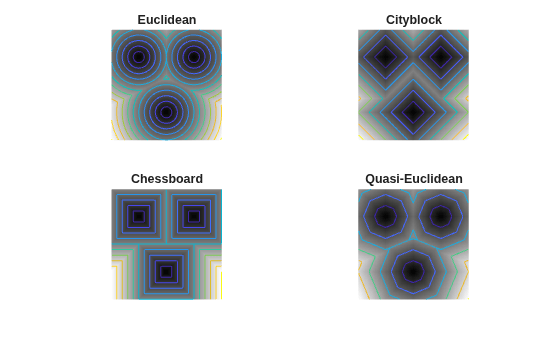
This example shows how to compare the 2-D distance transforms for supported distance methods. In the figure, note how the quasi-Euclidean distance transform best approximates the circular shape achieved by the Euclidean distance method.
bw = zeros(200,200);
bw(50,50) = 1; bw(50,150) = 1; bw(150,100) = 1;
D1 = bwdist(bw,'euclidean');
D2 = bwdist(bw,'cityblock');
D3 = bwdist(bw,'chessboard');
D4 = bwdist(bw,'quasi-euclidean');
RGB1 = repmat(rescale(D1), [1 1 3]);
RGB2 = repmat(rescale(D2), [1 1 3]);
RGB3 = repmat(rescale(D3), [1 1 3]);
RGB4 = repmat(rescale(D4), [1 1 3]);

figure
subplot(2,2,1), imshow(RGB1), title('Euclidean')
hold on, imcontour(D1)
subplot(2,2,2), imshow(RGB2), title('Cityblock')
hold on, imcontour(D2)
subplot(2,2,3), imshow(RGB3), title('Chessboard')
hold on, imcontour(D3)
subplot(2,2,4), imshow(RGB4), title('Quasi-Euclidean')
hold on, imcontour(D4)
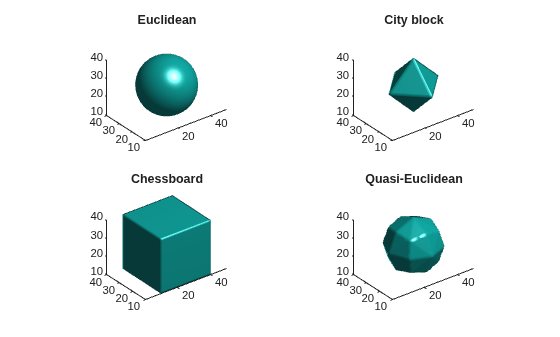
This example shows how to compare isosurface plots for the distance transforms of a 3-D image containing a single nonzero pixel in the center.
bw = zeros(50,50,50); bw(25,25,25) = 1;
D1 = bwdist(bw);
D2 = bwdist(bw,'cityblock');
D3 = bwdist(bw,'chessboard');
D4 = bwdist(bw,'quasi-euclidean');
figure
subplot(2,2,1), isosurface(D1,15), axis equal, view(3)
camlight, lighting gouraud, title('Euclidean')
subplot(2,2,2), isosurface(D2,15), axis equal, view(3)
camlight, lighting gouraud, title('City block')
subplot(2,2,3), isosurface(D3,15), axis equal, view(3)
camlight, lighting gouraud, title('Chessboard')
subplot(2,2,4), isosurface(D4,15), axis equal, view(3)
camlight, lighting gouraud, title('Quasi-Euclidean')
Input Arguments
Output Arguments
Algorithms
bwdist uses fast algorithms to compute the true Euclidean distance
transform, especially in the 2-D case. The other methods are provided primarily for
pedagogical reasons. However, the alternative distance transforms are sometimes
significantly faster for multidimensional input images, particularly those that have
many nonzero elements.
For Euclidean distance transforms,
bwdistuses the fast algorithm [1].For cityblock, chessboard, and quasi-Euclidean distance transforms,
bwdistuses the two-pass, sequential scanning algorithm [2].The different distance measures are achieved by using different sets of weights in the scans, as described in [3].
References
[1] Maurer, Calvin, Rensheng Qi, and Vijay Raghavan, "A Linear Time Algorithm for Computing Exact Euclidean Distance Transforms of Binary Images in Arbitrary Dimensions," IEEE Transactions on Pattern Analysis and Machine Intelligence, Vol. 25, No. 2, February 2003, pp. 265-270.
[2] Rosenfeld, Azriel and John Pfaltz, "Sequential operations in digital picture processing," Journal of the Association for Computing Machinery, Vol. 13, No. 4, 1966, pp. 471-494.
[3] Paglieroni, David, "Distance Transforms: Properties and Machine Vision Applications," Computer Vision, Graphics, and Image Processing: Graphical Models and Image Processing, Vol. 54, No. 1, January 1992, pp. 57-58.

