Registration Estimator
R2026bRegister 2-D grayscale images
Description
The Registration Estimator app aligns 2-D grayscale images using automatic image registration. Using this app, you can:
Compare feature-based, intensity-based, and nonrigid registration techniques interactively.
Obtain the registered image and the geometric transformation.
Generate a function with the desired registration technique and settings. Call this function to register other images using the same settings.
For more information about the different registration techniques supported by Registration Estimator, see More About.
Open the Registration Estimator App
MATLAB® Toolstrip: On the Apps tab, under Image Processing and Computer Vision, click the Registration Estimator app icon.
MATLAB command prompt: Enter
registrationEstimator.
Examples
Create two misaligned images in the workspace. This example creates the
moving image J by rotating the fixed image
I clockwise by 30 degrees.
I = imread("cameraman.tif");
J = imrotate(I,-30);Open Registration Estimator from the command window. Specify the moving image and the fixed image as the two input arguments.
registrationEstimator(J,I)
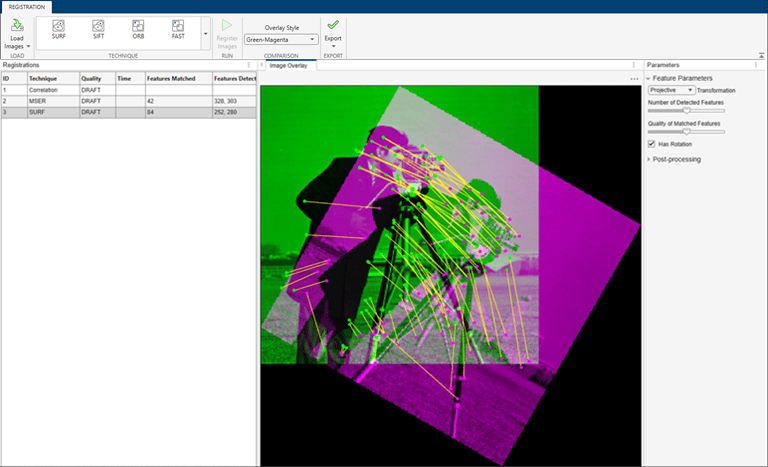
After you load the images, the app creates three registration trials: Correlation, MSER, and SURF. These trials appear as drafts in the Registrations list. The app also displays an overlay of the images. The default Green-Magenta overlay style shows the fixed image in green and the moving image in magenta. The overlay looks gray in areas where the two images have similar intensity. When you click a feature-based technique in the history list, the image overlay displays the matched features as a set of red and green dots connected by yellow lines.

Run the three default registration trials with the default settings. Click each trial in the history list, then click Register Images.
After the registration finishes, the trial displays a quality score and
computation time. The quality score is based loosely on the ssim
function and provides an overall estimate of registration quality. A score
closer to 1 indicates a higher quality registration.
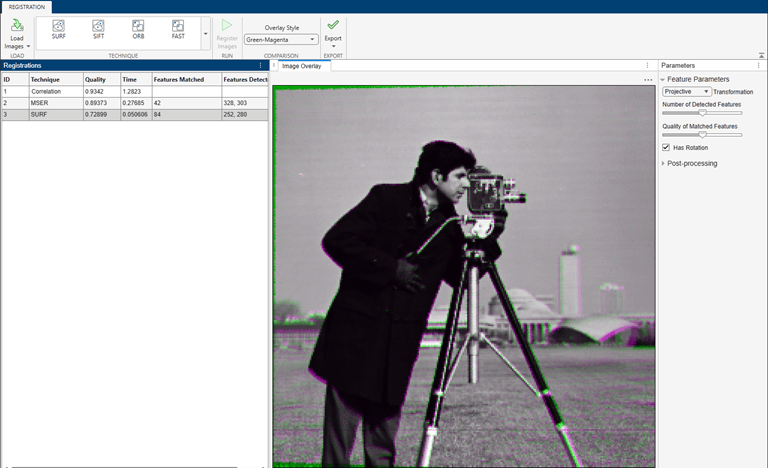
Inspect the image overlay to confirm which registration technique is the most acceptable. Colors in the image overlay indicate residual misalignment.
Programmatic Use
registrationEstimator opens the Registration Estimator app,
which enables you to perform intensity-based, feature-based, and nonrigid image
registration.
registrationEstimator(
opens Registration Estimator, loading the grayscale images
moving,fixed)moving and fixed into the app.
registrationEstimator close closes all open instances of the
Registration Estimator app.
More About
Feature-based registration techniques automatically detect distinct image features such as blobs, sharp corners, or regions of uniform intensity. Each category has different strengths depending on the content of your images and the expected geometric distortion.
Use blob detectors when images differ in scale or have significant rotation, with distinct shapes in the scene.
Use corner detectors when images have scenes with sharp corners, such as aerial views of a city and other constructed scenes. Some corner detectors require the images to have similar scales, such as consecutive video frames or stereoscopic image pairs. Corner detectors provide the fastest results of the feature-based registration techniques.
Use uniform intensity detectors when images have uniform intensity and features are defined by intensity values. Uniform intensity detectors are more robust to affine transformations than blob detectors and corner detectors.
| Technique | Category | Description |
|---|---|---|
SURF | Blob detector | Detect blobs in images with changes in scale or rotation. SURF is faster than SIFT while maintaining good accuracy, making it a good general-purpose registration technique. |
SIFT | Blob detector | Detect blobs in images with changes in scale or rotation. SIFT provides the highest accuracy among the blob detectors but is computationally intensive compared to SURF. |
ORB | Corner detector | Detect corners in images with changes in scale or rotation. ORB is generally faster and more robust to rotation than BRISK. |
FAST | Corner detector | Detect corners in images with little or no scale change. FAST provides a very fast computation, which makes it useful when you need to match a large number of corners in real time. FAST does not support rotation. |
BRISK | Corner detector | Detect corners in images with changes in scale or rotation. BRISK generally provides more accurate results for complex scenes than ORB. |
Harris | Corner detector | Detect corners in images with little or no scale change. Harris provides a more efficient algorithm than MinEigen, although it can be more sensitive to noise. |
MinEigen | Corner detector | Detect corners in images with little or no scale change. MinEigen is the most accurate of the fixed-scale corner detectors, especially when there are strong corners in the images. However, MinEigen is the slowest of the fixed-scale corner detectors. |
MSER | Uniform intensity detector | Detect regions of uniform intensity. MSER is more robust to affine transformations than the other feature-based registration algorithms. However, MSER is not suitable when the images differ greatly in intensity. |
KAZE | Blob detector | Detect multiscale blobs in images. KAZE is edge-aware, which can improve results near sharp boundaries. KAZE is computationally intensive. |
To register the images, the moving image undergoes a single global transformation to provide the best alignment of corresponding features with the fixed image. For more details about each feature detection algorithm and the registration process, see Local Feature Detection and Extraction (Computer Vision Toolbox).
Intensity-based registration techniques correlate image intensity in the spatial or frequency domain. Intensity-based registration can be useful when an image has few distinct shapes or corners, such as for medical images. Registration Estimator offers these registration techniques that use intensity metric optimization.
| Technique | Description |
|---|---|
Monomodal Intensity | Register images with similar brightness and contrast that are captured on the same type of scanner or sensor. For example, use monomodal intensity to register MRI scans taken of similar subjects using the same imaging sequence. |
Multimodal Intensity | Register images with different brightness and contrast. These images can come from two different types of devices, such as two camera models or two types of medical imaging systems (such as CT and MRI). These images can also come from a single device with different settings between captures. For example, use multimodal intensity to register images taken with the same camera using different exposure settings, or to register MRI images acquired during a single session using different imaging sequences. |
Correlation | Register images using gradient or phase correlation. Like multimodal intensity, correlation is invariant to image brightness. Correlation is more robust to noise than the other intensity-based registration techniques. |
To register the images, the moving image undergoes a single global transformation to maximize the correlation of its intensity with the intensity of the fixed image. For more information about the registration process, see Intensity-Based Automatic Image Registration.
Nonrigid transformations generate a displacement field, in which each pixel
location in the fixed image is mapped to a corresponding location in the moving
image. The moving image is then warped according to the displacement field and
resampled using linear interpolation. For more information about estimating a
displacement field for nonrigid transformations, see imregdemons.
| Technique | Description |
|---|---|
Nonrigid | Register images with local distortions. |
Tips
You can register images and generate functions for all feature-based techniques without a Computer Vision Toolbox™ license. However, to run an autogenerated function that uses a feature-based registration technique, you must have Computer Vision Toolbox. For more information, see Export Results from Registration Estimator App.
Version History
Introduced in R2017aThe app now supports the SIFT feature-based registration technique. You can use SIFT to register images with rotation and scale differences. SIFT provides the highest accuracy among the feature-based blob detectors, but it is computationally intensive compared to SURF.
The app now supports the KAZE and ORB feature-based registration techniques. The KAZE technique is a multiscale 2-D feature detection and description algorithm in nonlinear scale spaces. The ORB technique detects corners in images with changes in scale, rotations, or both.
MATLAB Command
You clicked a link that corresponds to this MATLAB command:
Run the command by entering it in the MATLAB Command Window. Web browsers do not support MATLAB commands.
Select a Web Site
Choose a web site to get translated content where available and see local events and offers. Based on your location, we recommend that you select: .
You can also select a web site from the following list
How to Get Best Site Performance
Select the China site (in Chinese or English) for best site performance. Other MathWorks country sites are not optimized for visits from your location.
Americas
- América Latina (Español)
- Canada (English)
- United States (English)
Europe
- Belgium (English)
- Denmark (English)
- Deutschland (Deutsch)
- España (Español)
- Finland (English)
- France (Français)
- Ireland (English)
- Italia (Italiano)
- Luxembourg (English)
- Netherlands (English)
- Norway (English)
- Österreich (Deutsch)
- Portugal (English)
- Sweden (English)
- Switzerland
- United Kingdom (English)