Main Content

phased.MVDREstimator2D

2-D MVDR (Capon) spatial spectrum estimator

Description

The MVDREstimator2D object computes a 2-D minimum variance distortionless response (MVDR) spatial spectrum estimate. This DOA estimator is also referred to as a Capon estimator.

To estimate the spatial spectrum:

  1. Create the phased.MVDREstimator2D object and set its properties.

  2. Call the object with arguments, as if it were a function.

To learn more about how System objects work, see What Are System Objects?

Creation

Description

estimator = phased.MVDREstimator2D creates a 2-D MVDR spatial spectrum estimator System object™, estimator. The object estimates the spatial spectrum of the signal using a narrowband MVDR beamformer.

estimator = phased.MVDREstimator2D(Name=Value) creates object, estimator, with each specified property Name set to the specified Value. You can specify additional name-value arguments in any order as (Name1=Value1,...,NameN=ValueN).

example

Properties

expand all

Unless otherwise indicated, properties are nontunable, which means you cannot change their values after calling the object. Objects lock when you call them, and the release function unlocks them.

If a property is tunable, you can change its value at any time.

For more information on changing property values, see System Design in MATLAB Using System Objects.

Sensor array, specified as a Phased Array System Toolbox array System object.

Example: phased.URA

Signal propagation speed, specified as a real-valued positive scalar. Units are in meters per second. The default propagation speed is the value returned by physconst("LightSpeed").

Example: 3e8

Data Types: single | double

Operating frequency, specified as a positive scalar. Units are in Hz.

Example: 1e9

Data Types: single | double

The number of bits used to quantize the phase shift component of beamformer or steering vector weights, specified as a non-negative integer. A value of zero indicates that no quantization is performed.

Example: 5

Data Types: single | double

Perform forward-backward averaging status, specified as a logical 1 (true) or 0 (false). Specify true to use forward-backward averaging to estimate the covariance matrix for sensor arrays with conjugate symmetric array manifold.

Data Types: logical

Azimuth scan angles, specified as a L-element row vector. L is the number of elements in the sensor array. Values must be in the ascending order and in the range (-180, 180). Units are in degrees.

Data Types: single | double

Elevation scan angles, specified as a scalar or a L-element row vector. L is the number of elements in the sensor array. If you specify an array, values must be in the ascending order and in the range (-90, 90). Units are in degrees.

Data Types: single | double

Enable DOA output status, specified as a logical 1 (true) or 0 (false). Specify true to obtain the signal's direction of arrival (DOA)

Data Types: logical

Number of signals to estimate DOA, specified as a positive scalar.

Note

To specify NumSignals property, you must specify the DOAOutputPort property as true.

Data Types: single | double

Usage

Description

Y = estimator(X) estimates the spatial spectrum Y from the specified channels X.

[Y,ANG] = estimator(X) additionally returns ANG which represents the signal’s direction of arrival (DOA) when the DOAOutputPort property is true.

Note

The object performs an initialization the first time the object is executed. This initialization locks nontunable properties and input specifications, such as dimensions, complexity, and data type of the input data. If you change a nontunable property or an input specification, the System object issues an error. To change nontunable properties or inputs, you must first call the release method to unlock the object.

example

Input Arguments

expand all

Channels to estimate spatial spectrum, specified as a P-by-Q matrix. P is the number of elements in the sensor array and Q is the number of channels.

The size of the first dimension of the input matrix can vary to simulate a changing signal length. A size change can occur, for example, in the case of a pulse waveform with variable pulse repetition frequency.

Data Types: single | double

Output Arguments

expand all

Magnitude of the estimated 2-D spatial spectrum, returned as an M-by-N real-valued matrix. M is the number of angles in the ElevationScanAngles and N is the number of angles in the AzimuthScanAngles property.

Response directions, returned as a 2-by-Q matrix of real-values. First row represents the estimated azimuth angles and the second row represents the estimated elevation angles. Q is the number of channels. Units are in degrees.

Object Functions

To use an object function, specify the System object as the first input argument. For example, to release system resources of a System object named obj, use this syntax:

release(obj)

expand all

plotSpectrumPlot spatial spectrum
stepRun System object algorithm
releaseRelease resources and allow changes to System object property values and input characteristics
resetReset internal states of System object

Examples

collapse all

Estimate the DOAs of two signals received by a 50-element URA with a rectangular lattice. The antenna operating frequency is 150 MHz. The actual direction of the first signal is −37° in azimuth and 0° in elevation. The direction of the second signal is 17° in azimuth and 20° degrees in elevation. Then, plot the spatial spectrum.

Create the arriving signals.

fs = 8000;
t = (0:1/fs:1).';
x1 = cos(2*pi*t*300);
x2 = cos(2*pi*t*400);
array = phased.URA(Size=[5 10],ElementSpacing=[1 0.6]);
array.Element.FrequencyRange = [100e6 300e6];
fc = 150e6;
x = collectPlaneWave(array,[x1 x2],[-37 0;17 20]',fc);

Add noise.

noise = 0.1*(randn(size(x))+1i*randn(size(x)));

Create the MVDR DOA estimator and estimate the DOAs.

estimator = phased.MVDREstimator2D(SensorArray=array, ...
    OperatingFrequency=fc, ...
    DOAOutputPort=true,NumSignals=2, ...
    AzimuthScanAngles=-50:50, ...
    ElevationScanAngles=-30:30);
[~,doas] = estimator(x + noise);

Plot the spectrum.

plotSpectrum(estimator)
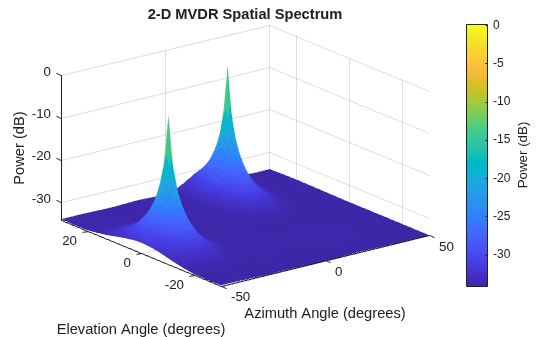
Figure contains an axes object. The axes object with title 2-D MVDR Spatial Spectrum, xlabel Azimuth Angle (degrees), ylabel Elevation Angle (degrees) contains an object of type surface.

Estimate the DOAs of two signals received by a 50-element URA with a rectangular lattice. The antenna operating frequency is 150 MHz. The actual direction of the first signal is -37° in azimuth and 0° in elevation. The direction of the second signal is 17° in azimuth and 20° in elevation.

Create signals sampled at 8 kHz.

fc = 150e6;
fs = 8000;
t = (0:1/fs:1).';
x1 = cos(2*pi*t*300);
x2 = cos(2*pi*t*400);
array = phased.URA('Size',[5 10],'ElementSpacing',[1 0.6]);
array.Element.FrequencyRange = [100e6 300e6];
x = collectPlaneWave(array,[x1 x2],[-37 0;17 20]',fc);

Add complex noise.

noise = 0.1*(randn(size(x))+1i*randn(size(x)));

Create the MVDR DOA estimator for URA.

estimator = phased.MVDREstimator2D(SensorArray=array,...
    OperatingFrequency=fc,...
    DOAOutputPort=true,NumSignals=2,...
    AzimuthScanAngles=-50:50,...
    ElevationScanAngles=-30:30);

Use the step method to the DOA estimates.

[~,doas] = estimator(x + noise)
doas = 2×2

    17   -37
    20     0

Plot the spectrum.

plotSpectrum(estimator)
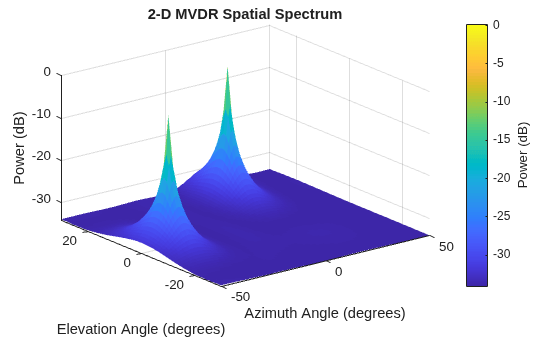
Figure contains an axes object. The axes object with title 2-D MVDR Spatial Spectrum, xlabel Azimuth Angle (degrees), ylabel Elevation Angle (degrees) contains an object of type surface.

Algorithms

expand all

References

[1] Van Trees, H. Optimum Array Processing. New York: Wiley-Interscience, 2002.

Extended Capabilities

expand all

Version History

Introduced in R2011a