cholcov
R2026bCholesky factorization
Description
T = cholcov(X)T of the matrix X such that
X = T'*T. The input matrix X must be symmetric
positive definite or symmetric positive semi-definite. Otherwise, T is
empty. For more information, see Symmetric Positive Definite Matrix.
If your input matrix X is positive definite, you can also use the
chol function to compute its Cholesky
factor.
[
specifies whether to compute T,num] = cholcov(X,AllowPosSemiDef)T when X is positive
semi-definite. The function returns T as empty and
num as an arbitrary positive integer when
AllowPosSemiDef is false and X
is positive semi-definite.
Examples
Create a symmetric positive definite 3-by-3 matrix of integers.
rng(0,"twister")  % For reproducibility
A = randi([0 2],3,3);
X = A'*A
X = 3×3

     8     6     2
     6     5     1
     2     1     5
Compute the Cholesky factor T such that X = T'*T.
T = cholcov(X)
T = 3×3

    2.8284    2.1213    0.7071
         0    0.7071   -0.7071
         0         0    2.0000
Because X is positive definite, T is a square, upper triangular matrix.
Verify that X = T'*T.
all(isapprox(X,T'*T),"all")ans = logical
1
Create a symmetric positive semi-definite 3-by-3 matrix of integers.
rng(0,"twister")  % For reproducibility
v1 = randi([0 2],3,1);
v2 = randi([0 2],3,1);
X = v1*v1.' + v2*v2.'
X = 3×3

     8     6     0
     6     5     0
     0     0     0
Compute the eigenvalues of X.
eig(X)
ans = 3×1

         0
    0.3153
   12.6847
X is positive semi-definite because it has no negative eigenvalues and at least one zero eigenvalue.
Compute the Cholesky factor T such that X = T'*T. Also return the number of negative eigenvalues num in X.
[T,num] = cholcov(X)
T = 2×3

   -0.3456    0.4426         0
    2.8072    2.1918         0
num =
0
Because X is positive semi-definite, T is not a square matrix.
Verify that X = T'*T.
all(isapprox(X,T'*T),"all")ans = logical
1
Create a column vector of means mu and a positive definite covariance matrix Sigma.
mu = [-4; 0; 4];
Sigma = [2 1 0; 1 2 1; 0 1 2];
Calculate the Cholesky factor of the covariance matrix.
T = cholcov(Sigma)
T = 3×3

    1.4142    0.7071         0
         0    1.2247    0.8165
         0         0    1.1547
Generate 200 random deviates from a standard normal distribution and transform them using the means mu and the Cholesky factor T.
rng(0,"twister")  % For reproducibility
n = 200;
Z = randn(length(mu),n); % Standard normal deviates
X = T*Z + mu;
X = X';
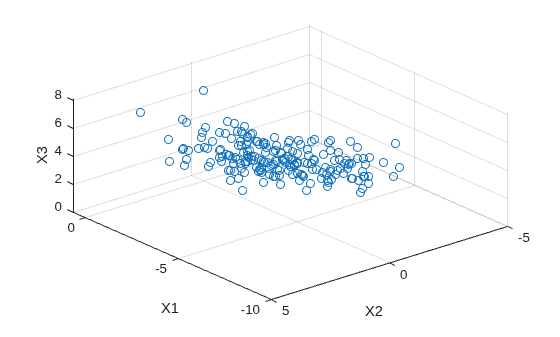
X is a 200-by-3 matrix of correlated samples drawn from the set of means mu using the covariance matrix Sigma.
Create a 3-D scatter plot of the samples.
scatter3(X(:,1),X(:,2),X(:,3));
xlabel("X1")
ylabel("X2")
zlabel("X3")
view([230 45])