Pull up a chair!
Discussions is your place to get to know your peers, tackle the bigger challenges together, and have fun along the way.
- Want to see the latest updates? Follow the Highlights!
- Looking for techniques improve your MATLAB or Simulink skills? Tips & Tricks has you covered!
- Sharing the perfect math joke, pun, or meme? Look no further than Fun!
- Think there's a channel we need? Tell us more in Ideas
Updated Discussions

I have created a mqtt device in thingspeak, allocated a channel for pub and sub. I noted down the credentials for connection when the device was created. I tried to connect using the host mqtt3.thingspeak.com port 1883 and the supplied credentials(user name and password). I tried with node red (mqtt node) and also mqtt lense but still cannot connect. Would appreciate advice some advise. Thanks

Congratulations, @John D'Errico for winning the Editor's Pick badge awarded for MATLAB Answers, in recognition of your awesome solution in What to be chosen c so that all elements of matrix B will be a round number. B=A.c; where A is the matrix of non integers. The OP has not accepted his answer yet, but
As with other nominated answers, you provided detailed explanation with examples to show that what the OP is looking for may not be possible in some cases.
Unfortunately, you can only get this badge once - perhaps this raises a question about how this award should work. In any case, we nonetheles appreciate your ongoing effort to help other users in the community. Thnk you so much!
MATLAB Central Team

AI, Robotics, Autonomous Systems: MATLAB EXPO is coming up soon and it is time to register. It's free and open to everyone. You will have the opportunity to connect with engineers, scientists, educators, and researchers, and new ideas.
disp('It is time to register for MATLAB EXPO 2023!');
Featured Sessions:
- Project-Based Learning and Design with Simulation - Professor Claire Lucas, King’s College London
- How Siemens Energy Enables the Global Energy Transition - Jens Dietrich, Siemens Energy AG
Features Topics:
- AI
- Autonomous Systems
- Electrification
- Robotics

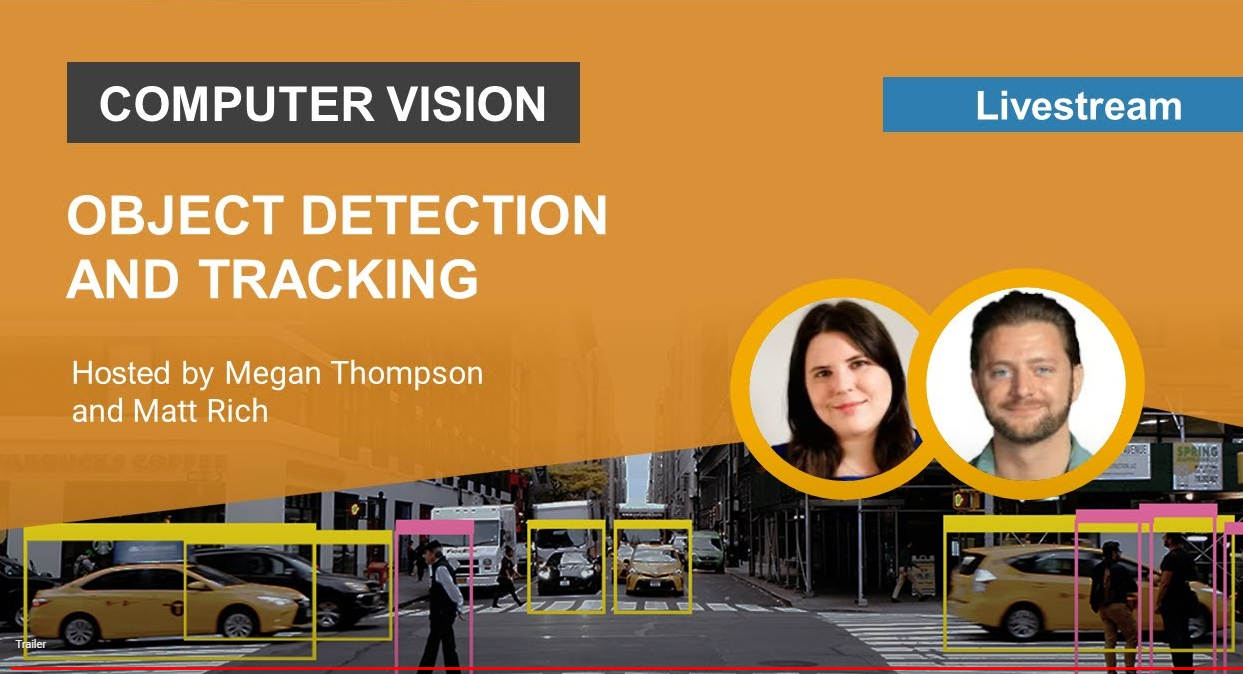
Object Detection and Tracking using Computer Vision
In this event, Matt and Megan show you how to perform one or the more difficult task in computer vision: tracking multiple objects.
They will walk through an example from the new Coursera specialization, Computer Vision for Engineering and Science. The code and video used in the example are available to those who sign up for the specialization.

AI
22%
Wireless Connectivity and Radar
4%
Autonomous Systems and Robotics
15%
Cloud, Enterprise, and DevOps
2%
Algorithms and Data Analytics
17%
Modeling and Simulation
36%
179 votes

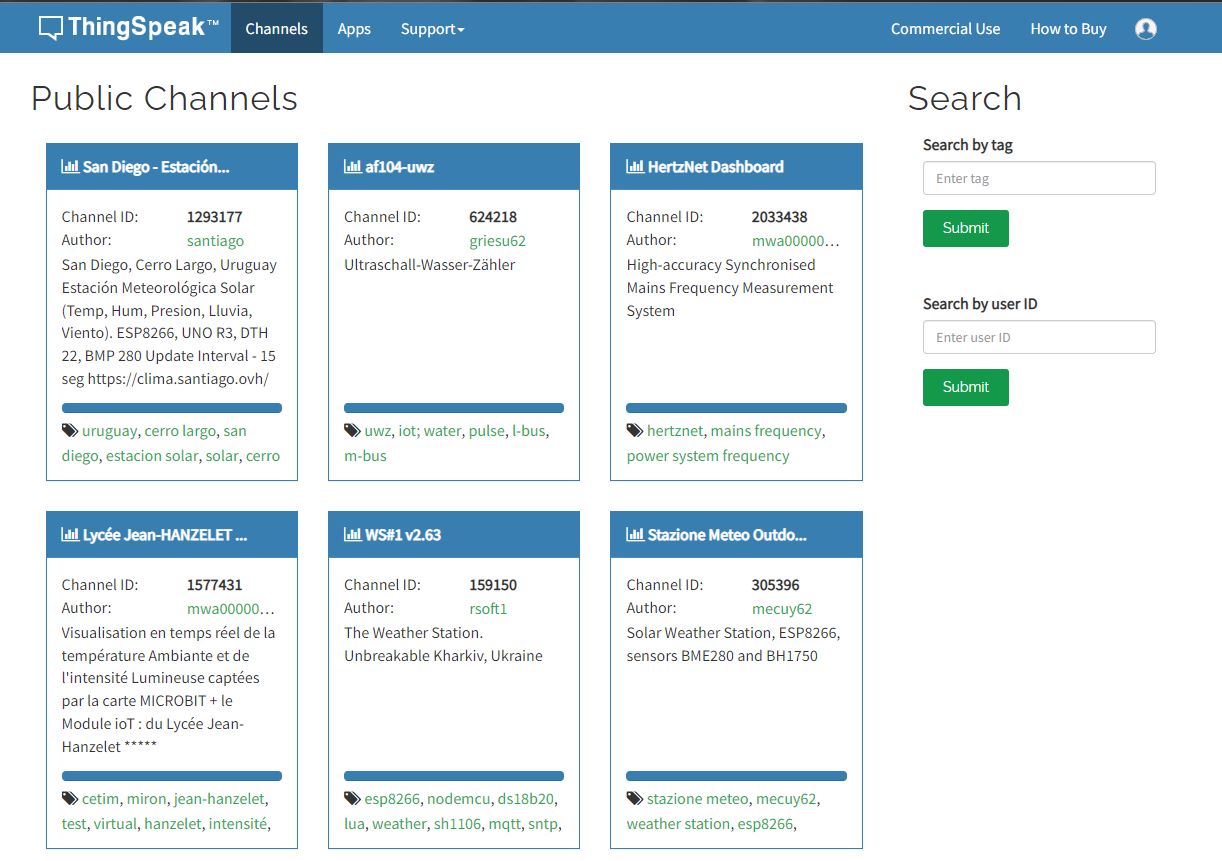
Hello - I have a new account and when I click My Channels, I don't get a drop down menu with choices like My Channels, My Image Channels, ect. I only get Public Channels when I click the Channels tab. I can't select My Channels. Could someone please help me?
Thank you

I try this code in MATLAB:
This code working fine:
readChannelID = [1788078];
fieldID1 = [1];
readAPIKey = '';
[data, time] = thingSpeakRead(readChannelID, 'Field', fieldID1, 'NumPoints', 30, 'ReadKey', readAPIKey);
plot(time, data);
This code have error : Unrecognized table variable name 'x1'.
readChannelID = [1788078];
fieldID1 = [2];
readAPIKey = '';
[data, time] = thingSpeakRead(readChannelID, 'Field', fieldID1, 'NumPoints', 30, 'ReadKey', readAPIKey);
plot(time, data);
What i do wrong? Thanks.

We need to do IoT work for our university project. I want to open a channel without any profit motive so that I can see the statistics. New Channel option does not appear.

After signing in pop up showing succesfully signed in ,but its getting signed out automatically
plz help me and comment if you are facing same problem

Hello,
I want to make a weather forecast for the next 3 days using the data I received from my sensors on the thingsspeak server I gave the link above, how can I do this?
I need to do it with mathlab code in Thingsspeak system but I am very new to Mathlab.
Thanks for your help.
Bill
Beginner, Novice, still learning
50%
Adequate, I can get by easily
34%
Proficient / fluent can do anything
12%
Grand Master, one of the very best
3%
2510 votes

I'm running the same code as a week ago but now it reports the error: MATLAB code has timed out.

Absolute path
14%
Relative inside the top project
48%
Relative outside the top project
19%
All the above
19%
21 votes

Currently, I am on a test account with Thingspeak but it would be no problem to upgrade to a subscription plan if it provides the required features.
I would like to edit the time scale (currently only around 10h) and export time (currently only around 24h) for the graphs and the export function in the public channel.
How is this possible? It would be nice to have the option to plot 12h, 1d, 1w, 1m etc. in the graphs and also have the respective export function.

Hello,
I have an Open Loop Transfer Function:
Gc(s)Gp(s) = aKp(1+Tis) / Tis(s+1+p)
It was decided for this system a=5, Ti=0.1 and p=0.5
What would the poles and zeroes be for this?
Ive done the other examples but this one looks very different to the other questions and it has me stuck.
Any help is appreciated and sorry if this is the wrong place to post such questions.

Hello,
can someone help me with HEV model? I have no experience with simulink modeling, maybe someone have any simple HEV models or any tutorials how to start everything? :)
Thank you.
I have purchased an 8in1 weather station from Seed (see Link here), added it to TheThingsStack v3 and changed the payload formatter such that I receive following payload:
{
"barometric_pressure": 96920,
"battery": 0,
"humidity": 92,
"light_intensity": 11848,
"rain_gauge": 0,
"temperature": 6.8,
"uv_index": 0.6,
"wind_direction": 60,
"wind_speed": 0
}
I have followed the ThingSpeak manual here, which seems pretty straight forward to me: just add channel ID and Write Api Key.
However, on TheThingsStack, I see following error:
"data": {
"@type": "type.googleapis.com/ttn.lorawan.v3.ErrorDetails",
"namespace": "pkg/applicationserver/io/web",
"name": "request",
"message_format": "request",
"correlation_id": "XXXXprivate",
"code": 14,
"details": [
{
"@type": "type.googleapis.com/google.protobuf.Struct",
"value": {
"body": "error_too_many_requests",
"status_code": 429,
"url": "https://api.thingspeak.com/things_network/v3/update/",
"webhook_id": "loraweatherstation"
}
}
]
},
[...]
"visibility": {
"rights": [
"RIGHT_APPLICATION_TRAFFIC_READ"
]
TheThingSpeak reports entries without the actual data. I think the entries are generated with all get requests.

If you use MATLAB online, you might already know about the advanced search feature that groups your results into the top suggestions by type of result – such as examples functions or blocks. This release, there is a new group for video results: you can see an icon sized thumbnail and the video length all in the search box dialog.
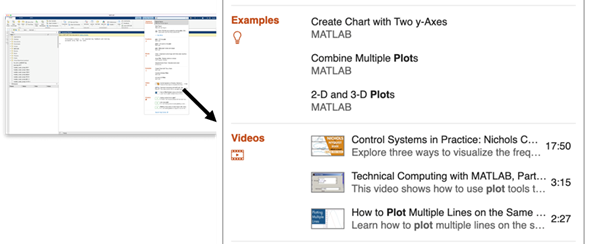
Try out all the search groups - you can even try it out in dark mode!

Hi there,
Truncation error happens when an infinite series is ignored except for a small subset of its values. For instance, the exponential function e^x could be written as the infinite series total of 1 + x + x^2/2 + x^3/6 +... + x^n/n! +....
Any finite number of n will result in an approximation of the value of e^x that is inaccurate, but by increasing n, the error can be reduced to the desired level but this increase computation time.
How can I speed up the calculation by determining the dynamic level where error can be reduced to the barest minimum?
The error is different for each input; if the input number is small, the error condition can be reached quickly, say 1e-6; if the input number is large, we need more terms in the polynomial equation, i.e. more iteration; how can I make the threshold dynamic so that I don't have a fixed error tolerance number?
What I want to know is how to make the threshold dynamic so that I can decrease the polynomial's order and lower the number of terms, which will speed up execution time.
Any assistance would be greatly appreciated.
format long e
[exp(log(2)/2), 1+log(2)/2 + (log(2)/2)^2/factorial(2) + (log(2)/2)^3/factorial(3) + (log(2)/2)^4/factorial(4),(exp(log(2)/2) - 1+log(2)/2 + (log(2)/2)^2/factorial(2) + (log(2)/2)^3/factorial(3) + (log(2)/2)^4/factorial(4))]
[exp(-log(2)/2), 1+(-log(2)/2) + (-log(2)/2)^2/factorial(2) + (-log(2)/2)^3/factorial(3) + (-log(2)/2)^4/factorial(4),(exp(log(2)/2) - 1+log(2)/2 + (log(2)/2)^2/factorial(2) + (log(2)/2)^3/factorial(3) + (log(2)/2)^4/factorial(4))]

Bonjour,
pour un projet d'école j'ai besoin de faire analyser des données saisies directement dans Appinventor et non pas à partir de capteurs. J'ai cherché un peu partout sur le web mais je n'ai pas trouvé la solution. Quelqu'un peut il m'aider ?
About Discussions
Discussions is a user-focused forum for the conversations that happen outside of any particular product or project.
Get to know your peers while sharing all the tricks you've learned, ideas you've had, or even your latest vacation photos. Discussions is where MATLAB users connect!
Get to know your peers while sharing all the tricks you've learned, ideas you've had, or even your latest vacation photos. Discussions is where MATLAB users connect!
More Community Areas

MATLAB Answers
Ask & Answer questions about MATLAB & Simulink!

File Exchange
Download or contribute user-submitted code!

Cody
Solve problem groups, learn MATLAB & earn badges!

Blogs
Get the inside view on MATLAB and Simulink!

AI Chat Playground
Use AI to generate initial draft MATLAB code, and answer questions!