convintrlv
R2026bPermute symbols using shift registers
Syntax
Description
intrlvd = convintrlv(data,nrows,slope)data by using a set of
nrows internal shift registers. Before the function begins to process
data, it initializes all shift registers with zeros. For information about delays, see Delays of Convolutional Interleaving and Deinterleaving.
Examples
Input Arguments
Output Arguments
More About
The total delay due to a convolutional interleaver and deinterleaver pair is N × slope × (N – 1).
N is the number of registers and equals the value of the
nrowsargumentslope is the register length step and equals the value of the
slopeargument
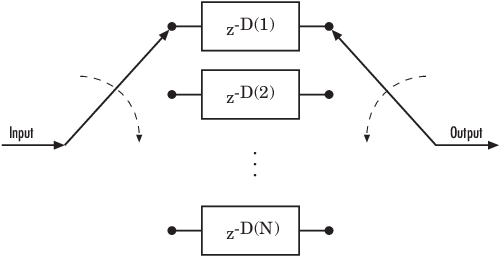
The structure of a general convolutional interleaver comprises a set of shift registers, each having a specified delay D(1), D(2),..., D(N), and a commutator to switch input and output symbols through registers. The kth shift register holds D(k) symbols, where k = 1, 2, 3, … N. The kth shift register has a delay value of ((k–1) × slope). With each new input symbol, the commutator switches to a new register and shifts in the new symbol while shifting out the oldest symbol in that register. When the commutator reaches the Nth register, upon the next new input, the commutator returns to the first register.
References
[1] Heegard, Chris and Stephen B. Wicker. Turbo Coding. Boston: Kluwer Academic Publishers, 1999.
Version History
Introduced before R2006a

