Time and Frequency Domain Analysis
R2026bTime-domain and frequency-domain analysis commands let you compute and visualize SISO and MIMO system responses such as Bode plots, Nichols plots, step responses, and impulse responses. You can also extract system characteristics such as rise time and settling time, overshoot, and stability margins. To get started with plotting responses, see Plotting System Responses. For more information on customizing response plots, see Plot Customization.
Functions
Apps
| Linear System Analyzer | Analyze time-domain and frequency-domain responses of linear time-invariant (LTI) systems |
Tools
| Linear Simulation Tool | Specify input signals and initial conditions for simulating linear models with arbitrary input signals and initial conditions |
Live Editor Tasks
| Create Plot | Interactively create linear analysis response plots in the Live Editor (Since R2022b) |
Blocks
 | LTI System | Use linear time invariant system model object in Simulink |
Topics
Analysis Plots Basics
- Plotting System Responses
This example shows an overview of generating time-domain and frequency-domain response plots.
Time-Domain Analysis
- Time-Domain Responses
Generate and visualize time-response data such as step response and impulse response.
- Time-Domain Characteristics on Response Plots
Visualize time-domain system characteristics such as settling time and overshoot on response plots. - Numeric Values of Time-Domain System Characteristics
Use thestepinfofunction to obtain numeric values of step response characteristics such as rise time, settling time, and overshoot.
Frequency-Domain Analysis
- Frequency-Domain Responses
Generate and visualize frequency-response data such as Bode plots and Nichols plots.
- Frequency-Domain Characteristics on Response Plots
Visualize frequency-domain system characteristics such as peak response on plots. - Numeric Values of Frequency-Domain Characteristics of SISO Model
Obtain numeric values of frequency-domain characteristics such as peak gain, dc gain, and system bandwidth.
Linear System Analyzer
- Joint Time-Domain and Frequency-Domain Analysis
Compare multiple types of responses side by side, including both time-domain and frequency-domain responses, using the Linear System Analyzer app. - Analyzing MIMO Models
In analysis plots of multiple-input, multiple output LTI models, there are plot tools for selecting subsystems and grouping I/O pairs.
Systems with Time Delays
- Analyze Dynamic Systems with Time Delays
The time and frequency responses of delay systems can have features that can look odd to those only familiar with delay-free LTI analysis. - Analyze Control Systems with Delays
Many processes involve dead times, also referred to as transport delays or time lags. Controlling such processes is challenging because delays cause phase shifts that limit the control bandwidth and affect closed-loop stability. - Validate Simulation Results for Models with Internal Delays
Validate the accuracy of simulations with internal delays by varying sample time. (Since R2026a)
Related Information
Featured Examples
Analyzing the Response of an RLC Circuit
Analyze the time and frequency responses of a second-order system.
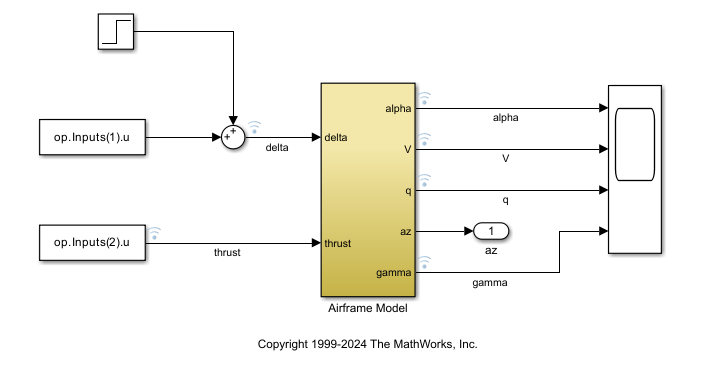
Use Linearization Offsets to Help Compare Nonlinear and Linearized Responses
Use offsets from linearization to facilitate the comparison of the nonlinear and linearized responses of a Simulink model.
Teaching Resources
Transfer Function Analysis of Dynamic Systems
Learn how to compute transfer functions, and use poles, zeros, and Bode plots to analyze transfer functions.

